Decision-Useful Implementation Science: What Makes Research Actually Useful?
This article is part of Decision-Useful Implementation Science, an ongoing series exploring what implementation research actually tells us about putting evidence into practice. Using large-scale text analysis, natural language processing, and bibliometric methods, the project examines nearly 1.5 million PubMed-indexed publications from 1980 to 2025.
Rather than reviewing individual studies, the series steps back to ask bigger questions. How has implementation science evolved? What kinds of evidence does it produce? And, most importantly, does it generate knowledge that helps leaders make better implementation decisions?
Every analysis is fully reproducible. The complete technical report, code, and data processing workflow are openly available.
Previous articles
- We Keep Studying Barriers. Why Doesn’t Implementation Get Easier?
- When Everything Is a Barrier, Nothing Is
- A List Isn’t a Decision
- The Missing Ingredient in Implementation Research: Prioritization
- Leadership Isn’t a Mechanism in Implementation Science
- The Comfortable Politics of Implementation Science
- Why Authority Matters More than Buy-In
Technical resources
Before we go on, if you haven’t signed up for our weekly newsletter, please do. We distill the hottest-off-the-presses science and why it matters for public health practice and policy.
Implementation science has become very good at identifying barriers and facilitators. But is it helping people make better decisions? A new framework—Decision-Useful Implementation Science—argues that research should do more than describe implementation problems. It should help leaders decide what to do next.
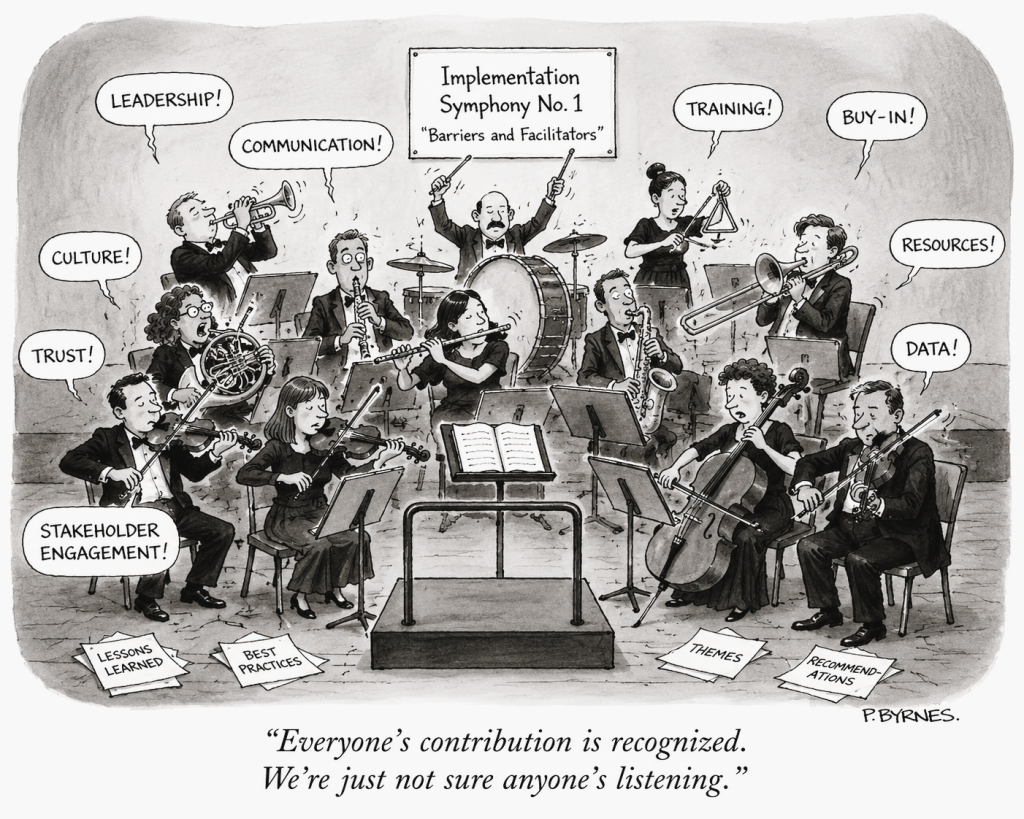
Implementation science has produced an enormous literature on barriers and facilitators. Every year, new studies remind us that leadership matters, resources are limited, communication is essential, staff needs training, organizational culture influences adoption, and stakeholder engagement improves implementation.
None of these findings are wrong. The problem is that they often leave decision-makers exactly where they started.
A state agency deciding where to invest implementation funding does not need another paper listing twenty barriers. A hospital executive already knows leadership matters. A school district understands that staff buy-in is important. What these organizations actually need is research that helps them choose between competing priorities when time, money, and political capital are limited.
That is the central idea behind Decision-Useful Implementation Science. Rather than asking whether implementation research identifies barriers, this framework asks a different question: Does the research actually help someone decide what to do?
The Four Ingredients of Decision-Useful Implementation Science
Decision-makers rarely need exhaustive descriptions of implementation problems. They need evidence that answers four practical questions.
First, what matters most? Research should help readers prioritize rather than simply catalog barriers and facilitators.
Second, why does it matter? Saying that leadership influences implementation is only the beginning. Useful research explains the mechanisms involved. Does leadership affect authority, coordination, protected time, accountability, psychological safety, resources, or workflow? Understanding the mechanism is what makes the finding actionable.
Third, who actually has the power to change it? Many implementation challenges cannot be solved by frontline staff, even though frontline workers often receive the recommendations. Decision-useful research identifies the institutional level where the real leverage exists, whether that is managers, executives, school districts, state agencies, regulators, funders, or payers.
Finally, what should happen next? Research should point toward the next decision without pretending certainty where uncertainty remains. Good implementation science should help readers understand the most reasonable next step given the available evidence.
Together, these four pillars—prioritization, mechanism, institutional leverage, and action—transform implementation research from descriptive evidence into decision support.
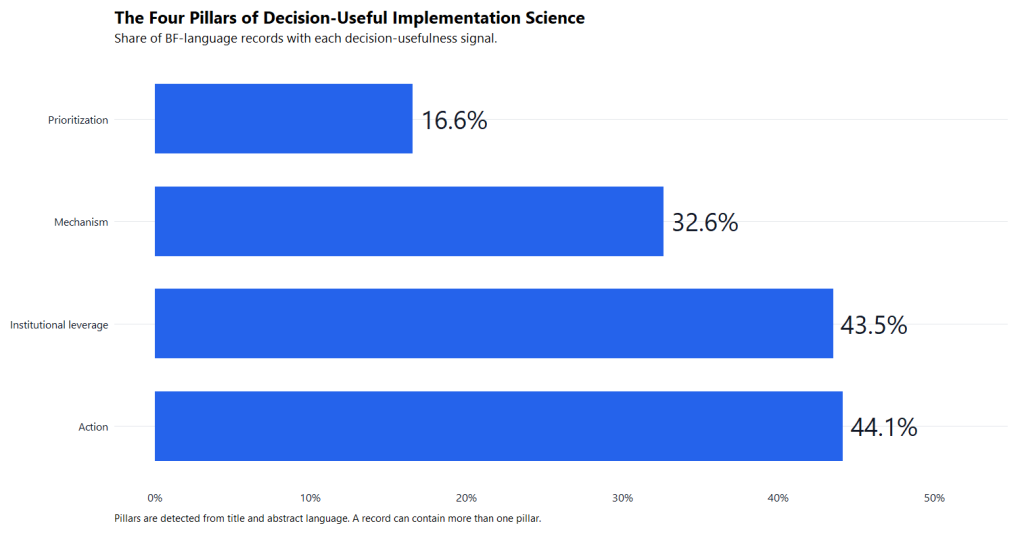
This figure introduces the four pillars and shows how frequently each appears across the implementation literature.
The Good News: The Pieces Already Exist
One encouraging finding is that implementation science already contains many of these ingredients.
Across 1,455,485 barriers and facilitators records, action language appeared in 44.1% of records, institutional leverage appeared in 43.5%, mechanisms appeared in 32.6%, and prioritization appeared in 16.6%.
That is both encouraging and revealing. Implementation researchers are already discussing actions that organizations might take. They are increasingly acknowledging institutional structures and occasionally explaining why implementation succeeds or fails.
What remains comparatively rare is helping readers understand which barrier deserves attention first.
That finding reinforces one of the central themes running throughout this series. Implementation science has become increasingly sophisticated at identifying problems, but it is still less effective at helping organizations determine where to begin.
Importantly, these percentages represent signals identified in titles and abstracts rather than complete assessments of full papers. Nevertheless, they suggest that the building blocks of decision-useful research already exist—they simply are not consistently assembled into a coherent framework.
Measuring Decision Usefulness
To explore this idea further, each record received a simple Decision-Usefulness Score ranging from zero to four. One point was awarded for each pillar present:
- prioritization,
- mechanism,
- institutional leverage,
- and action.
This score was never intended as a perfect measure of research quality. Instead, it serves as a transparent indicator of how many decision-useful elements appear within a paper’s title or abstract.
Across the entire literature, the average score was only 1.37 out of 4.
Looking more closely, 22.1% of records contained none of the four pillars. Another 35.6% contained only one. 28.0% included two pillars, 12.4% included three, and only 2.0% contained all four.
In other words, roughly one out of every fifty implementation records provided all four ingredients that decision-makers are likely to need.
That finding is perhaps the clearest summary of this entire project. Implementation science is not failing because it lacks knowledge. It is falling short because the knowledge is rarely organized in a way that directly supports decision-making.
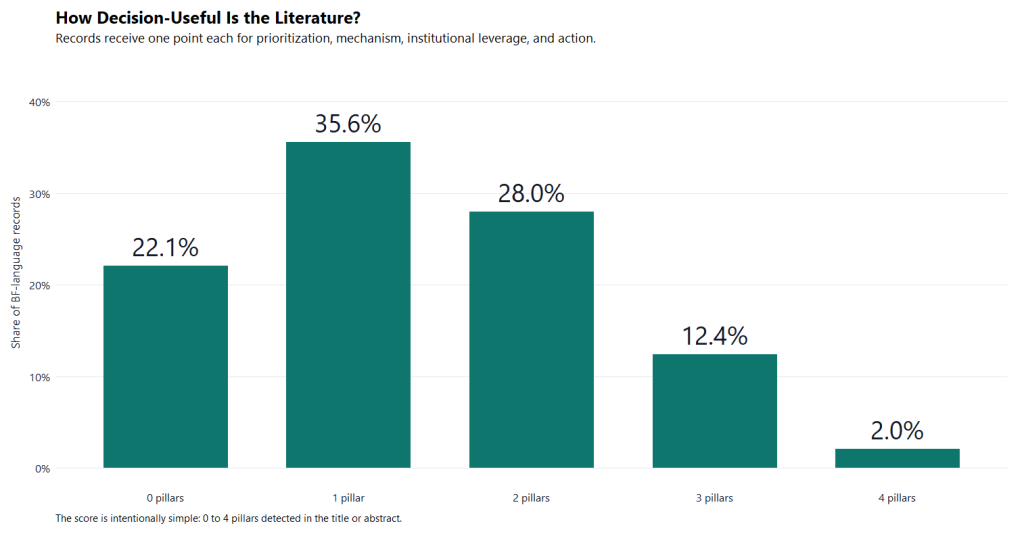
Figure 2 illustrates how uncommon fully decision-useful records remain across the literature.
Why Missing Even One Pillar Matters
Another way to understand these findings is to group papers according to their overall level of decision usefulness.
More than half (57.6%) of all records fell into a low decision-usefulness category because they contained either zero or one pillar. Another 28.0% demonstrated partial decision usefulness with two pillars. Only 12.4% reached a strong level by including three pillars, while just 2.0% achieved the complete four-pillar framework.
These numbers help explain why implementation findings often feel unsatisfying.
A study may successfully identify the most important barrier without explaining why that barrier matters. Another may describe mechanisms while never identifying who controls the relevant organizational lever. Still another may recommend action without clarifying which problem deserves immediate attention.
Each missing piece leaves decision-makers doing additional work that the research could have done for them.
Decision usefulness depends on connecting all four elements rather than treating them as separate contributions.
The Literature Is Getting Better
The encouraging news is that implementation science appears to be moving steadily toward more decision-useful research.
Between 1980–1999 and 2020–2025, the average Decision-Usefulness Score increased from 0.99 to 1.50. During the same period, the proportion of papers containing all four pillars rose from 0.7% to 2.6%, while papers containing three or more pillars increased from 6.6% to 17.4%. Meanwhile, the percentage of papers containing no pillars at all dropped from 34.9% to 18.0%.
The newest studies show even stronger progress.
In 2025, the average score reached 1.67, the proportion of studies with three or more pillars climbed to 22.1%, and the percentage including all four pillars reached 3.5%.
Those trends deserve recognition.
Implementation science is becoming more practical.
Yet even today, fully decision-useful papers remain uncommon. Organizations deciding whether to fund, scale, adapt, or sustain interventions generally need all four ingredients—not just one or two.
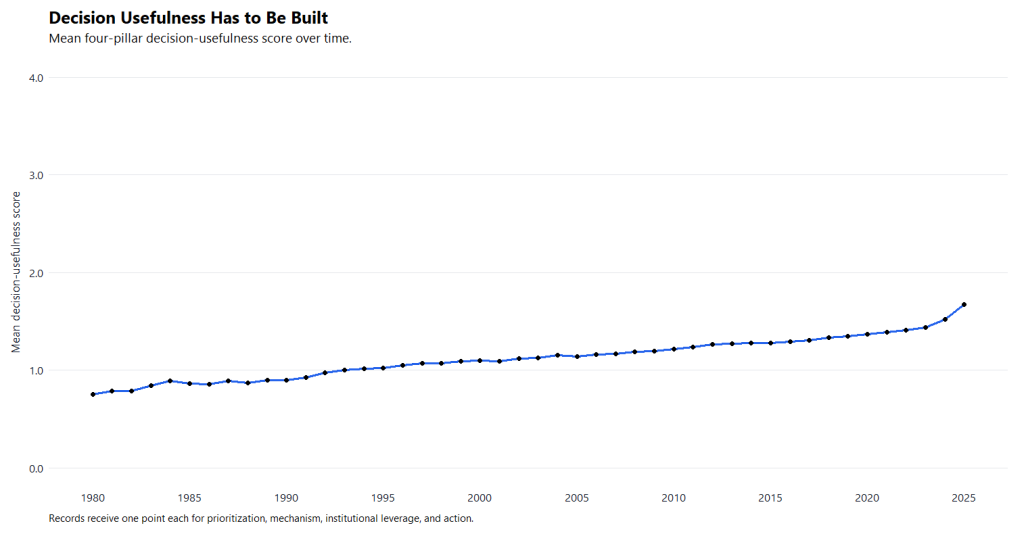
Figure 3 shows the steady increase in overall decision usefulness over time.
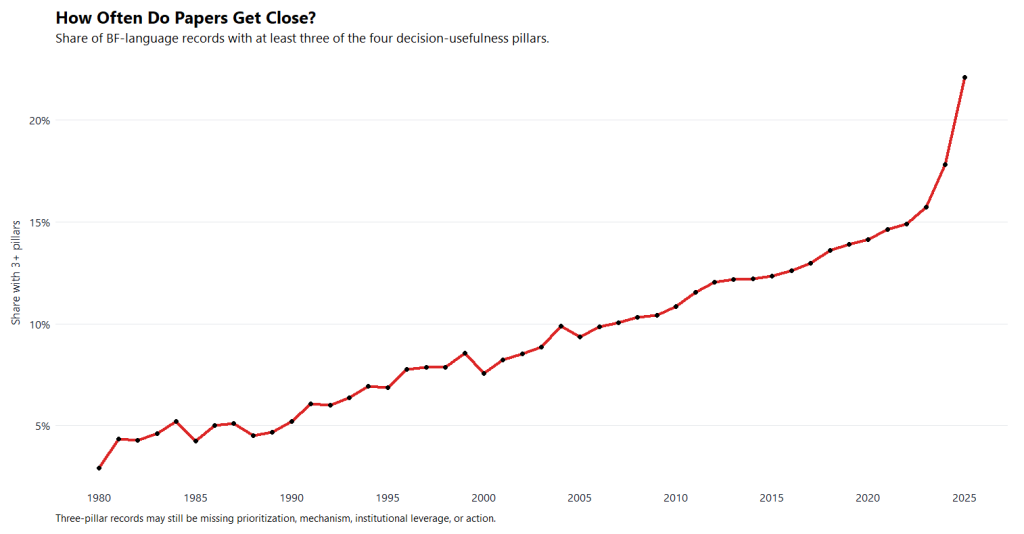
Figure 4 demonstrates that more studies are approaching the complete framework, even if relatively few achieve all four pillars.
Prioritization Remains the Biggest Gap
Looking individually at each pillar reveals an interesting pattern.
Between 1980–1999 and 2020–2025, prioritization increased from 12.2% to 18.0%. Mechanism increased from 24.3% to 36.3%. Institutional leverage rose from 37.2% to 45.5%, while action nearly doubled from 25.1% to 50.2%.
The dramatic rise in action-oriented language is especially encouraging.
However, action without prioritization can still leave readers wondering where to begin. Researchers may recommend implementation strategies without identifying the most important barrier, explain interventions without identifying who controls the necessary resources, or encourage change without establishing why one action deserves precedence over another.
This is precisely why Decision-Useful Implementation Science requires all four pillars rather than relying on any single one.
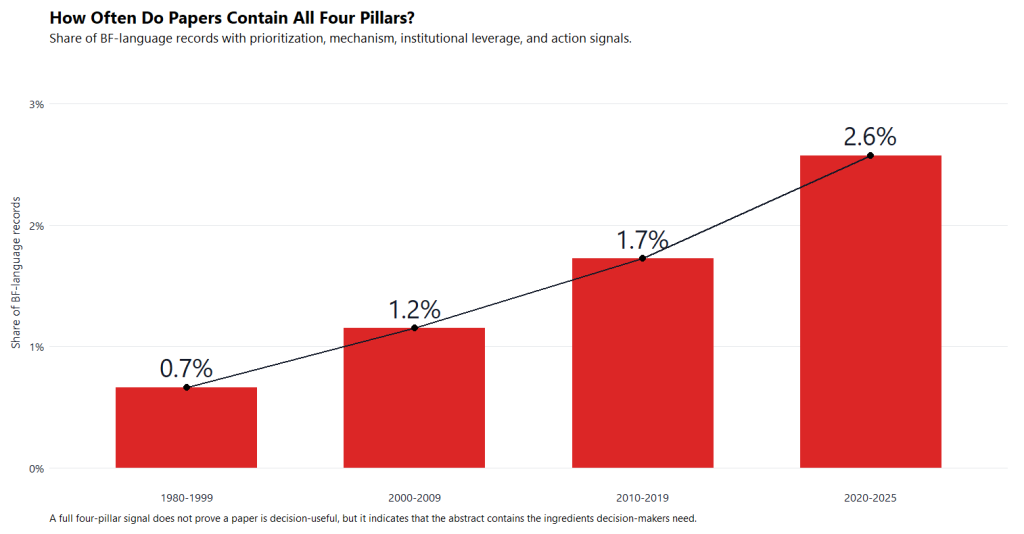
Figure 5 highlights the steady growth of studies containing all four pillars while emphasizing how rare they remain.
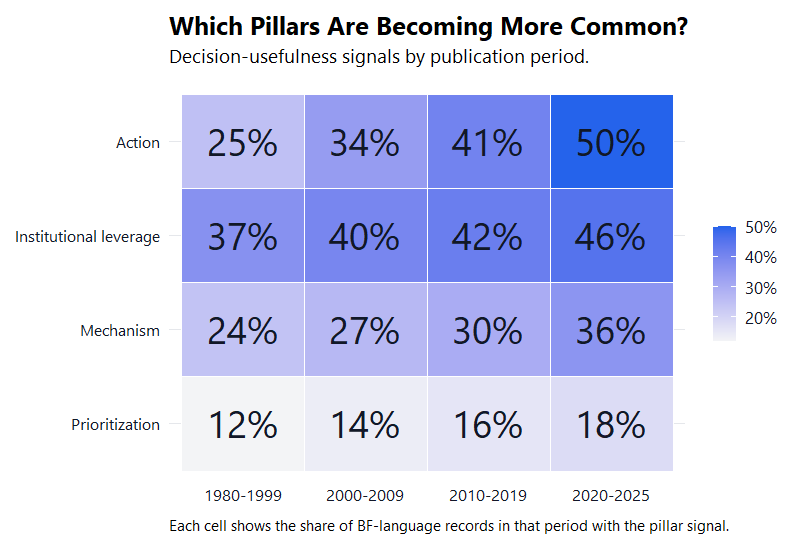
Figure 6 is a heatmap that illustrates improvements across all four pillars and shows that prioritization continues to lag behind the others.
What Decision-Useful Research Looks Like
Imagine an implementation paper that concludes the biggest obstacle is not staff buy-in but a lack of protected implementation time.
Instead of stopping there, the paper explains that insufficient protected time prevents clinicians from completing training, adapting workflows, and participating in feedback cycles. It identifies the relevant decision-maker by showing that frontline staff cannot solve the problem because protected time depends on clinic leadership and organizational budgeting. Finally, it recommends that organizations fund protected implementation time before expanding the intervention while monitoring fidelity during the first three months.
That paper does far more than describe implementation. It helps someone make a decision.
The Future of Implementation Science Should Be Decision Support
Season 1 of this series has argued that implementation science often excels at describing barriers while struggling to guide decisions.
Decision-Useful Implementation Science offers one possible solution. Instead of simply asking What barriers exist?, future studies should routinely ask:
- Which barriers matter most?
- Why do they matter?
- Who controls the relevant lever?
- What should happen first?
Implementation science has already developed much of the knowledge needed to answer these questions. The next challenge is designing studies that present that knowledge in ways that decision-makers can actually use.
Ultimately, research should do more than explain implementation. It should make implementation decisions easier