Leadership Isn’t a Mechanism in Implementation Science
This article is part of Decision-Useful Implementation Science, an ongoing series exploring what implementation research actually tells us about putting evidence into practice. Using large-scale text analysis, natural language processing, and bibliometric methods, the project examines nearly 1.5 million PubMed-indexed publications from 1980 to 2025.
Rather than reviewing individual studies, the series steps back to ask bigger questions. How has implementation science evolved? What kinds of evidence does it produce? And, most importantly, does it generate knowledge that helps leaders make better implementation decisions?
Every analysis is fully reproducible. The complete technical report, code, and data processing workflow are openly available.
Previous articles
- We Keep Studying Barriers. Why Doesn’t Implementation Get Easier?
- When Everything Is a Barrier, Nothing Is
- A List Isn’t a Decision
- The Missing Ingredient in Implementation Research: Prioritization
Technical resources
Before we go on, if you haven’t signed up for our weekly newsletter, please do. We distill the hottest-off-the-presses science and why it matters for public health practice and policy.
Leadership Isn’t a Mechanism: Why Naming Barriers Isn’t Enough in Implementation Research
Implementation science has become remarkably good at identifying the factors that influence whether evidence-based practices succeed. We routinely read about leadership, communication, organizational culture, relationships, resources, and training as key barriers or facilitators. But there is an important distinction that often gets lost in this literature: identifying a factor is not the same as explaining how it changes implementation outcomes.
In the previous post, I argued that implementation research has a prioritization problem. Papers increasingly discuss decisions, strategies, feasibility, and action, but they still rarely tell readers which barriers deserve attention first. This post examines a related challenge. Even when implementation studies identify the “right” barriers and facilitators, they often stop short of explaining why those factors matter.
Leadership matters. Communication matters. Relationships matter.
That is almost certainly true.
But none of those are mechanisms. They are ingredients.
A mechanism explains how or why those ingredients produce successful implementation.
Description Is Not the Same as Explanation
One of the strengths of implementation science is its ability to describe complex systems. Researchers conduct interviews, identify themes, organize barriers, and categorize facilitators. Those descriptive efforts are valuable because practitioners must first recognize what exists before they can improve it.
However, description alone cannot explain change.
Consider a study that concludes successful implementation was associated with strong leadership, effective communication, and trusted relationships. While useful, those findings leave an obvious question unanswered:
What did leadership actually do?
- Did leaders protect staff time?
- Did they reduce uncertainty?
- Did they align incentives?
- Did they authorize workflow changes?
- Did they resolve conflict?
- Did they legitimize participation?
- Did they connect the intervention to organizational priorities?
Those are mechanism questions. Without answering them, “leadership” becomes a label attached to success rather than an explanation of why success occurred.
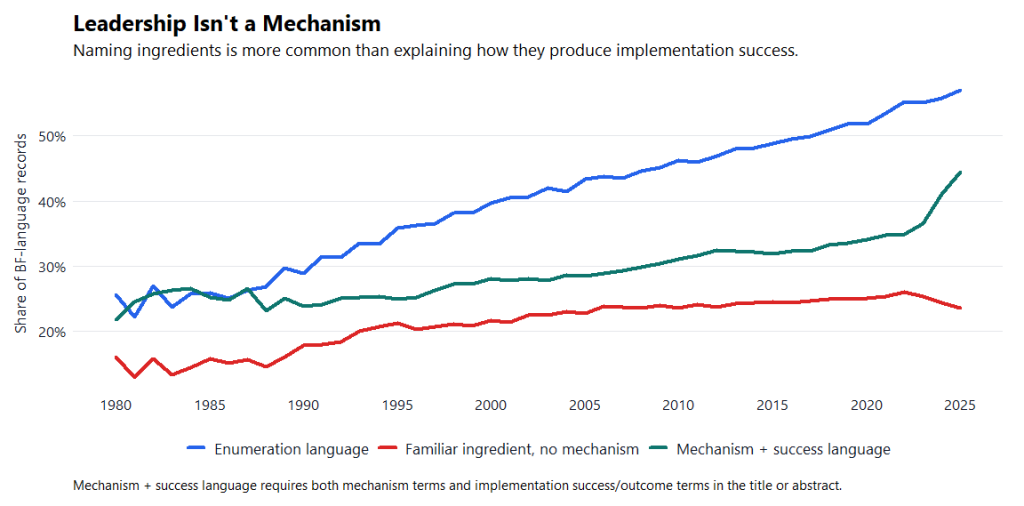
This figure compares enumeration language, mechanism-plus-success language, and familiar implementation ingredients over time. It illustrates the central argument of this post: implementation research has become increasingly effective at naming and organizing factors, but naming factors is not the same as explaining how implementation succeeds.
The Literature Frequently Names Ingredients
Across 1,455,485 barriers and facilitators records, 50.6% used enumeration language: terms such as themes, codes, categories, factors, domains, interviews, perspectives, or experiences. Roughly half of the literature is therefore engaged in identifying, grouping, and describing implementation factors.
That is an important first step. But description has limits.
Nearly 40% (39.7%) of all records mentioned at least one of three familiar implementation ingredients:
- Communication: 287,638 records (19.8%)
- Leadership: 229,907 records (15.8%)
- Relationships: 211,978 records (14.6%)
These concepts are clearly central to the way implementation science talks about change. The more difficult question is whether studies explain how these ingredients influence outcomes.
- Among papers that mention communication, 42.7% also include mechanism-plus-success language.
- Among papers mentioning leadership, 42.9% did.
- Among papers mentioning relationships, only 36.3% did.
In other words, even when familiar implementation ingredients are discussed, many studies stop short of describing the processes by which those ingredients actually influence implementation outcomes.
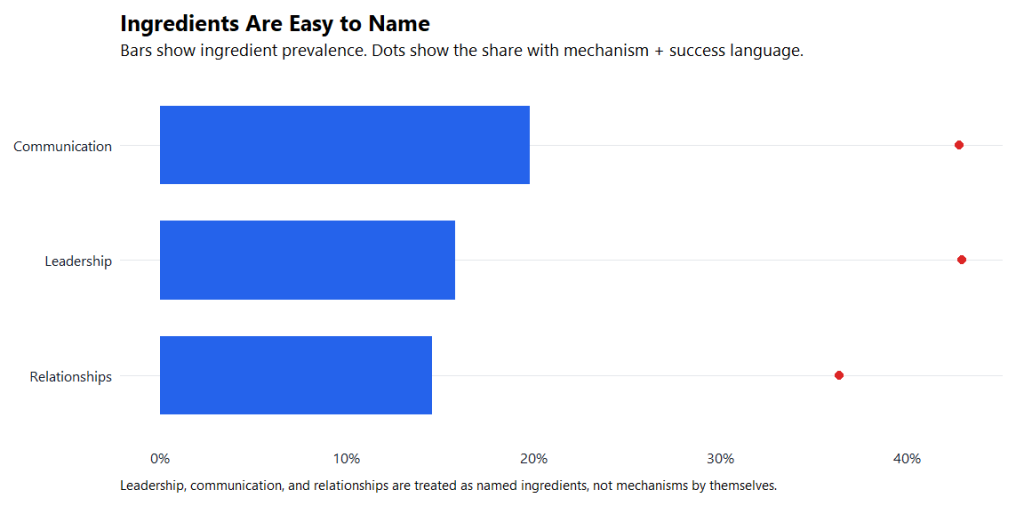
The bars show how frequently communication, leadership, and relationships appear in the literature, while the dots indicate the percentage of papers that also include mechanism-plus-success language. The figure highlights the gap between naming common ingredients and explaining how they produce implementation success.
Leadership Sounds Causal—But It Isn’t
Leadership is perhaps the clearest example of this problem because it naturally sounds like an explanation.
When implementation succeeds, leadership is frequently credited.
When implementation fails, leadership is often blamed.
Yet leadership can represent many very different behaviors. It might involve formal authority, visible endorsement, resource allocation, supervision, emotional support, accountability, political cover, conflict resolution, or day-to-day problem solving.
Those are not interchangeable activities. Simply stating that “leadership facilitated implementation” leaves practitioners without guidance because it does not identify which leadership behaviors actually mattered.
The same problem appears with communication. Communication could refer to information sharing, feedback loops, coordination, sensemaking, psychological safety, messaging, shared goals, or conflict repair.
Relationships are similarly broad. They may reflect trust, credibility, reciprocity, professional identity, social support, partnership, or informal influence. Each of these operates through different causal pathways.
That is why phrases like “leadership, communication, and relationships” can sound explanatory while still leaving the causal story incomplete.
The Mechanism Gap Has Narrowed—but It Has Not Disappeared
There is encouraging evidence that implementation research is becoming more mechanism-oriented. Between 1980 and 1999, only 25.6% of barriers and facilitators records included mechanism-plus-success language. That increased to:
- 29.0% during 2000–2009
- 32.5% during 2010–2019
- 38.8% during 2020–2025
This represents meaningful progress. At the same time, papers that mention familiar implementation ingredients without accompanying mechanism language remain remarkably common.
Records naming leadership, communication, or relationships without mechanism-plus-success language accounted for:
- 19.0% (1980–1999)
- 23.1% (2000–2009)
- 24.5% (2010–2019)
- 24.7% (2020–2025)
The field is clearly improving at discussing mechanisms, but a substantial portion of the literature continues to identify familiar implementation ingredients without explaining how those ingredients actually lead to successful implementation.
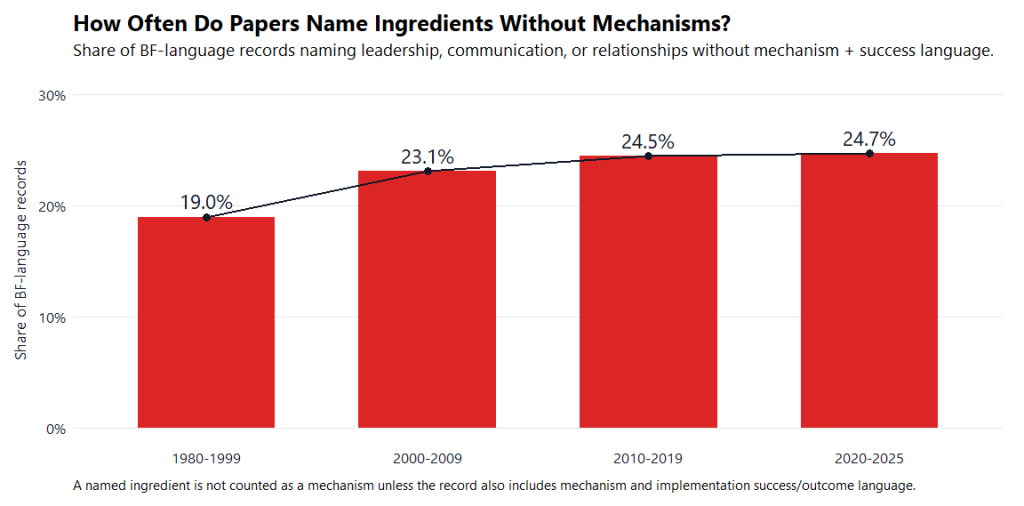
This figure isolates papers that mention leadership, communication, or relationships but do not include mechanism-plus-success language. It demonstrates that the “ingredient without explanation” problem has remained remarkably persistent over time.
Four Types of Implementation Papers
One useful way to think about the literature is to separate studies according to whether they primarily describe implementation factors or explain mechanisms.
Across the dataset:
- 32.3% relied on enumeration only
- 18.3% combined enumeration with mechanisms
- 16.6% focused on mechanisms without enumeration
- 32.7% used neither
Perhaps the most striking finding is that the largest categories are enumeration only and neither.
Enumeration-only studies often create the appearance of explanation because they identify themes, organize barriers, and summarize experiences. But many stop before describing how one factor produces another.
That distinction matters because implementation ultimately depends on understanding processes, not simply compiling lists.
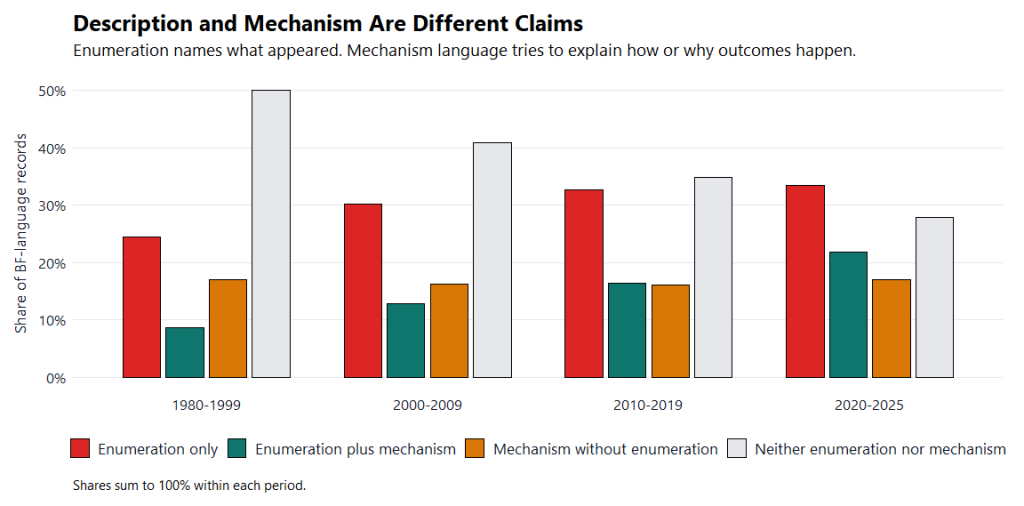
This figure compares enumeration-only papers, mechanism-plus-enumeration papers, mechanism-only papers, and papers containing neither across different time periods, illustrating that descriptive studies continue to dominate much of the literature.
What Mechanism-Oriented Research Looks Like
Mechanism-based explanations are more specific.
Rather than simply stating: Leadership facilitated implementation.
A mechanism-oriented paper might say: Leadership protected staff time, increasing participation in training and improving implementation fidelity during early rollout.
Or: Trusted relationships encouraged staff to openly discuss workflow problems, allowing teams to adapt the intervention before disengagement occurred.
Or: Clear communication reduced uncertainty about role expectations, increasing adoption across implementation sites.
These explanations may still require empirical testing, but they provide something practitioners can act upon. They encourage researchers and practitioners to ask:
- What changed?
- For whom?
- Under what conditions?
- Through what process?
- With what implementation outcome?
Those questions move implementation science from description toward explanation.
Why Mechanisms Matter for Practice
Implementation takes place inside real organizations with limited time, limited resources, and competing priorities. When a study concludes that “leadership matters,” implementation teams rarely learn anything they did not already suspect. When a study explains how leadership matters, however, the findings become actionable.
- Organizations can protect staff time.
- They can clarify authority.
- They can establish feedback loops.
- They can build trust.
- They can redesign workflows.
- They can reduce uncertainty.
Mechanisms transform abstract observations into practical guidance by identifying the processes that link implementation strategies to implementation outcomes.
A list of barriers tells practitioners what was present. A mechanism tells them how change happened. That is a much stronger scientific contribution.
The Next Frontier for Barriers and Facilitators Research
This series has followed the evolution of the implementation literature one step at a time. This analysis adds another piece to the puzzle. Even when implementation studies identify familiar ingredients such as leadership, communication, and relationships, they often stop short of explaining how those ingredients actually lead to successful implementation.
The next frontier is not simply identifying more barriers, longer lists, or familiar concepts.
Implementation science needs richer causal explanations.
The question is no longer simply: What causes implementation to succeed?
The answer cannot simply be: Leadership.
A more useful answer is: What does leadership change, through what process, under what conditions, and with what effect?
That is a mechanism. And until implementation research consistently answers those questions, we will still be much better at describing the room than explaining what makes it move.