The Comfortable Politics of Implementation Science
This article is part of Decision-Useful Implementation Science, an ongoing series exploring what implementation research actually tells us about putting evidence into practice. Using large-scale text analysis, natural language processing, and bibliometric methods, the project examines nearly 1.5 million PubMed-indexed publications from 1980 to 2025.
Rather than reviewing individual studies, the series steps back to ask bigger questions. How has implementation science evolved? What kinds of evidence does it produce? And, most importantly, does it generate knowledge that helps leaders make better implementation decisions?
Every analysis is fully reproducible. The complete technical report, code, and data processing workflow are openly available.
Previous articles
- We Keep Studying Barriers. Why Doesn’t Implementation Get Easier?
- When Everything Is a Barrier, Nothing Is
- A List Isn’t a Decision
- The Missing Ingredient in Implementation Research: Prioritization
- Leadership Isn’t a Mechanism in Implementation Science
Technical resources
Before we go on, if you haven’t signed up for our weekly newsletter, please do. We distill the hottest-off-the-presses science and why it matters for public health practice and policy.
Why Implementation Science Talks More About People Than Institutions
Over the last several posts, I’ve been returning to the same question from different angles. First, we saw that implementation science loves lists of barriers and facilitators but rarely tells us which ones deserve our attention first. Then we found that leadership appears almost everywhere in the literature, yet surprisingly few papers explain how leadership actually changes implementation outcomes. As I continued digging through the data, another pattern began to emerge. The field spends an enormous amount of time talking about people, and considerably less time talking about the institutions that shape what people are actually able to do.
That observation isn’t meant as a criticism of concepts like trust, engagement, buy-in, relationships, or communication. Those are all fundamental to implementation. No intervention succeeds unless people understand it, believe it is worthwhile, and invest their time and energy in making it work.
But implementation also unfolds inside organizations governed by budgets, procurement rules, reimbursement systems, contracts, regulations, reporting requirements, and organizational policies. Those structures often determine whether an intervention can be purchased, sustained, expanded, or even legally delivered. The question, then, is not whether people matter. It is whether implementation science sometimes treats people as the primary site of implementation problems while leaving institutions in the background.
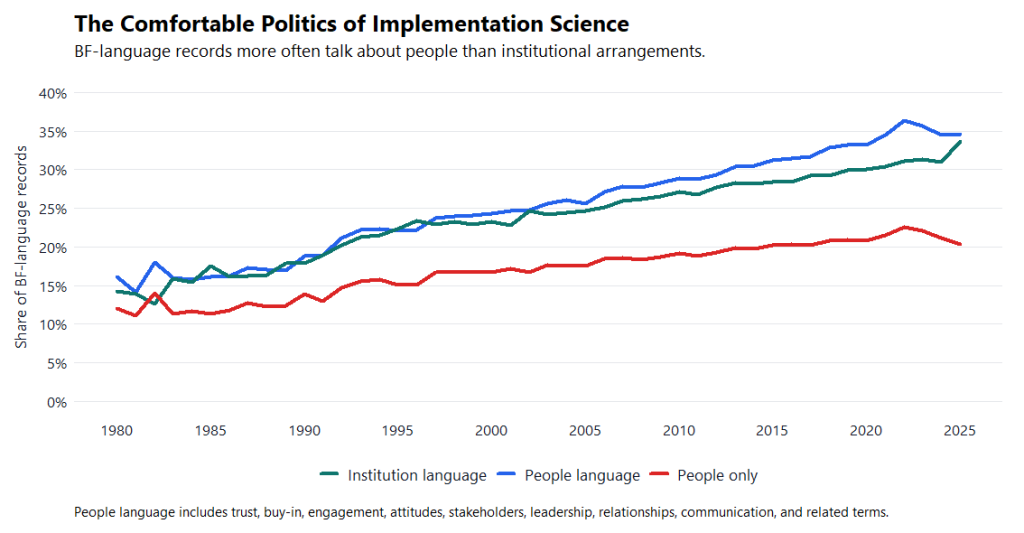
Figure 1 compares people-focused language and institution-focused language across time. Both have increased, but people-centered language consistently remains more common, while people-only framing has also become more frequent.
The Literature Discusses Institutions—Just Not Often Alongside People
One of the surprises from analyzing 1,455,485 barriers and facilitators records was that the field is not actually silent about institutions. People-centered language appeared in 32.0% of records, capturing discussions of trust, engagement, buy-in, leadership, communication, relationships, stakeholder attitudes, and collaboration. Institutional language appeared in 29.3% of records, covering topics such as procurement, contracting, reimbursement, finance, regulation, governance, infrastructure, and policy. On the surface, those numbers seem fairly balanced.
The more interesting finding emerges when we ask whether these conversations happen together. Across the full dataset, 20.2% of records discussed people without institutions, 17.5% discussed institutions without people, and only 11.8% discussed both simultaneously. The remaining 50.5% mentioned neither category. In other words, only about one in nine barriers and facilitators records explicitly connected human behavior with institutional structures.
That matters because implementation almost never separates the two in practice. A paper can recommend increasing engagement without asking what people are actually being asked to engage with. It can emphasize trust without considering whether the organization has earned that trust through consistent behavior. It can call for stronger buy-in while never examining who controls the budget or whether reimbursement actually supports the work. The result is that implementation challenges often become framed as problems of people, while the institutional conditions shaping those behaviors remain largely implicit.
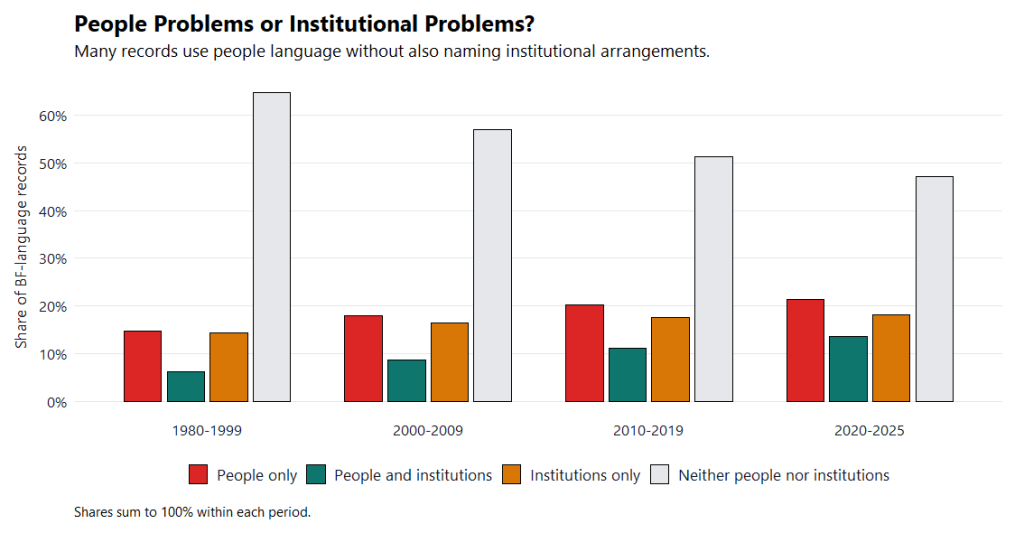
Figure 2 separates the literature into people-only, institution-only, both, and neither. It illustrates that the field regularly discusses both domains but much less frequently examines how they interact.
The Gap Has Persisted as the Field Has Grown
This separation has not disappeared as implementation science has matured. In fact, people-centered language has steadily increased over the past four decades. Between 1980 and 1999, 21.0% of records included people-focused language. That rose to 26.6% during 2000–2009, 31.2% during 2010–2019, and 34.8% during 2020–2025. Institutional language followed a remarkably similar trajectory, growing from 20.5% to 25.1%, 28.6%, and finally 31.6% across those same periods.
At first glance, this looks like a success story. The literature has become increasingly attentive to both people and institutions. Yet another trend complicates that optimistic interpretation. People-only language also increased, rising from 14.8% in the earliest period to 21.3% in the most recent one. Meanwhile, papers explicitly connecting people and institutions reached only 13.6% between 2020 and 2025. The field has become better at naming institutional issues, but it still too often discusses relational challenges and structural constraints as though they occupy separate worlds. Anyone who has worked in implementation knows they rarely do.
Where Implementation Science Pays Attention—and Where It Doesn’t
The category-level results reinforce this pattern. Among institutional topics, regulation and policy appeared most frequently, occurring in 15.7% of records. Budgets and funding appeared in 8.9%, while payment and reimbursement appeared in just 3.2% and procurement and contracting in only 1.7%. On the relational side, relationships appeared in 13.0% of records, engagement in 11.8%, buy-in in 7.6%, and trust in 1.4%.
What makes these numbers so revealing is that many of the hardest implementation problems live precisely in the least-discussed institutional categories. Procurement rarely appears in conceptual frameworks, reimbursement is seldom highlighted in implementation theories, and contracts almost never occupy center stage in logic models. Yet these are often the factors that determine whether an intervention survives beyond a pilot project. An organization cannot sustain a program it cannot purchase, bill for, staff, or legally deliver. Budgets, contracts, reimbursement systems, and regulations are not administrative afterthoughts. They are the conditions that make implementation possible.
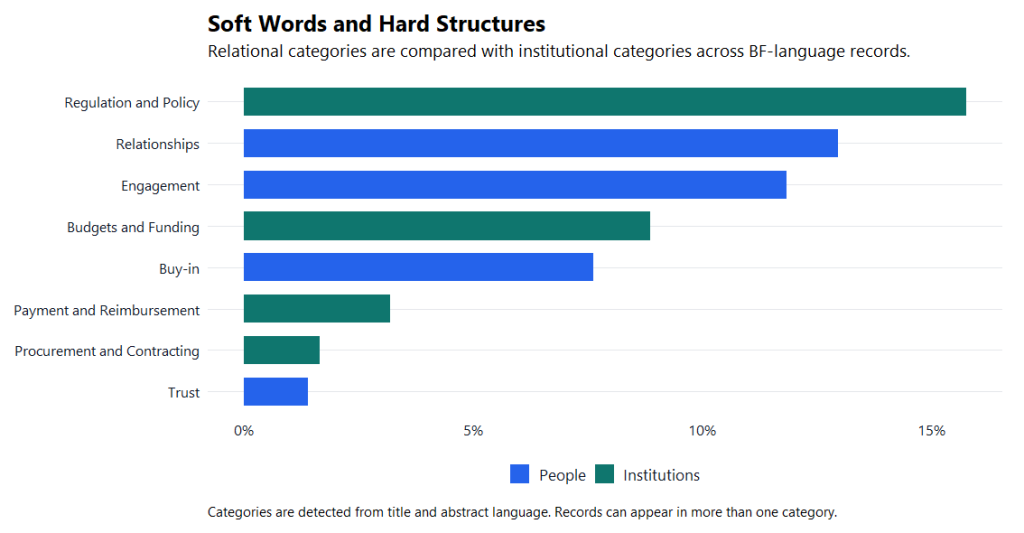
Figure 3 compares relational concepts such as engagement, relationships, buy-in, and trust with institutional concepts including regulation, budgets, reimbursement, and procurement. It highlights where scholarly attention clusters and where important structural issues remain comparatively underrepresented.
The Comfort of Framing Problems as Human Rather Than Institutional
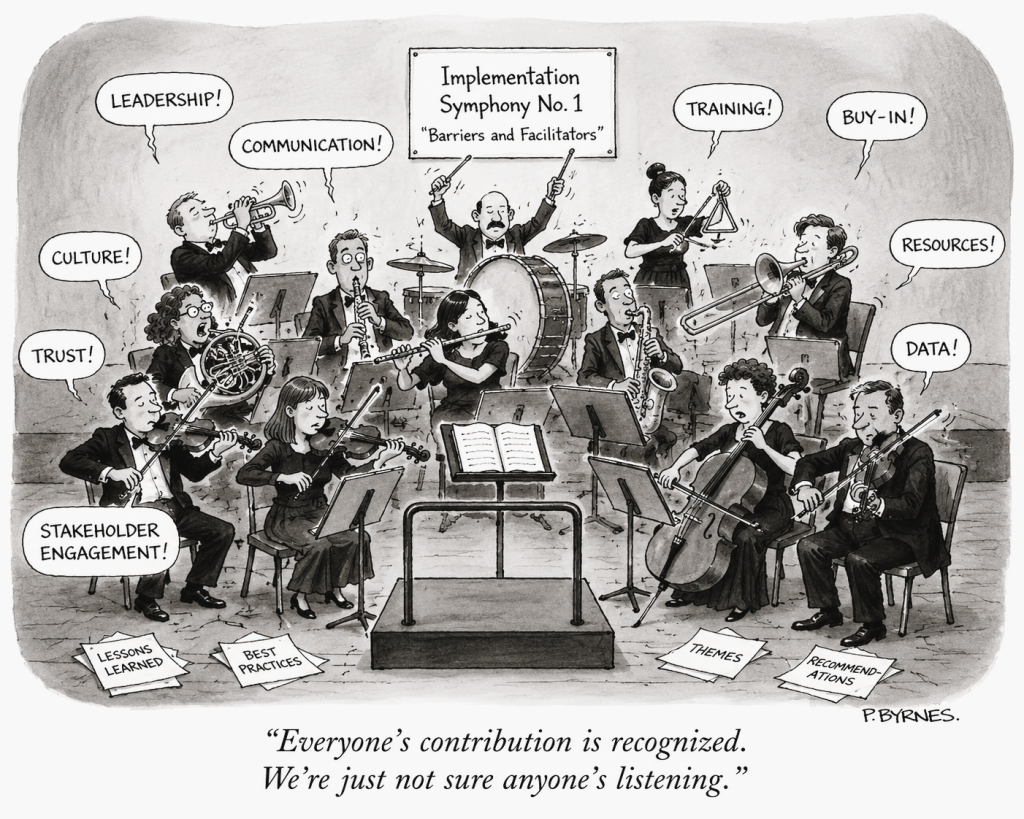
Part of the reason this pattern persists may be that people-centered explanations are simply easier to discuss. Recommending more engagement, stronger communication, greater collaboration, or increased trust rarely challenges existing organizational arrangements. These are valuable recommendations, but they are also politically safe ones.
Institutional explanations are different. If implementation fails because staff lacked buy-in, responsibility appears to rest primarily with the workforce. If it fails because procurement rules prevented the intervention from ever being purchased, the conversation shifts toward organizational systems. If reimbursement does not cover the work, or if leaders endorse an intervention while refusing to allocate funding, implementation becomes a question of governance and power rather than motivation. Those conversations are inherently less comfortable because they ask organizations to examine how their own structures shape implementation outcomes.
Better Questions Connect People to Institutions
None of this means implementation science should spend less time studying trust, leadership, engagement, or buy-in. Those concepts remain essential. The problem arises when we discuss them as though they exist independently of the institutional environments in which they develop.
Instead of asking whether staff trust a new intervention, we might ask what organizational history has made that trust reasonable or unreasonable. Instead of asking whether stakeholders have bought in, we might ask whether reimbursement systems, staffing models, and budgets actually allow them to support the change being requested. Rather than celebrating communication as a solution, we might ask whether anyone in the organization possesses the authority to modify procurement policies or payment structures in response to what communication reveals.
These are better implementation questions because they connect individual behavior to institutional context. They acknowledge that attitudes emerge within systems rather than apart from them.
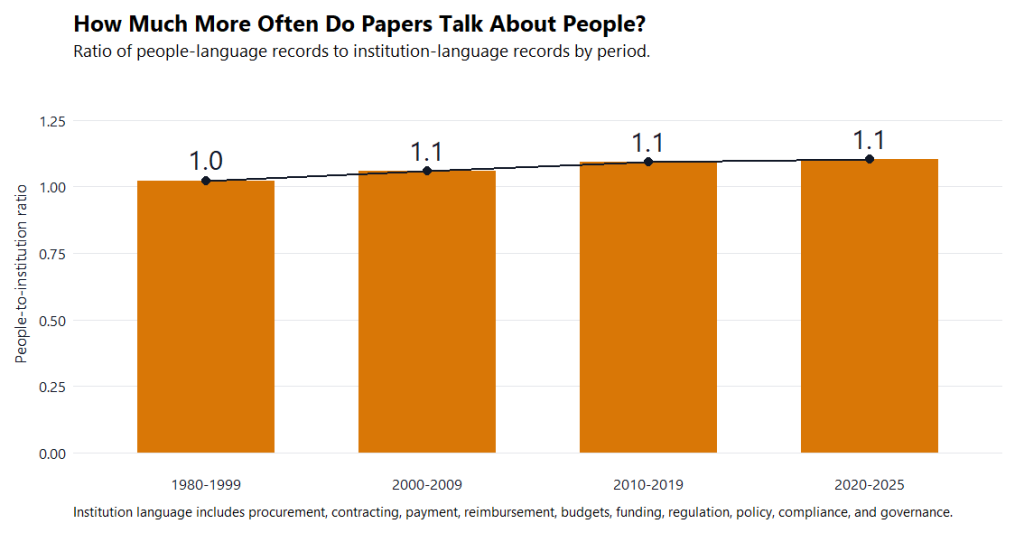
Figure 4 summarizes the balance between people-focused and institution-focused language over time, illustrating that although both have increased, people-centered framing consistently remains slightly more common.
Why This Matters
This post builds directly on the arguments developed throughout this series. We’ve already seen that lists are not decisions, that prioritization remains surprisingly uncommon, and that leadership is often treated as a conclusion rather than an explanation. The next step is recognizing that people problems and institutional problems are rarely separate.
Implementation science is at its strongest when it explains how these levels interact. Staff may distrust a new initiative because previous programs were repeatedly introduced and abandoned. Clinicians may resist adoption because reimbursement makes the new workflow financially unsustainable. Leaders may publicly champion implementation while quietly maintaining budgets that guarantee failure. Communication may appear ineffective when, in reality, no one has the authority to change the procurement timeline or renegotiate existing contracts.
Those are more complicated stories than simply calling for greater engagement or stronger buy-in. They are also closer to how implementation actually unfolds in organizations. Implementation does not fail only because people lack trust or motivation. It also fails because contracts cannot be changed, reimbursement does not support the work, budgets are never adjusted, regulations constrain action, and governance structures make success impossible.
That, ultimately, is the comfortable politics of implementation science. We readily ask whether people trust the system. The more difficult and perhaps more important question is whether the system has given people good reasons to trust it.