The Missing Ingredient: Do Implementation Papers Actually Prioritize Barriers?
This article is part of Decision-Useful Implementation Science, an ongoing series exploring what implementation research actually tells us about putting evidence into practice. Using large-scale text analysis, natural language processing, and bibliometric methods, the project examines nearly 1.5 million PubMed-indexed publications from 1980 to 2025.
Rather than reviewing individual studies, the series steps back to ask bigger questions. How has implementation science evolved? What kinds of evidence does it produce? And, most importantly, does it generate knowledge that helps leaders make better implementation decisions?
Every analysis is fully reproducible. The complete technical report, code, and data processing workflow are openly available.
Previous articles
- We Keep Studying Barriers. Why Doesn’t Implementation Get Easier?
- When Everything Is a Barrier, Nothing Is
- A List Isn’t a Decision
Technical resources
Before we go on, if you haven’t signed up for our weekly newsletter, please do. We distill the hottest-off-the-presses science and why it matters for public health practice and policy.
The Missing Ingredient in Implementation Research: Prioritization
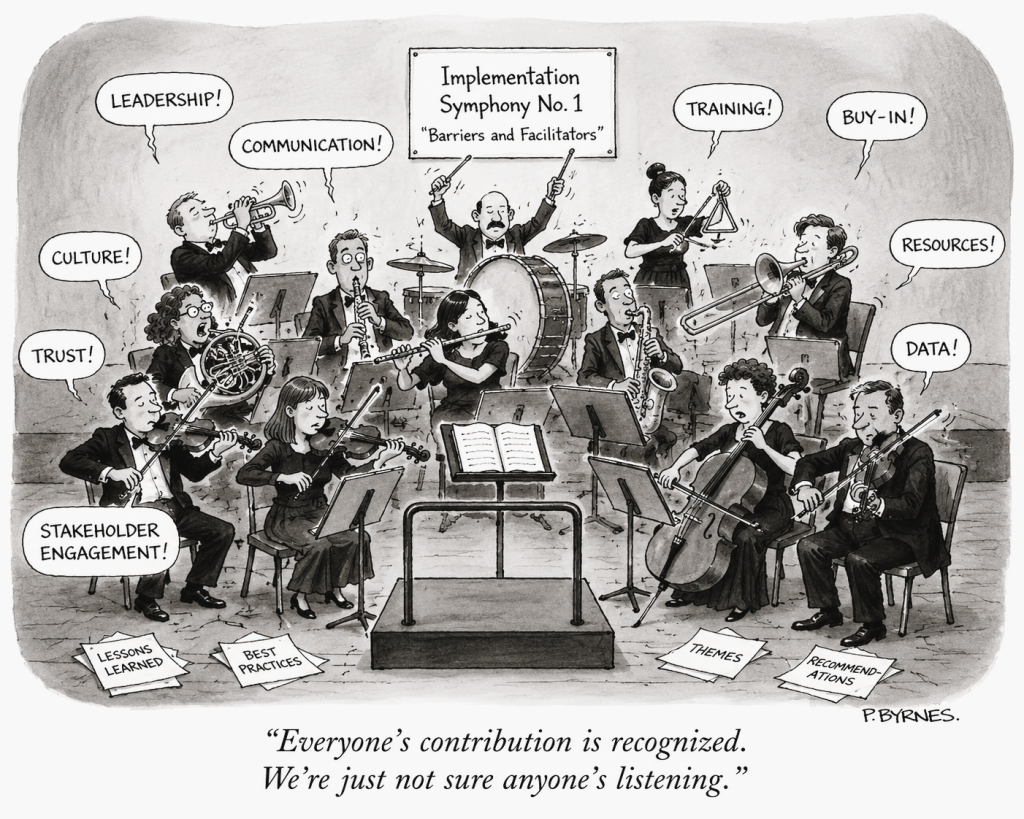
In the previous post, I argued that a list is not a decision. Implementation studies routinely identify barriers and facilitators—such as leadership, resources, communication, training, workflow, culture, and evidence—but simply naming these factors does not tell practitioners what to do next. When every barrier appears equally important, the central question remains unanswered: Which one should we address first?
That distinction matters because implementation is fundamentally a process of making choices under constraint. Organizations rarely have unlimited time, staff, funding, or political capital. Success depends not only on recognizing obstacles, but on determining which obstacles deserve attention first. This analysis asks a straightforward question: Does the implementation science literature actually prioritize barriers, or does it primarily identify them?
What Counts as Prioritization in Implementation Science?
To answer that question, I distinguished between two kinds of language found in the barriers-and-facilitators literature.
The first category was explicit prioritization language. This included terms such as priority, rank, weighting, relative importance, most important, least important, Delphi, nominal group, analytic hierarchy process, conjoint analysis, and discrete choice. These terms indicate that researchers are actively comparing barriers, weighing alternatives, or ranking implementation options.
The second category was ambient decision language. This broader category included words such as decision, choice, actionable, strategy, recommendation, leverage, impact, feasibility, cost, and trade-offs. These terms suggest that a paper is oriented toward implementation or practical application, but they do not necessarily indicate that the authors actually prioritized barriers.
The distinction is important because a study can discuss strategies, feasibility, recommendations, or implementation implications without ever explaining which barrier matters most. It can sound practical while still leaving practitioners uncertain about where to begin.
Explicit Prioritization Remains the Exception, Not the Rule
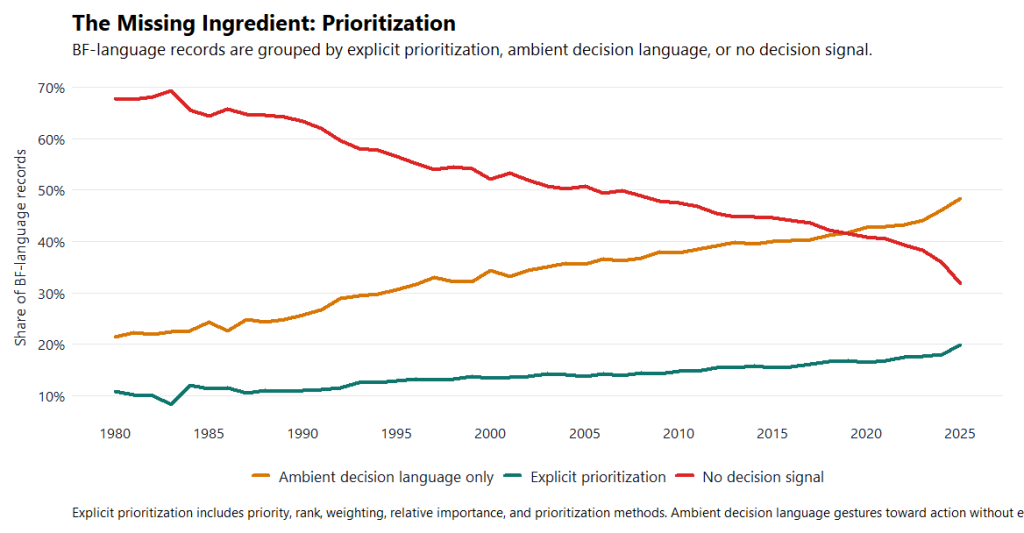
Across 1,455,485 barriers and facilitators records, only 16.6% contained explicit prioritization language. In other words, roughly one in six records suggested that barriers, facilitators, strategies, or implementation options were ranked, weighted, scored, or compared for relative importance.
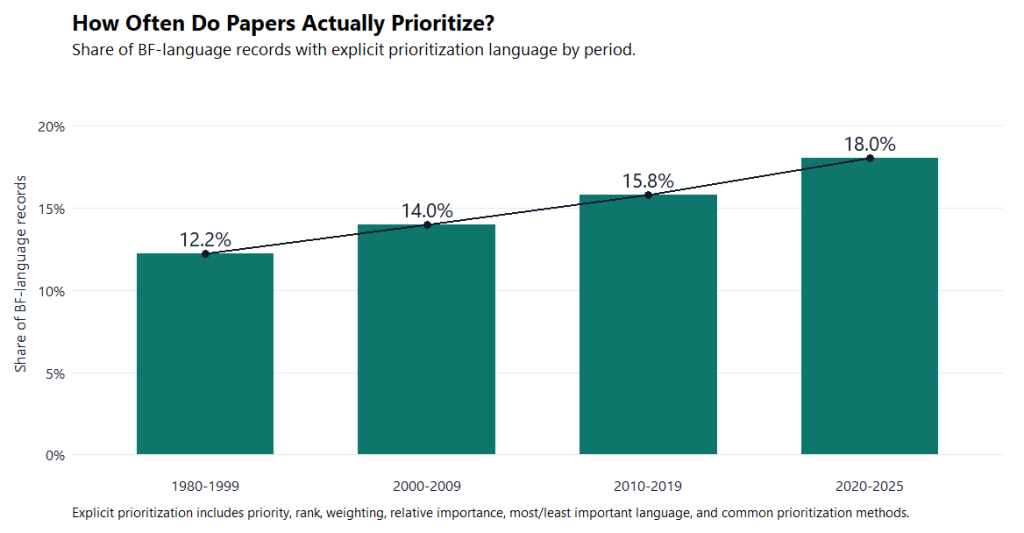
There has been gradual improvement over time. Between 1980 and 1999, only 12.2% of records included explicit prioritization language. That increased modestly to 14.0% during 2000–2009, rose again to 15.8% during 2010–2019, and reached 18.0% between 2020 and 2025.
This upward trend is encouraging, as it suggests that implementation science is gradually becoming more decision-oriented. However, the broader conclusion is difficult to ignore. Even in the most recent five-year period, fewer than one in five studies explicitly prioritized barriers. For a field dedicated to helping organizations implement evidence successfully, that remains a surprisingly small proportion.
Implementation is not simply about identifying barriers. It is about deciding what to do despite them. And decisions require prioritization.
Implementation Research Talks About Decisions More Than It Makes Them
Although explicit prioritization was relatively uncommon, decision-oriented language appeared much more frequently.
Overall, 50.9% of all records contained some form of ambient decision language. Yet much of that language stopped short of actual prioritization. Across the full dataset, 16.6% of records included explicit prioritization language, 41.6% contained only ambient decision language, and 41.8% showed no meaningful decision signal.
This distinction represents one of the clearest findings from the analysis.
Much of the literature sounds action-oriented. Papers frequently discuss strategies, recommendations, implementation implications, feasibility, impact, and decision-making. Yet these discussions often stop before answering the practical question practitioners actually face: Which barrier should we tackle first?
A paper can conclude that “future work should address these barriers” or that “implementation strategies are needed” without providing any framework for choosing among competing priorities. In that sense, ambient decision language creates the appearance of guidance without necessarily offering real decision support.
The Growing Gap Between Decision Language and Decision Support
Historical trends reinforce this pattern.
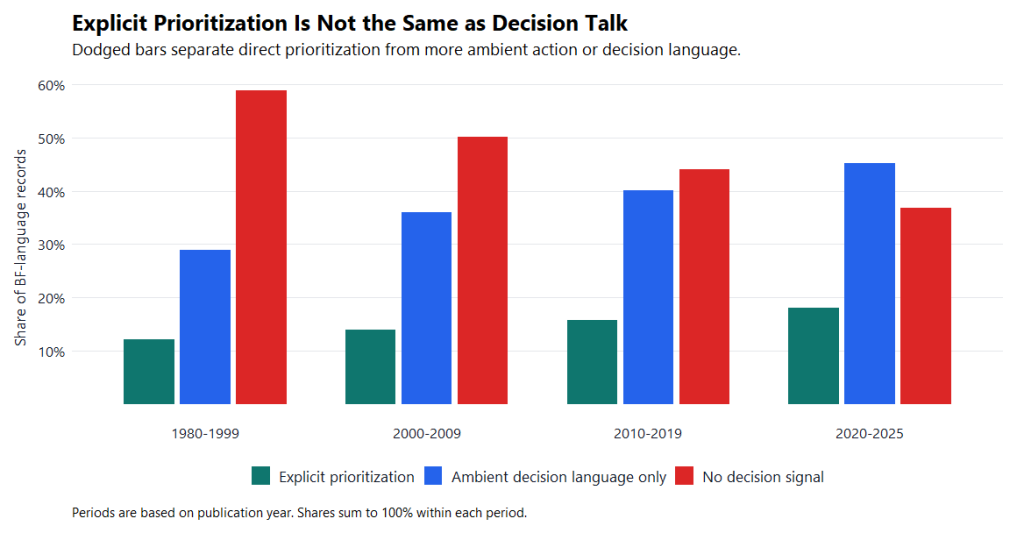
Between 1980 and 1999, 28.9% of records contained ambient decision language without explicit prioritization. That proportion increased steadily over the following decades, reaching 35.9% during 2000–2009, 40.1% during 2010–2019, and 45.2% during 2020–2025.
This suggests that implementation science has become increasingly concerned with translation, application, and practical relevance. Researchers now speak much more frequently about strategy, feasibility, impact, and recommendations than they did several decades ago.
However, explicit prioritization has not grown at the same pace.
By 2020–2025, nearly half of all records (45.2%) contained ambient decision language without explicit prioritization, while only 18.0% explicitly ranked or compared barriers.
That widening gap may represent the missing ingredient in implementation science.
The field increasingly talks about decisions. It still far less frequently helps people make them.
Why Prioritization Matters for Real-World Implementation
Every implementation effort operates under constraints. There is never enough time, enough staff, enough funding, enough organizational attention, or enough patience to address every obstacle simultaneously.
As a result, treating every barrier as equally actionable is rarely realistic.
Some barriers are important but largely unchangeable. Others are easy to address but have relatively little influence on outcomes. Some are urgent but prohibitively expensive. Others receive considerable attention simply because they are visible, while less obvious barriers may actually determine whether an intervention succeeds.
Barrier and facilitator studies become genuinely useful only when they move beyond identification and help organizations navigate these trade-offs.
The practical question is not simply, What barriers exist?
It is, Which barriers should we address first, given our goals, resources, and constraints?
That question requires prioritization.
The Risk of Being “Actionable” Without Being Prioritized
Implementation science has long emphasized practical usefulness. The field naturally focuses on adoption, delivery, sustainability, and real-world change, so it is understandable that decision-oriented language appears frequently.
Yet there is a subtle risk.
Language about action can create the impression of guidance without actually providing a decision framework.
For example, a paper may identify several barriers and recommend implementation strategies. But if it never explains which barriers are most influential, most feasible to address, or most strongly connected to implementation outcomes, practitioners are still left making those judgments themselves.
The same limitation applies to discussions of feasibility, impact, and strategy. Declaring something feasible does not establish that it should be the highest priority. Suggesting that a factor influences implementation does not demonstrate that it matters more than competing explanations. Recommending a strategy does not show why it should be chosen over alternatives.
Implementation decisions require comparison.
Without comparison, “actionable” risks becoming more of a rhetorical style than a practical guide.
Moving from Barrier Lists to Decision Support
Improving prioritization does not require a single preferred methodology. Researchers could rank barriers alongside stakeholders, rate barriers according to both importance and feasibility, map barriers to implementation outcomes, conduct Delphi panels or nominal group exercises, compare the expected impact of competing implementation strategies, estimate costs and organizational readiness, or distinguish common barriers from true binding constraints.
The specific method is less important than the contribution.
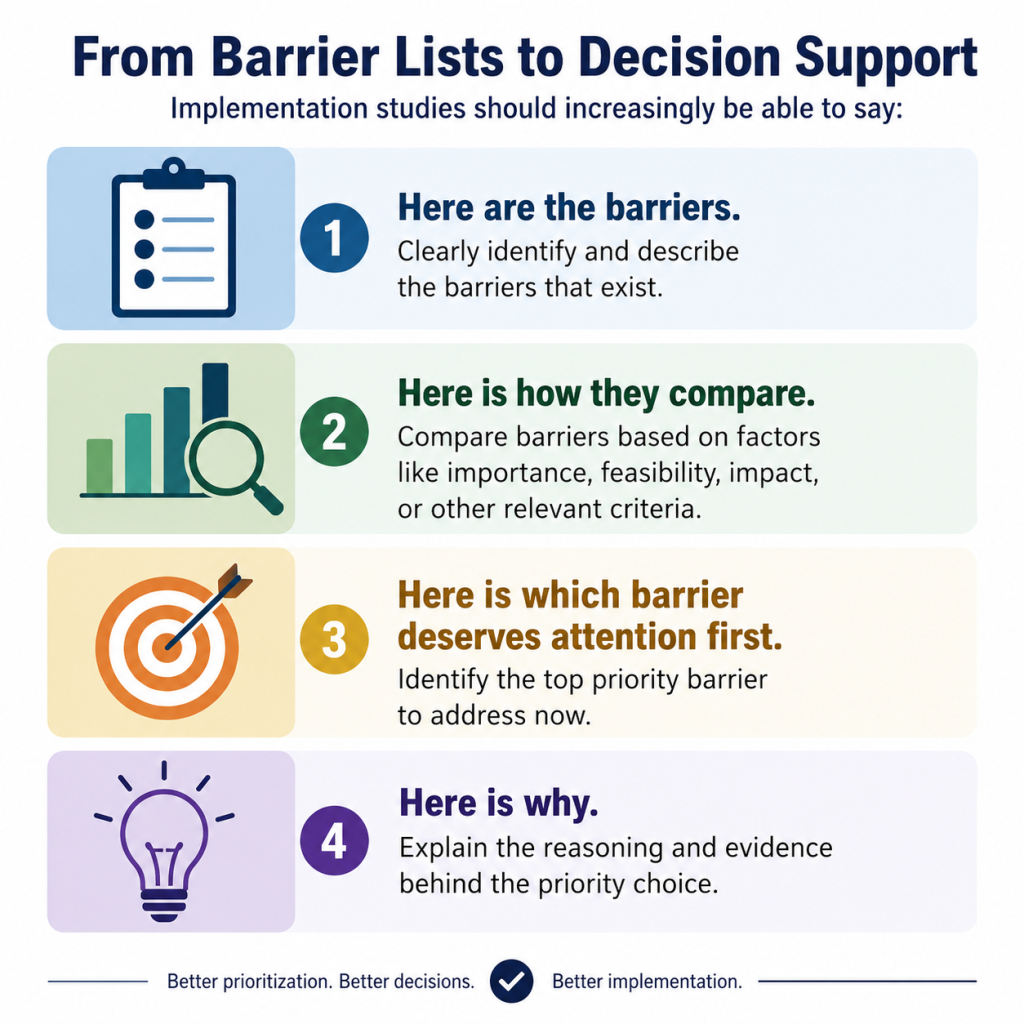
Implementation studies should increasingly be able to say:
- Here are the barriers.
- Here is how they compare.
- Here is which barrier deserves attention first.
- Here is why.
That shift transforms implementation research from descriptive reporting into meaningful decision support. Here’s an inspirartional infographic
Conclusion: A Field That Identifies More Than It Prioritizes
This analysis offers both encouraging and cautionary news.
The encouraging finding is that explicit prioritization is becoming more common. The proportion of records containing prioritization language has increased from 12.2% during 1980–1999 to 18.0% during 2020–2025.
The cautionary finding is that explicit prioritization remains relatively rare. Across more than 1.45 million barriers and facilitators records, only 16.6% included language indicating that barriers were actually ranked, weighted, or compared. Meanwhile, ambient decision language has grown dramatically, reaching 45.2% of records in the most recent period.
Together, these findings provide a useful diagnosis of where implementation science stands today. The field has become increasingly action-oriented in its language, but it often remains underdeveloped as a source of decision support.
This also reinforces the central argument of the previous article. A list is not a decision. And simply talking about decisions is not the same as helping people prioritize.
The future of implementation science may not depend on identifying more barriers. It may depend on helping practitioners choose among the ones they already know.
Because implementation ultimately succeeds or fails through choices. And research still too rarely makes them.