A List Isn’t a Decision: Why Barrier and Facilitator Studies Don’t Always Help People Choose
This article is part of Decision-Useful Implementation Science, an ongoing series exploring what implementation research actually tells us about putting evidence into practice. Using large-scale text analysis, natural language processing, and bibliometric methods, the project examines nearly 1.5 million PubMed-indexed publications from 1980 to 2025.
Rather than reviewing individual studies, the series steps back to ask bigger questions. How has implementation science evolved? What kinds of evidence does it produce? And, most importantly, does it generate knowledge that helps leaders make better implementation decisions?
Every analysis is fully reproducible. The complete technical report, code, and data processing workflow are openly available.
Previous articles
- We Keep Studying Barriers. Why Doesn’t Implementation Get Easier?
- When Everything Is a Barrier, Nothing Is
Technical resources
Before we go on, if you haven’t signed up for our weekly newsletter, please do. We distill the hottest-off-the-presses science and why it matters for public health practice and policy.
A List Isn’t a Decision: Why Barrier and Facilitator Studies Don’t Always Help People Choose
In the previous post, I examined whether the barriers and facilitators literature has become more conceptually diverse as it has grown.
The answer was surprisingly simple: not really.
The literature has expanded dramatically, but the language used to describe implementation challenges has remained remarkably stable. A familiar set of concepts continues to dominate the conversation. That naturally leads to the next question: if researchers continue to publish more studies identifying the same barriers and facilitators, what are we actually gaining?
The problem is that a list is not the same thing as a decision.
Naming factors such as leadership, resources, communication, training, workflow, culture, and evidence tells us what might matter, but it does not tell implementation leaders what they should do first. For a clinic director, school administrator, public health team, or community organization, that distinction is critical. They are rarely asking for a catalog of possible barriers. They are asking a much more practical question: Which one matters most?
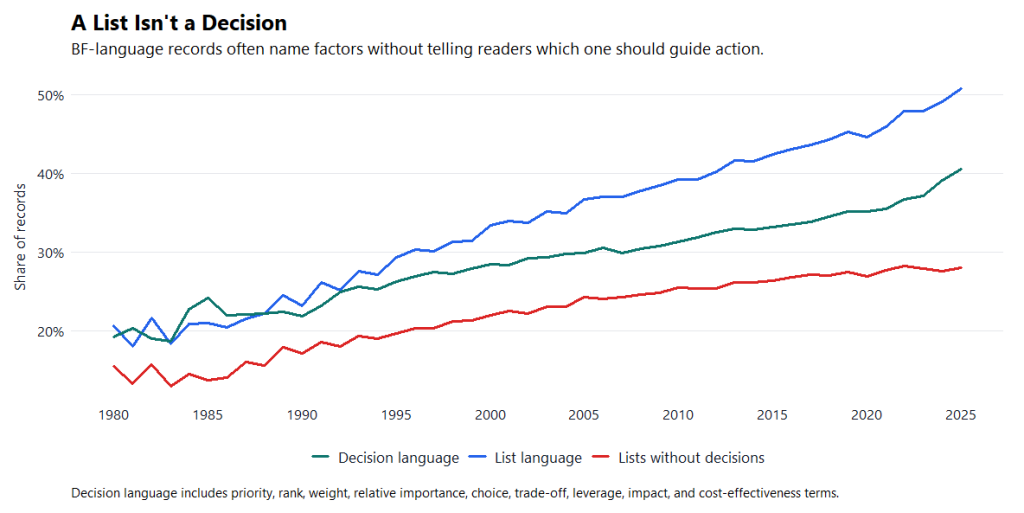
This figure compares the share of barriers and facilitators records using list-oriented language, decision-oriented language, and list-without-decision language over time. Although list language has become increasingly common, a substantial portion of the literature still identifies factors without providing any signal about how to prioritize them.
The data illustrate just how pervasive this pattern has become. Across the dataset, 1,455,485 records used barriers and facilitators language. Nearly 44.0% relied on list-style terminology such as themes, codes, categories, domains, or factors, reflecting the field’s heavy emphasis on qualitative identification through interviews and thematic analysis. That work is undeniably valuable because it gives practitioners language for challenges they often recognize but struggle to articulate. However, only 34.9% of records included decision-oriented language such as priority, ranking, weighting, relative importance, trade-offs, leverage, impact, or cost-effectiveness. More strikingly, 26.4% of all records used list language without any accompanying decision language. That gap lies at the heart of this discussion. The issue is not that implementation research produces inaccurate lists. The issue is that many studies stop just before the point when practitioners most need guidance.
Common Doesn’t Mean Actionable
Figure 2 highlights an important distinction between common implementation themes and actionable implementation guidance. The figure compares two different characteristics of the seven most frequently discussed barriers and facilitators in the literature. First, it shows how often each theme appears across all studies on barriers and facilitators. Second, it shows how often studies mentioning that theme also include language suggesting prioritization or decision-making, such as priority, ranking, relative importance, trade-offs, impact, or cost-effectiveness. At first glance, the results seem reassuring because the same familiar concepts consistently appear throughout implementation research. Evidence is mentioned in 54.6% of all barriers and facilitators records, followed by resources (31.5%), workflow (27.3%), training (25.0%), communication (19.8%), culture (16.5%), and leadership (15.8%). These themes have become the field’s common vocabulary for describing implementation challenges.
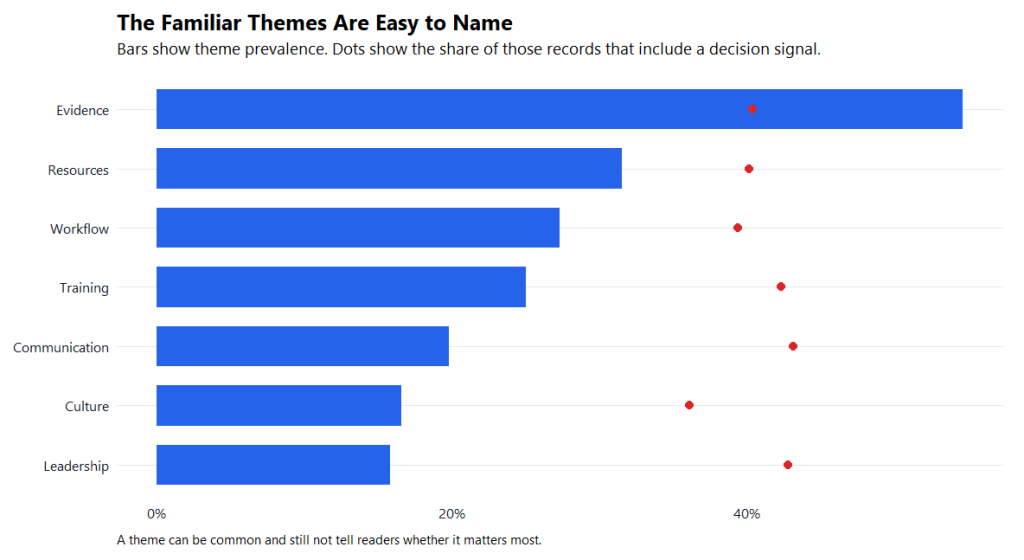
The more revealing finding emerges when we ask whether studies move beyond simply naming these themes to help readers decide among them. Across every major theme, less than half of the records mentioning that theme also included any decision-oriented language. Communication had the highest proportion, yet only 43.1% of studies mentioning communication also contained a decision signal. Leadership followed at 42.8%, training at 42.3%, evidence at 40.3%, resources at 40.1%, workflow at 39.4%, and culture at just 36.1%.
Put differently, roughly six out of every ten papers discussing these familiar implementation themes provide no indication of which factor should receive priority.
Even among nearly 241,000 studies mentioning organizational culture, fewer than four in ten offered language suggesting whether culture should be considered more or less important than competing concerns such as leadership, workflow, communication, or resources.
This distinction matters because implementation is fundamentally a resource allocation problem. Organizations almost never have sufficient time, money, staff, or organizational capacity to address every identified barrier simultaneously. Leaders must continually decide whether their next investment should focus on improving leadership, redesigning workflows, expanding training, strengthening communication, adapting an intervention, or securing additional resources. Simply identifying all of these as important does little to support those decisions. In fact, comprehensive lists can unintentionally imply that every barrier deserves equal attention, leaving practitioners without clear guidance about where their next dollar, hour, or staff effort will have the greatest impact.
Ultimately, Figure 2 illustrates the difference between frequency and utility. The implementation literature has become exceptionally good at identifying recurring barriers and facilitators, but identifying common themes is not the same as helping practitioners make better decisions. Practice does not simply need to know that leadership, communication, training, workflow, resources, and culture all matter. It needs evidence that helps distinguish which of those factors matters most in a particular context and which should be addressed first. That shift from cataloging implementation challenges to supporting implementation decisions represents one of the field’s most important opportunities for future progress.
The Shopping List Problem
Perhaps the clearest evidence of this challenge is what might be called the shopping list problem. Across the dataset, 16.7% of barriers and facilitators records mentioned three or more familiar implementation themes without including any decision-oriented language. Even more concerning, this pattern has become increasingly common over time. Between 1980 and 1999, only 10.8% of records contained three or more familiar themes without a decision signal. That proportion increased to 14.2% during 2000–2009, rose again to 16.4% in 2010–2019, and reached 18.1% between 2020 and 2025.
n other words, as the implementation literature has matured, it has become increasingly likely to present readers with increasingly comprehensive lists that still fail to answer the most practical question: Where should we begin?
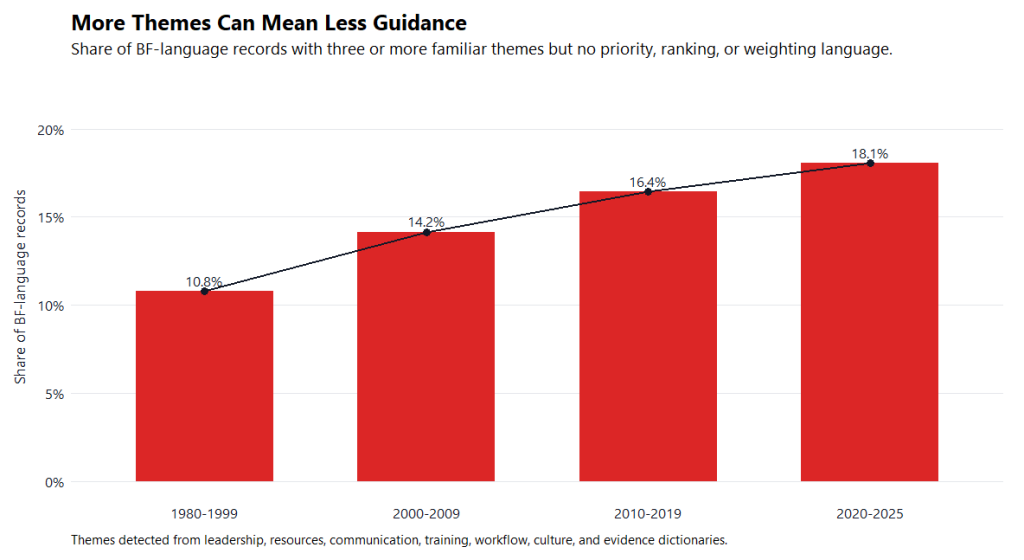
This figure illustrates the growing proportion of studies reporting three or more familiar implementation themes without providing any guidance about prioritization. The trend suggests that the literature is becoming increasingly effective at cataloging complexity without becoming equally effective at supporting implementation decisions.
Examples from the dataset demonstrate that this is not a problem confined to one corner of implementation science. The pattern appeared in studies examining primary care implementation, nursing conflict, adolescent sleep interventions, psycho-existential symptom assessment, Enhanced Recovery After Surgery (ERAS) protocols, pain management, virtual training, government policy implementation, climate-related HIV outcomes, artificial intelligence in diagnosis and management, and numerous qualitative studies of patient and provider experiences.
These topics span very different disciplines, populations, and intervention types. Yet their structure is remarkably similar: researchers identify multiple barriers and facilitators across several domains, but the abstract rarely indicates which of those barriers should receive priority. That observation should not be interpreted as a criticism of qualitative research. Abstracts are necessarily brief, many full manuscripts contain richer analyses, and exploratory qualitative studies are often designed to understand experiences rather than rank solutions. Nevertheless, from the perspective of someone responsible for implementing change, the pattern remains important. If the primary output is simply another list of barriers and facilitators, practitioners are still left to perform the prioritization themselves.
This distinction highlights why lists and decisions serve fundamentally different purposes. Lists are invaluable when the primary challenge is discovering what obstacles exist. They make invisible problems visible. Decision-making, however, requires comparison rather than identification. It requires distinguishing between barriers that are merely common and those that are genuinely consequential; between issues that generate frustration and those that actually prevent implementation success; between problems that are frequently mentioned and those that can realistically be addressed with available resources.
A list answers the question, What are the barriers? A decision answers the much harder question, Given limited time, money, and staff, which barrier should we tackle first?
Providing that level of guidance requires different kinds of evidence. Researchers may need to rank barriers according to perceived importance, evaluate them based on feasibility, develop causal models, incorporate stakeholder prioritization exercises, estimate implementation costs and resource requirements, or directly link specific barriers to measurable implementation outcomes. Without these additional analytical steps, implementation research often arrives at an unsatisfying conclusion: everything matters. Unfortunately, if everything matters equally, then nothing has truly been prioritized.
So is this blog just another list?
None of this suggests that implementation science should abandon interviews, thematic analysis, or qualitative coding. These approaches remain essential for understanding context and identifying implementation challenges. Instead, the field should become more explicit about the type of knowledge these methods produce. Exploratory work is well served by comprehensive lists of barriers and facilitators. But when the objective is to support real-world implementation, researchers must move beyond identifying problems and begin helping decision-makers choose among them. That means asking a different set of questions: Which barriers have the greatest influence on implementation success? Which facilitators are most actionable? Which themes explain the largest share of implementation variation? Which challenges are urgent but largely unsolvable? Which are highly solvable but relatively unimportant? Which problems require additional resources, which require better communication, and which demand redesign rather than incremental improvement?
Ultimately, implementation leaders are rarely asking researchers to identify yet another barrier. They are asking which barrier deserves their attention first. At present, too much of the barriers and facilitators literature still provides an extensive inventory without offering a roadmap. The next step for implementation science is not to produce longer lists. It is to produce better decisions