Who Really Controls Implementation? Why Authority Matters More Than Buy-In
This article is part of Decision-Useful Implementation Science, an ongoing series exploring what implementation research actually tells us about putting evidence into practice. Using large-scale text analysis, natural language processing, and bibliometric methods, the project examines nearly 1.5 million PubMed-indexed publications from 1980 to 2025.
Rather than reviewing individual studies, the series steps back to ask bigger questions. How has implementation science evolved? What kinds of evidence does it produce? And, most importantly, does it generate knowledge that helps leaders make better implementation decisions?
Every analysis is fully reproducible. The complete technical report, code, and data processing workflow are openly available.
Previous articles
- We Keep Studying Barriers. Why Doesn’t Implementation Get Easier?
- When Everything Is a Barrier, Nothing Is
- A List Isn’t a Decision
- The Missing Ingredient in Implementation Research: Prioritization
- Leadership Isn’t a Mechanism in Implementation Science
- The Comfortable Politics of Implementation Science
Technical resources
Before we go on, if you haven’t signed up for our weekly newsletter, please do. We distill the hottest-off-the-presses science and why it matters for public health practice and policy.
Implementation science spends a great deal of time asking front-line workers about barriers.
Nurses describe impossible workloads. Teachers explain why a new curriculum never quite fit into the school day. Behavioral health clinicians talk about documentation burdens. Community organizations describe trying to coordinate services across fragmented systems.
Those stories matter. They tell us where implementation breaks.
But they rarely answer this question: Who actually had the authority to prevent those problems in the first place?
That distinction matters because the people responsible for carrying out implementation are often not the people who control the conditions under which implementation occurs. Budgets, staffing, procurement, reimbursement, policy, contracts, reporting requirements, and information systems usually sit somewhere upstream.
The result is a subtle but important mistake. Implementation research often measures where problems become visible rather than where decisions are made.
Visibility Is Not the Same as Control
Across 1,455,485 barriers and facilitators records, front-line workers appeared in just 19.9% of records. These included clinicians, nurses, teachers, counselors, therapists, case managers, social workers, and other professionals directly responsible for delivering services.
At first glance, that may seem surprisingly low. After all, implementation science frequently interviews front-line staff.
But another pattern immediately stands out. Organizational authority language, including references to organizations, leaders, hospitals, agencies, managers, executives, and governance, appeared in 59.7% of all records.
System, state, or payer authority appeared in 18.5%.
Overall, 67.2% of all barriers and facilitators records mentioned some form of authority.
That tells us that implementation science is not ignoring organizations. In fact, it discusses organizations and authority far more often than it discusses front-line workers. The real question is not whether authority is mentioned. The question is whether the literature connects authority to responsibility.
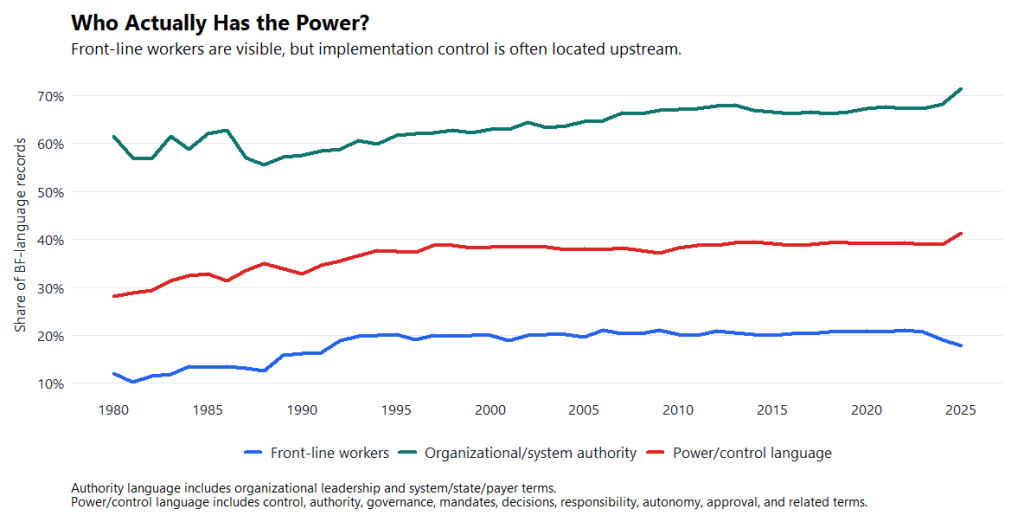
This figure shows how references to front-line workers, organizational authority, system authority, and power/control language have changed over time. The key takeaway is that authority language consistently dominates the literature, while explicit discussions of power and control have steadily become more common.
Most Implementation Problems Are Not Front-Line Problems Alone
One of the clearest findings in the analysis was how rarely front-line workers appeared without any accompanying authority. Only 3.4% of all records discussed front-line workers alone. By contrast:
- 50.7% mentioned authority without front-line workers.
- 16.5% mentioned both front-line workers and authority.
- 29.4% mentioned neither.
This is an encouraging finding in one sense. The field is not simply blaming nurses, teachers, clinicians, or case managers for implementation failures.
Yet the front line still occupies a unique position. It is where implementation becomes visible. It is where additional documentation appears. It is where new workflows collide with existing practice. It is where staff experience increased workload, uncertainty, resistance, or frustration.
Those observations are valuable, but visibility should never be mistaken for control. The front line is often where implementation decisions arrive, not where they originate.
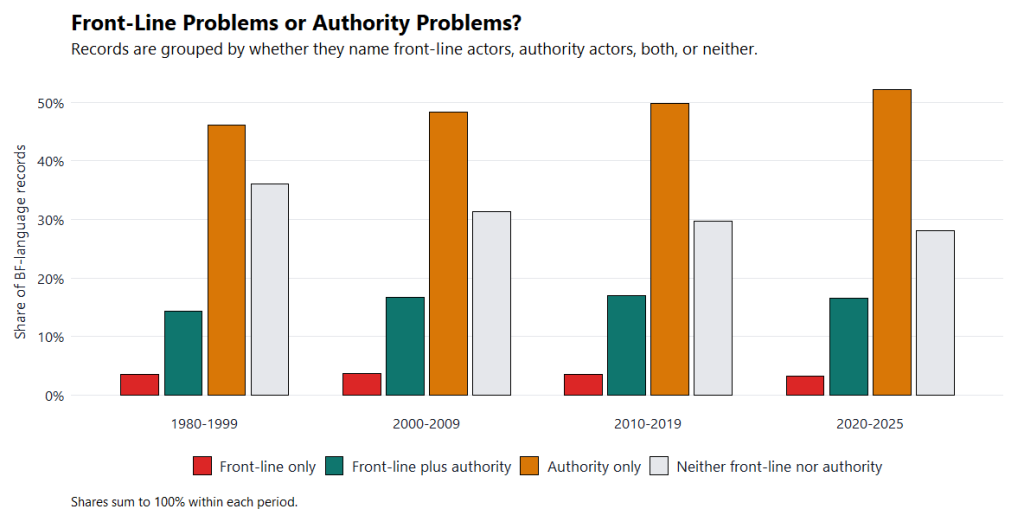
This figure compares records that mention front-line workers only, authority only, both, or neither. It demonstrates that “front-line only” framing is consistently rare, while authority-only framing dominates across publication periods.
When Researchers Talk About Power, They Mostly Talk About Authority
To explore this question more directly, I searched for explicit language related to power and control: governance, mandates, decision-making, accountability, ownership, autonomy, budget authority, resource allocation, policy levers, and similar concepts.
Overall, 39.1% of all records contained some form of power or control language. Among those records:
- 22.5% mentioned front-line workers.
- 70.9% mentioned organizational or institutional authority.
- 23.8% mentioned system, state, or payer authority.
That pattern is remarkably consistent. Whenever implementation papers explicitly discuss power, they overwhelmingly point toward organizations rather than individuals.
That makes intuitive sense. A nurse can adapt to an understaffed unit. A teacher can improvise around an impossible schedule. A clinician can absorb additional documentation.
But none of those professionals typically control staffing levels, reimbursement policies, procurement decisions, electronic health records, or district budgets. Those decisions are made elsewhere.
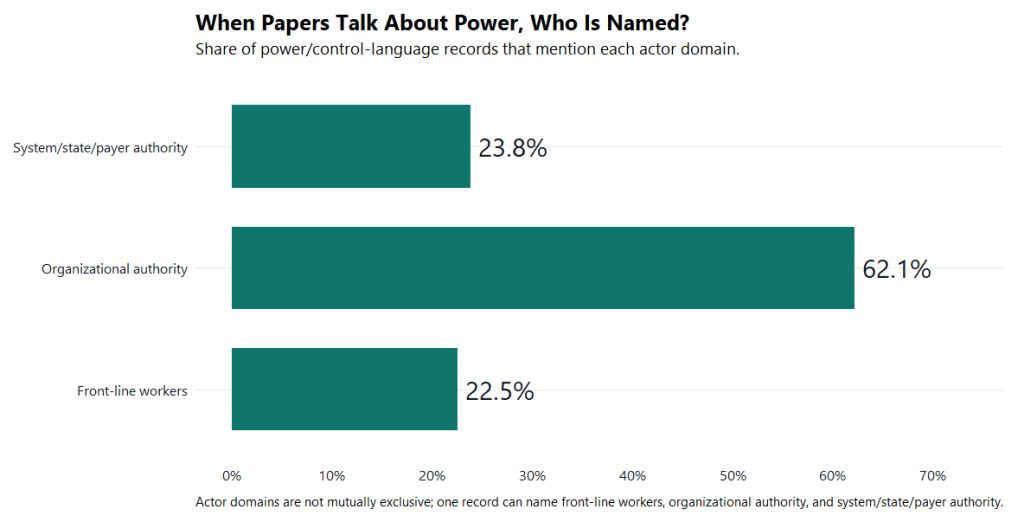
This figure focuses only on records containing power or control language. It shows that discussions of power overwhelmingly identify organizational or system authority rather than front-line actors.
The Control Point Depends on the Setting
One reason implementation research sometimes becomes confusing is that “authority” is not a single thing. It changes depending on the system.
State agencies, hospitals, school districts, and behavioral health systems all distribute authority differently. Among records involving state agencies, authority was almost universal. 98.9% mentioned some form of authority, while 96.9% specifically referred to state, system, or payer authority. Only 0.4% of state agency records discussed front-line workers without authority.
Hospitals showed a similarly strong organizational pattern. 98.5% of hospital records included authority language, and 98.2% specifically mentioned organizational authority. Although front-line workers appeared in 40.9% of hospital records, only 0.5% framed implementation exclusively as a front-line issue.
School districts looked different. Front-line workers appeared in 44.8% of school records, organizational authority in 55.0%, and system authority in 27.6%. Front-line-only framing rose to 11.6%, substantially higher than in hospitals or state agencies.
Behavioral health systems occupied a middle ground. Front-line workers appeared in 37.4% of records, organizational authority in 69.4%, and system authority in 20.8%. Authority-only framing accounted for 43.7% of records.
Different sectors therefore produce different implementation challenges. But the underlying principle remains remarkably consistent. Authority almost always sits upstream.
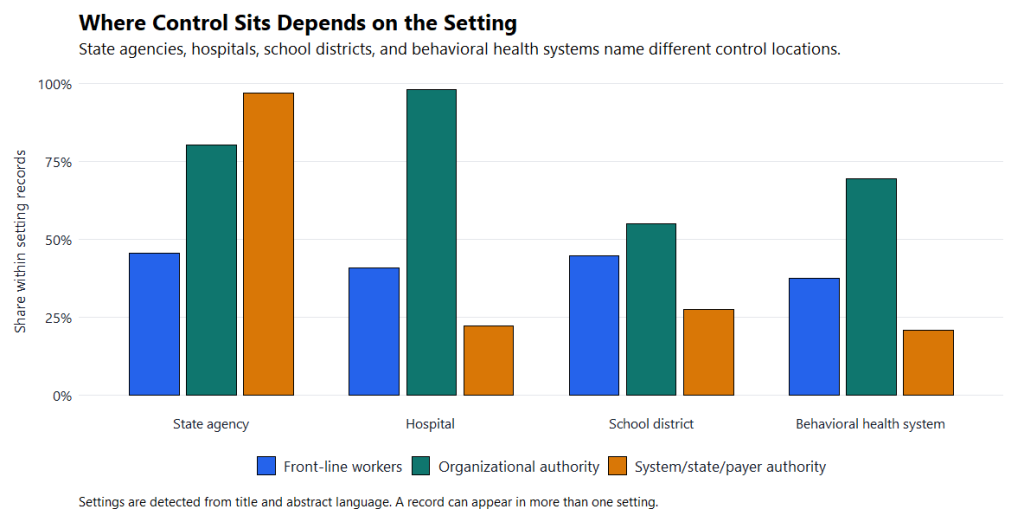
This figure compares front-line workers, organizational authority, and system/state/payer authority across four implementation settings. It illustrates that every setting has a different distribution of authority, but organizational control consistently outweighs front-line control.
Responsibility Often Falls on the Wrong People
This may be the most important insight from the analysis.
A hospital nurse may be responsible for implementing a new protocol but have no control over staffing.
A teacher may be expected to deliver a new intervention without controlling the school schedule.
A behavioral health clinician may be held accountable for outcomes shaped by reimbursement rules.
A community organization may be expected to coordinate care without controlling data-sharing agreements.
A case manager may be asked to reduce access barriers while having no authority over eligibility requirements.
In every case, the front-line worker experiences the consequences of implementation. But someone else controls many of the conditions that determine whether implementation succeeds.
Mapping Authority Is More Useful Than Listing Barriers
The actor-level analysis reinforces this conclusion.
Front-line workers appeared in 19.9% of all records.
Organizational authority appeared in 59.7%.
System, state, or payer authority appeared in 18.5%.
Power language appeared within 44.2% of front-line records, 40.7% of organizational authority records, and 50.2% of system/state/payer records.
Those numbers show that implementation research already recognizes authority. What it often lacks is an explicit map linking barriers to the actors capable of changing them.
Instead of asking only, “What barriers do front-line workers experience?” implementation studies should also ask:
- Who controls the budget?
- Who controls staffing?
- Who controls workflow?
- Who controls procurement?
- Who controls reimbursement?
- Who controls policy?
- Who controls training time?
- Who controls accountability?
- Who decides whether this continues after the grant ends?
They determine whether implementation is feasible in the first place.
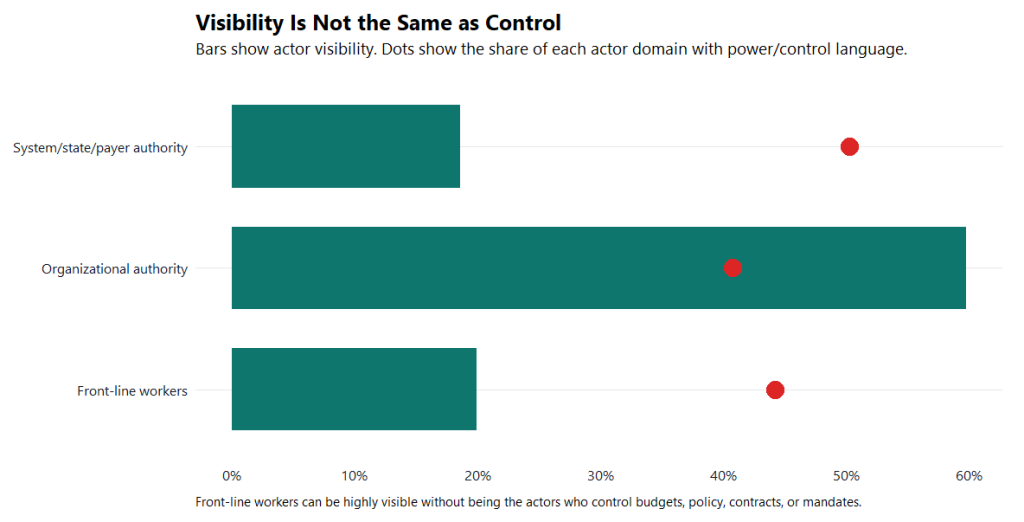
This final figure compares how frequently different actor groups appear in the literature with how often they are discussed alongside power and control. It visually captures the central argument of the post: visibility does not equal authority.
Implementation Science Needs to Map Power, Not Just Problems
This series has argued that implementation science has become extraordinarily good at cataloging barriers while remaining much less effective at helping decision-makers choose where to intervene.
This analysis extends that critique. Implementation does not fail simply because people resist change. It often fails because responsibility and authority are separated.
The people expected to make implementation work frequently lack control over budgets, staffing, contracts, technology, regulations, or incentives.
The front line is where implementation becomes visible. But visibility is not control.
If implementation science wants to become more useful for leaders and organizations, it must move beyond identifying barriers and begin mapping authority. Because until we know who actually controls the relevant decisions, we cannot know where meaningful implementation leverage truly exists.