Evaluating Air Cleaner Effectiveness in Schools: New Research Offers Insights
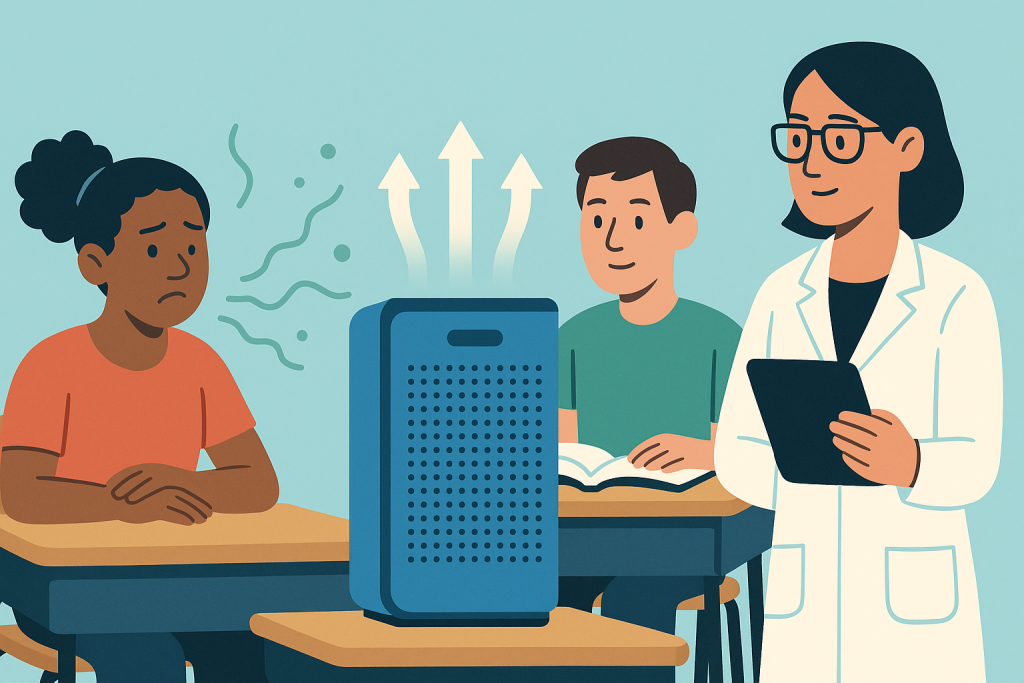
In a brightly lit classroom in the Netherlands, children sit scattered around the room, focused on their lessons. Yet, behind the scenes, a silent challenge affects their ability to learn effectively: air quality. Schools, often bustling and packed with students, must contend with airborne contaminants that can affect everything from respiratory health to cognitive function.
Build Your Public Health Issue
Tell us a little about your work, and we’ll build a personalized issue with five things worth knowing.
Understanding the Stakes
Indoor air quality (IAQ) in schools is a pressing public health issue. Poor air quality can exacerbate respiratory symptoms, contribute to asthma, and reduce cognitive performance. In the wake of the COVID-19 pandemic, the stakes are higher than ever, with increasing pressure to keep classrooms safe and open. Airborne viruses and other pollutants are daily concerns, making effective air-cleaning strategies crucial.
The School Air Quality Challenge
In the Netherlands, regulatory steps are being taken to monitor and enhance IAQ, such as mandatory CO₂ monitoring. However, even with these efforts, many classrooms still don’t meet the recommended air quality standards, raising concerns about both physical health and academic performance.
The Study’s Purpose
Recognizing this need, a cluster-randomized controlled trial was launched involving 180 classrooms across 29 Dutch primary schools. The study aimed to evaluate the effectiveness of portable air cleaners (PACs) in reducing airborne contaminants, focusing on both particulate matter and microbial markers. By comparing traditional high-efficiency particulate air (HEPA) filtration with newer technologies like ionization/plasma solutions, researchers sought to understand which methods best improve indoor environments for children.
How the Study Was Conducted
Researchers randomly assigned classrooms to one of three conditions: HEPA-filter PACs, ionization/plasma PACs, or no PACs (control). The design included a baseline period with no PACs, followed by successive intervention periods when air cleaners were deployed. Air quality data was meticulously gathered through devices and electrostatic dust collectors to analyze variations in bacterial and viral presence, particulate matter levels, and other IAQ indicators.
Key Findings
This comprehensive study suggests that while PACs can reduce overall particulate matter, their efficiency varies considerably across settings. Notably, air cleaners equipped with HEPA filters consistently lowered particulate matter levels in real-world classroom conditions.
Improving air quality in schools isn’t just about deploying air cleaners; it involves understanding how these devices work within the specific dynamics of individual classrooms.
Impact on Public Health
These findings matter to public health leaders and educators alike. They highlight that simply using technology isn’t enough. Instead, a thoughtful approach that considers classroom design, occupancy, ventilation systems, and real-world factors is essential to truly improve IAQ.
Putting Insights Into Practice
What This Means in Practice
- Schools should assess current IAQ conditions and prioritize air cleaning interventions that align with their specific environmental needs.
- Policymakers could fund field-based studies that examine the real-world efficacy of PACs in diverse settings.
- Community-based organizations might advocate for improved ventilation standards and support programs that help schools adopt effective air-cleaning technologies.
The Hard Part: Challenges Ahead
Despite the promising results, challenges remain in translating these findings into widespread practice. Funding limitations, differing school infrastructure, and varying levels of community support can hinder implementation. Furthermore, scientific limits such as generalizability and the study’s sample size must be considered carefully when applying findings broadly.
Conclusion: A Breath of Fresh Air
As our communities continue to grapple with the health and educational impacts of poor indoor air quality, research like this offers a valuable beacon. It underscores the complexity of improving IAQ but also provides evidence-based strategies to enhance learning environments. This study reinforces that with the right tools and understanding, schools can become healthier spaces where children thrive.