Southern California Floods Are More Than a Travel Headache: Why Even Shallow Flooding Becomes a Public Health Problem
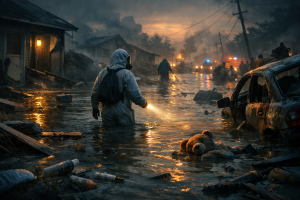
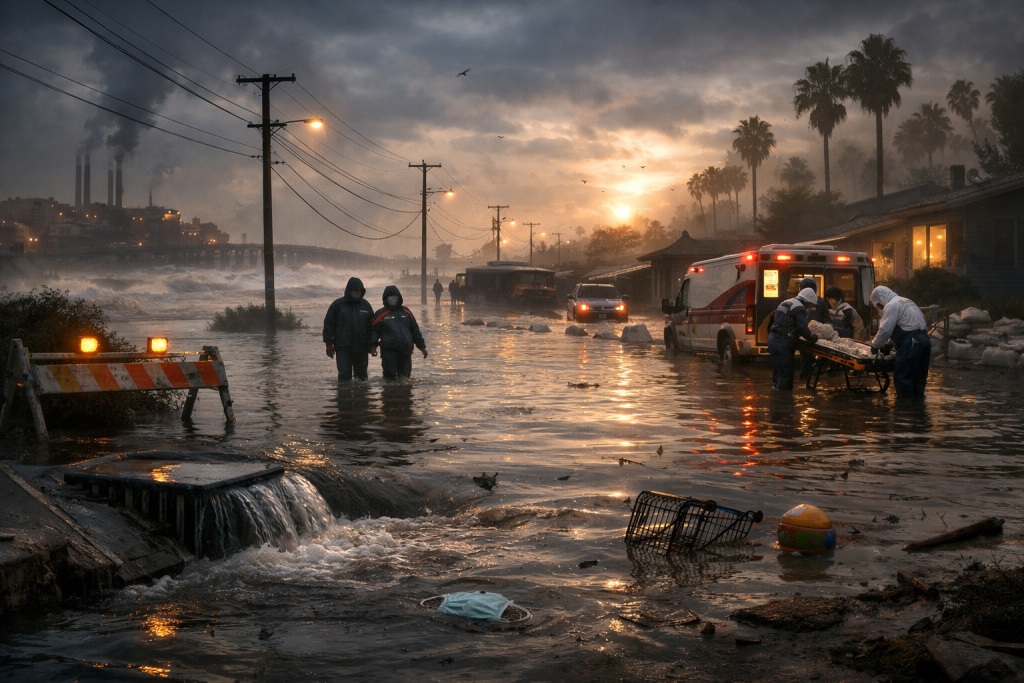
It does not take a towering wall of water to create a public health emergency. In Southern California, recent flooding included ankle- to knee-deep water in parts of Newport Beach during morning high tide, alongside broader storm-related impacts tied to Tropical Storm Rachel. That kind of flooding can look minor at first glance. It is not.
When water reaches streets, homes, businesses, and key infrastructure, health risks spread far beyond the flooded block. Roads become dangerous, access to care can be disrupted, buildings can take on water, and recovery can trigger longer-term problems such as mold exposure and stress-related health effects. Southern California’s recent flood events remind us that so-called nuisance flooding can quickly become a community health issue.
When high tide floods streets, health risks follow close behind
The National Weather Service issued coastal flood warnings and advisories for Newport Beach and nearby areas in late October, warning that low-lying roads, homes, businesses, and some critical infrastructure could be inundated. Local storm reports then documented actual flooding in Newport Beach, including ankle- to knee-deep water near the Balboa Fun Zone during high tide.
That matters for public health because even shallow flooding can disrupt the systems people depend on every day. Flooded roads can delay emergency response, block workers from reaching hospitals or care facilities, and keep residents from pharmacies, dialysis appointments, or other essential services. For older adults, people with disabilities, and families without flexible transportation options, a few inches of water can become a serious barrier.
Flooding also increases injury risk. Wet pavement, hidden debris, unstable footing, and drivers misjudging water depth all make short trips more hazardous. In densely used coastal areas, those risks can pile up quickly.
Southern California is seeing more than one kind of flood threat at once
The recent events were not limited to one dramatic storm scene. Official records show a mix of coastal flooding linked to unusually high tides and broader storm-related impacts tied to Tropical Storm Rachel. California listed Rachel as an open State of Emergency affecting Imperial, Los Angeles, Orange, and San Diego counties as of October 27, 2026, showing that the event had significance beyond isolated street flooding.
In San Bernardino County, flood-control documents describe 1.5 to 2 inches of rain in Yucca Valley and Twenty-Nine Palms between October 10 and 12, causing severe channel erosion and sediment deposition that required emergency work. That flood pattern differs from water washing over a coastal roadway, but the public health lesson is similar: flood risk in Southern California is not a single problem. Coastal communities, inland desert areas, and transportation corridors can all be affected in different ways by the same stretch of extreme weather.
For health agencies and emergency planners, that means response plans cannot focus only on one flood type. Coastal overtopping, storm runoff, erosion, and infrastructure disruption may all happen in the same season.
Why floodwater creates problems long after the water drains away
The most visible part of a flood is often the water itself. The less visible part is what happens next. Once water enters buildings or pools around them, cleanup begins under conditions that can strain both households and local services. Water-damaged spaces may need drying, repair, and careful re-entry planning. If that process is delayed, damp indoor environments can become harder to restore safely.
Floods also push communities into a chain of stressors: missed work, temporary displacement, school disruption, damage claims, transportation problems, and uncertainty about what comes next. Public health is not only about immediate injuries. It is also about whether people can maintain safe housing, daily routines, access to medication, and a sense of stability after a disruptive event.
That is why flood recovery is not just a public works issue. It is also a health systems issue, a housing issue, and an equity issue.
Critical infrastructure is part of the health story
The National Weather Service warnings did more than mention roads and homes. They also noted risk to some critical infrastructure. That phrase can sound abstract, but in public health terms it is very concrete. Critical infrastructure includes the systems that keep communities functioning: transportation links, utilities, and other services people rely on to stay safe and healthy.
When those systems are flooded, the effects can spread well beyond the area under water. A blocked roadway can disrupt health workers’ commutes. Utility interruptions can affect refrigeration, communications, and business operations. Repeated flood exposure can also put pressure on local governments that must repair the same vulnerable areas again and again.
California’s emergency planning documents recognize that coastal flooding can be driven by high tides and storm surge, and that Southern California has a history of repeated coastal flood events. In public health, repetition matters. Repeated events can wear down resilience, increase costs, and widen gaps between communities that can recover quickly and those that cannot.
Why this matters for preparedness, not just response
Flooding is often treated as a short-term weather story. From a public health perspective, it is better understood as a recurring exposure. The key question is not only how deep the water gets on one day, but how often homes, roads, and essential services are pushed to the edge.
That shift in thinking matters for preparedness. Communities need evacuation and access plans that account for older adults, medically vulnerable residents, and people with limited transportation. Health systems need continuity planning for staff access and service interruptions. Local leaders need to think about flood-prone roads, recurring trouble spots, and infrastructure that serves as a lifeline during emergencies.
Southern California’s recent floods show why this work cannot wait for a more dramatic disaster label. A flood does not need to look catastrophic on camera to disrupt care, threaten safety, and strain recovery.
A shallow flood can still reveal a deep vulnerability
The recent Southern California flooding reminded us that public health risk often begins before a disaster looks severe. High tides that push water into streets, storm runoff that damages channels, and warnings about inundated infrastructure all point to the same reality: small amounts of water in the wrong places can create outsized harm.
For public health professionals, the lesson is simple. Flood preparedness is not only about major river floods or rare worst-case storms. It is also about repeated coastal and storm-driven flooding that interrupts daily life, threatens safe housing and mobility, and tests whether communities can protect the people most at risk.
Build Your Public Health Issue
Tell us a little about your work, and we’ll build a personalized issue with five things worth knowing.
References
- National Weather Service coastal flood warning/advisory for Newport Beach
- National Weather Service local storm report for Newport Beach flooding
- California Governor’s Office of Emergency Services proclamations
- CEQA Notice: SBCFCD Zone 6 Emergency Activities – Tropical Storm Rachel and El Nino 2026-2027
- California State Emergency Plan 2024