
The Next Public Health Revolution Won’t Be a Vaccine—It Will Be Demographics
New UN population projections suggest that many of the biggest public health challenges of the next century are already unfolding.
When most people hear the phrase population projections, they imagine one number: how many people will live on Earth by the end of the century.
Public health professionals know the more important questions are different.
How old will those people be?
Where will they live?
Will there be enough healthcare workers to care for them?
Will communities have enough children to sustain schools and vaccination programs? Will there be enough working-age adults to support aging populations? Which countries will face growing demand for maternal and child health services, and which will instead confront unprecedented levels of chronic disease, dementia, and long-term care?
The latest United Nations population projections suggest that the answers to these questions are changing rapidly.
The defining demographic challenge of the next century may not be global population growth—it may be the widening gap between countries that are aging and shrinking and those that are still growing rapidly.
A world entering two demographic futures
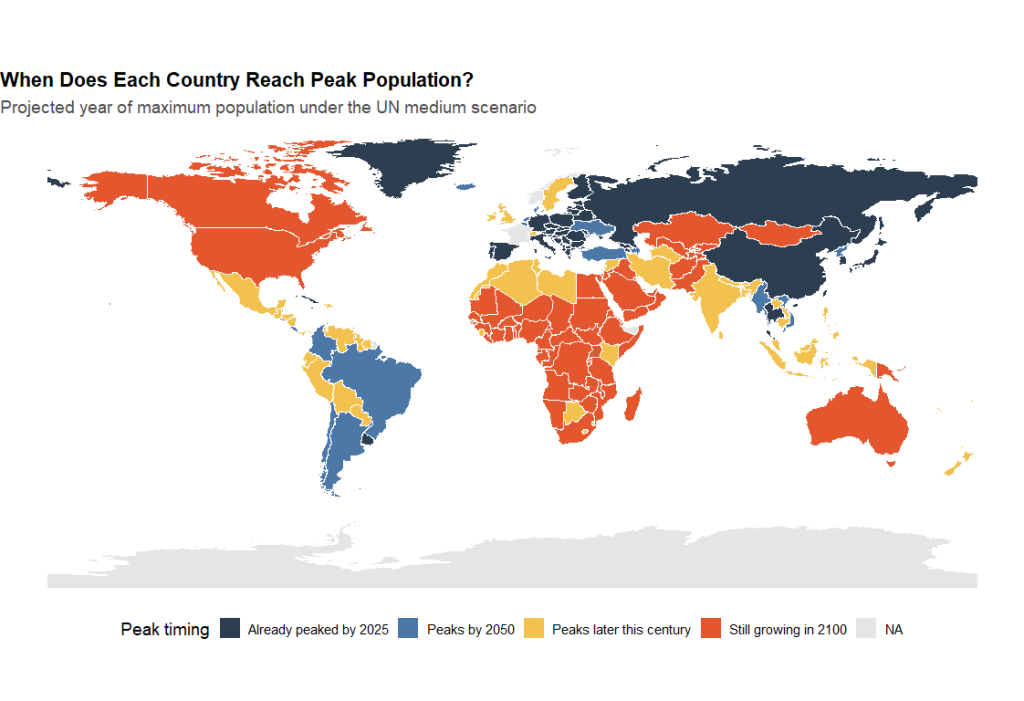
One of the clearest findings from the UN projections is that countries are not following a single demographic trajectory.
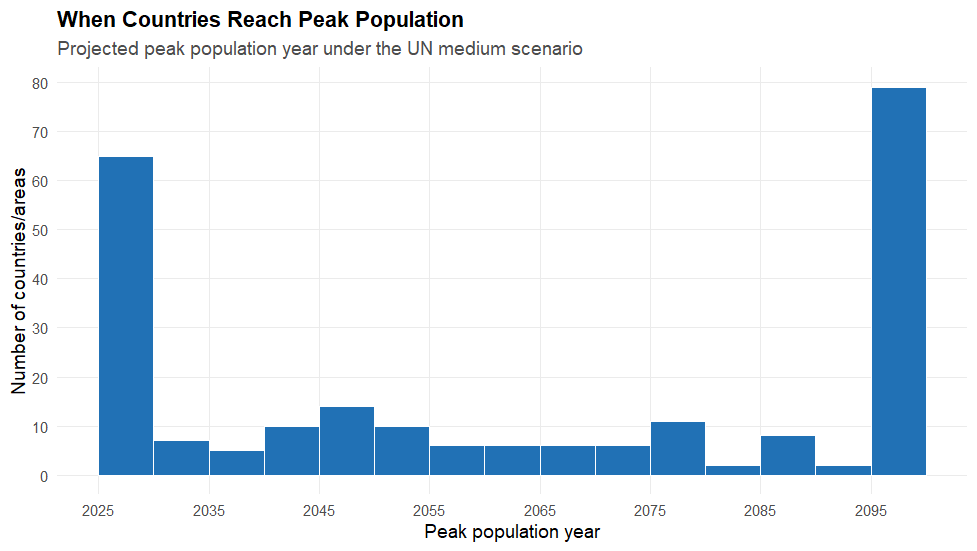
More than 100 countries are projected to reach their peak population before 2050, while 60 have already peaked by 2025.
These countries include many of the world’s largest economies, such as China, Japan, Italy, Poland, and the Republic of Korea.
For public health systems, this shift changes everything. Instead of preparing for larger populations, these countries increasingly face the challenges of supporting older populations with fewer working-age adults.
Hospitals, long-term care facilities, rehabilitation services, and community-based supports will all experience growing demand even as the healthcare workforce itself ages.
The coming workforce challenge
Healthcare depends on people caring for people. Demographic change therefore affects not only patients but also the professionals responsible for delivering care.
Countries experiencing sustained population decline may struggle to recruit enough physicians, nurses, home health aides, and public health workers to replace retiring professionals. Many are already relying more heavily on immigration to stabilize their healthcare workforce. Population projections are therefore also workforce projections.
Growth creates different public health needs
While many countries prepare for aging populations, others continue to grow rapidly.
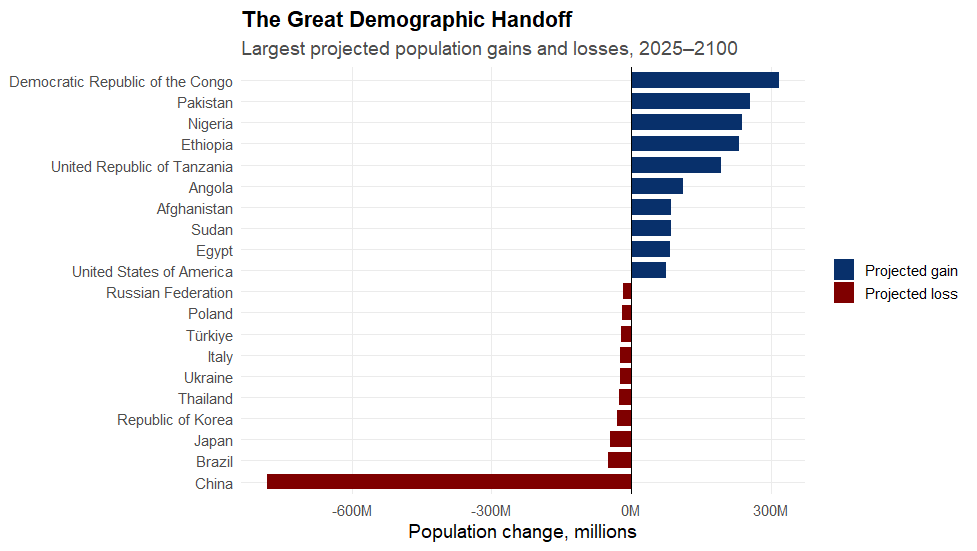
The Democratic Republic of the Congo, Pakistan, Nigeria, Ethiopia, Tanzania, and Angola are projected to add hundreds of millions of residents during the remainder of the century. These countries face a very different set of public health priorities. Rapid population growth increases demand for:
- Maternal health services
- Childhood immunization
- Nutrition programs
- Water and sanitation infrastructure
- Infectious disease surveillance
- Schools and primary healthcare clinics
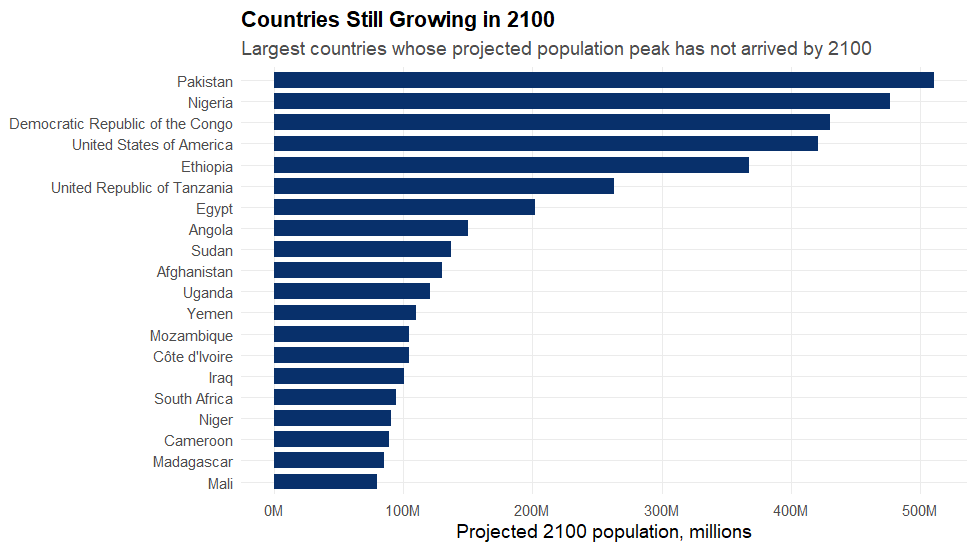
Rather than preparing for population decline, these health systems must expand capacity while maintaining quality and equitable access.
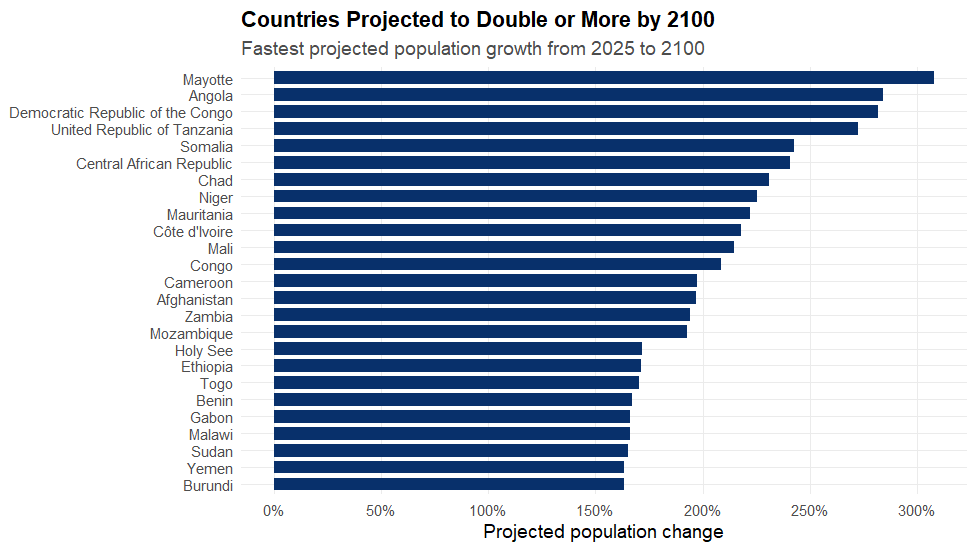
The public health implications become clearer when we look beyond the total population and examine the age structure. A growing country is not simply “larger.” It is often younger, with sustained demand for maternal health, pediatric care, vaccination, nutrition, schools, and primary care. An aging country faces a different set of pressures: chronic disease, disability, dementia care, long-term services, and a shrinking healthcare workforce.
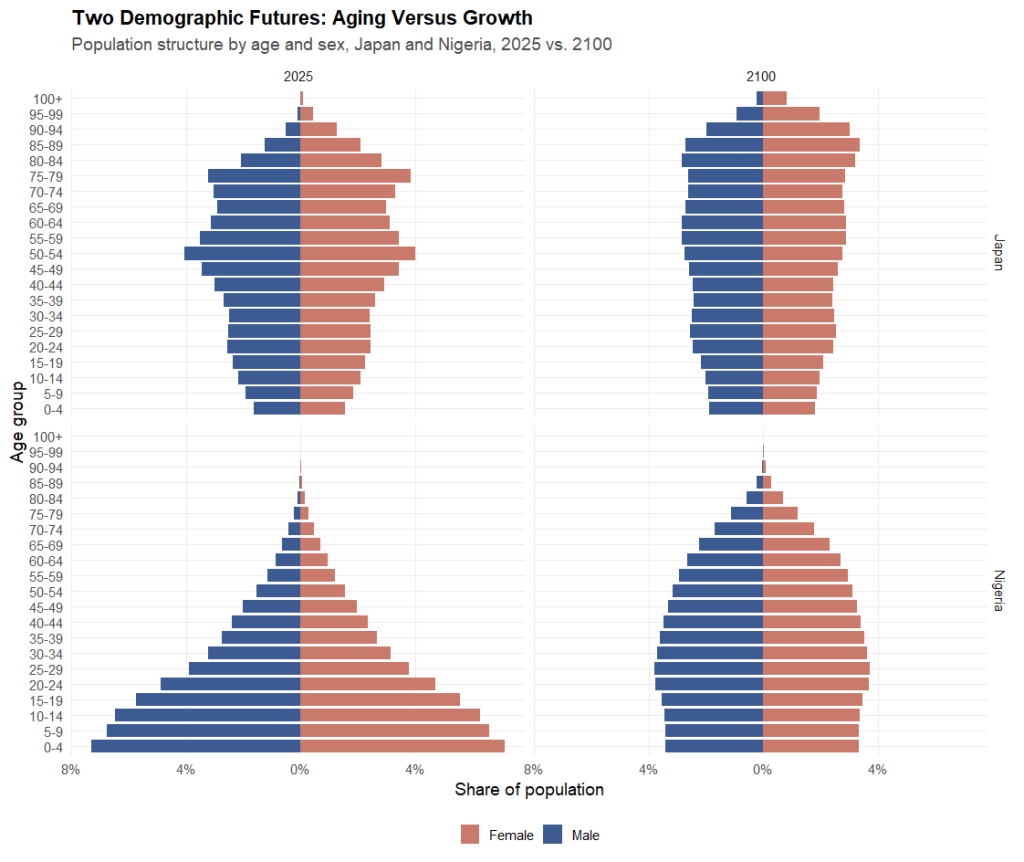
This is why population projections matter for public health planning. Japan and Nigeria are not just moving in different demographic directions; they are moving toward different health system futures. One must prepare for a society with a much larger older population. The other must continue expanding services for children, families, and young adults while also building capacity for future aging.
China’s demographic transition illustrates the scale of change
China provides perhaps the clearest example of how demographic shifts can reshape health systems.
The UN projects that China’s population will decline from roughly 1.42 billion today to about 633 million by 2100—a reduction of more than 780 million. That decline will not simply reduce the number of people needing healthcare. It will fundamentally alter the mix of health needs.
As populations age, healthcare systems generally experience higher demand for chronic disease management, cancer care, cardiovascular services, dementia care, rehabilitation, palliative care, and long-term support services.
The challenge becomes less about accommodating population growth and more about adapting to changing patterns of disease and disability.
Public health planning increasingly depends on demography
Many public health programs already rely on demographic projections. Health departments use them to estimate future vaccination needs. Hospitals use them to forecast demand for specialty services. Governments use them to plan retirement systems, emergency preparedness, and healthcare infrastructure. Population projections help answer questions such as:
- How many births should hospitals expect?
- How many primary care physicians will be needed?
- Where should new clinics be built?
- Which communities are likely to require expanded long-term care?
- Where will behavioral health services be most needed?
Demography is not simply about counting people. It is about anticipating future health needs before they emerge.
What public health can learn from demographic forecasting
Perhaps the most important lesson from these projections is that demographic change is slow—but not surprising. Unlike infectious disease outbreaks, demographic transitions unfold over decades.
That gives policymakers an opportunity that public health rarely enjoys: time.
The countries that will adapt most successfully are unlikely to be those with the largest populations.
They will be those that recognize today’s demographic signals and begin planning long before the consequences become unavoidable.
Population projections are not predictions of destiny. They are early warning systems.
For public health leaders, they offer something invaluable: the chance to prepare for tomorrow’s health challenges before tomorrow arrives.