
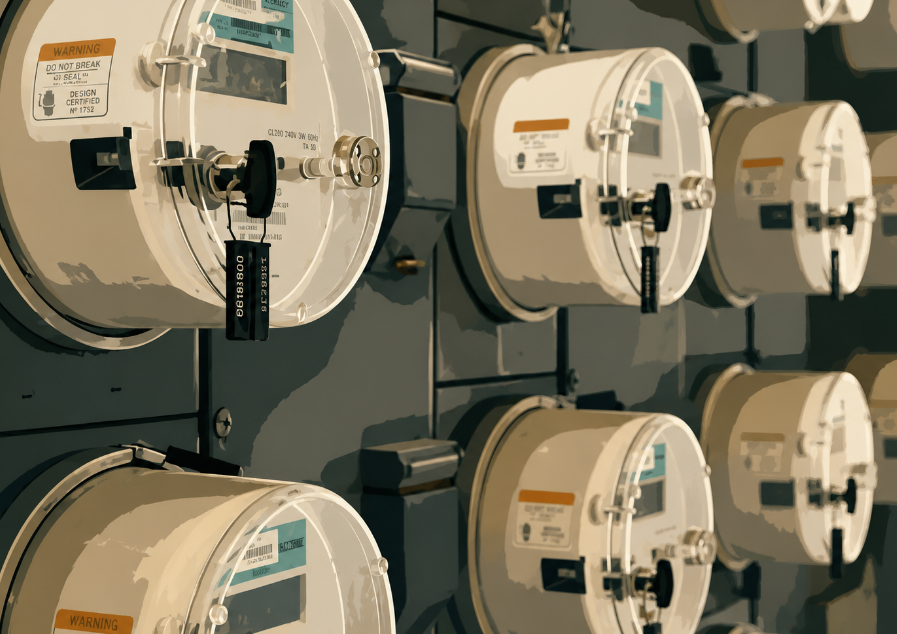
How much electricity does it actually take to answer your question?
With AI becoming part of everyday life, headlines often warn about massive data centers, soaring electricity demand, and the environmental cost of artificial intelligence. Those concerns are real. But they also make it easy to lose sight of an equally important question: what is the environmental footprint of an individual AI application?
At PubTrawlr, we believe transparency matters. So we decided to estimate our own AI footprint.
Measuring Our AI Footprint
Every day, PubTrawlr performs two primary AI-powered tasks:
- Summarizing approximately 200 newly published scientific article abstracts from journals across multiple disciplines.
- Answering approximately 100 user questions through our AI-powered research assistants.
To estimate the environmental impact of these activities, we turned to a recent preprint that evaluated the energy consumption of several real-world large language model (LLM) applications. Unlike earlier work that focused only on individual model calls, the researchers measured complete AI workflows, including retrieval, response generation, and hallucination checking, to estimate the electricity consumed by an entire user query.
The study reported median energy consumption ranging from:
- 0.000408 kWh per query for a streamlined retrieval-augmented generation (RAG) system
- 0.000500 kWh per query for a constrained GPT-4o-mini response
- 0.004530 kWh per query for a much more complex agentic RAG system with multiple verification steps.
Because PubTrawlr emphasizes concise summaries and relatively lightweight retrieval, our architecture is much closer to the first two categories than the third.
What That Means for PubTrawlr
Applying those estimates to our current workload produces a surprisingly modest annual footprint.
| Activity | Daily Volume | Annual Electricity |
|---|---|---|
| Scientific abstract summaries | 200/day | ~36.5 kWh |
| AI research questions | 100/day | ~15–165 kWh |
| Estimated total | 300 AI interactions/day | ~50–200 kWh/year |
That’s our best estimate today.
Of course, the exact number depends on factors we don’t directly control, including the hardware OpenAI uses, data center efficiency, and future improvements in model architecture. But even allowing for uncertainty, our annual electricity consumption appears to fall comfortably within this range.
Is That a Lot?
Numbers like “200 kilowatt-hours” don’t mean much by themselves.
Here’s what 50–200 kWh per year looks like in everyday life.
| Equivalent | ~50 kWh | ~200 kWh |
|---|---|---|
| LED light bulb left on continuously | 7 months | 2.3 years |
| Modern refrigerator | 2 months | 8 months |
| Laptop computer used full-time | About 1 year | About 4 years |
| 55-inch LED television | 500 hours | 2,000 hours |
| Electric clothes dryer | 15 loads | 60 loads |
| Electric vehicle | 170 miles | 700 miles |
| Average U.S. household electricity | About 2 days | About 1 week |
Another way to think about it: our entire annual AI workload likely uses roughly the same amount of electricity as running a household refrigerator for part of a year.
What About Carbon Emissions?
Electricity isn’t emitted directly into the atmosphere; it depends on how that electricity is generated.
Using average U.S. electricity generation, PubTrawlr’s AI usage likely produces approximately:
20–110 kilograms of CO₂ per year.
That is roughly equivalent to:
- Driving a gasoline-powered car 50–275 miles
- Burning 2–12 gallons of gasoline
- Eating approximately 20–100 beef hamburgers, depending on production methods
Again, these are estimates, but they help place the numbers into context.
The Biggest Lesson Wasn’t the Number
Perhaps the most interesting finding from the paper wasn’t how much energy AI uses. It was why.
The researchers found that retrieval itself consumes very little electricity. Instead, most of the energy comes from repeated LLM inference calls. Systems that repeatedly ask the model to classify queries, generate answers, verify every sentence, and perform multiple rounds of reasoning can consume more than ten times as much electricity as simpler architectures.
In other words, good AI architecture matters just as much as good AI models.
Adding complexity doesn’t automatically produce better answers, but it almost always consumes more energy.
Designing AI Responsibly
This finding reinforces many of the engineering decisions we’ve already made at PubTrawlr.
Whenever possible, we aim to:
- summarize rather than generate unnecessarily long responses
- retrieve only the documents relevant to a question
- Avoid multiple model calls unless they clearly improve accuracy
- keep outputs concise and evidence-focused
- continuously evaluate where additional computation actually benefits users
Efficiency isn’t just about reducing costs. It’s about respecting the resources required to produce every answer.
Could We Offset Our Entire AI Footprint?
Absolutely.
Because our estimated footprint is relatively small, fully offsetting it would be remarkably inexpensive. For example:
- Supporting the planting or restoration of one to five trees would likely offset our estimated annual emissions.
- Purchasing renewable energy credits would cost only a few dollars per year at our current scale.
- As cloud providers continue transitioning toward lower-carbon electricity, our footprint should decline further without changing our software.
Transparency Matters
Artificial intelligence has real environmental costs. Ignoring them doesn’t help anyone. But neither does assuming every AI application has the same footprint.
The environmental impact depends heavily on how AI is designed, how often it is used, and whether unnecessary computation is avoided.
At PubTrawlr, we think those numbers should be measured, discussed, and improved, not hidden. We plan to show and document how we are offsetting our use in an environmentally sustainable way.
As our platform grows, we’ll continue to track our AI usage and update these estimates. Because building trustworthy AI isn’t just about producing accurate answers.
It’s also about understanding and taking responsibility for the resources required to generate them.