

Trauma-Informed Care Is More Than Being Sensitive to Trauma
Nearly everyone experiences trauma at some point in life. Whether it stems from violence, abuse, neglect, disasters, serious illness, military service, discrimination, or community violence, traumatic experiences can have lasting effects on physical health, mental health, and interactions with healthcare systems.
That reality has changed how many healthcare organizations think about patient care.
Today, trauma-informed care (TIC) is recognized as one of the foundational approaches for creating healthcare systems that are safer, more compassionate, and less likely to unintentionally re-traumatize patients.
Rather than asking “What’s wrong with this patient?” trauma-informed care encourages providers to consider “What may have happened to this person?”
Importantly, trauma-informed care is not trauma therapy.
Instead, it is an organizational framework that shapes how healthcare systems operate—from front desk interactions to leadership decisions—to better support patients, families, and staff.
What Is Trauma-Informed Care?
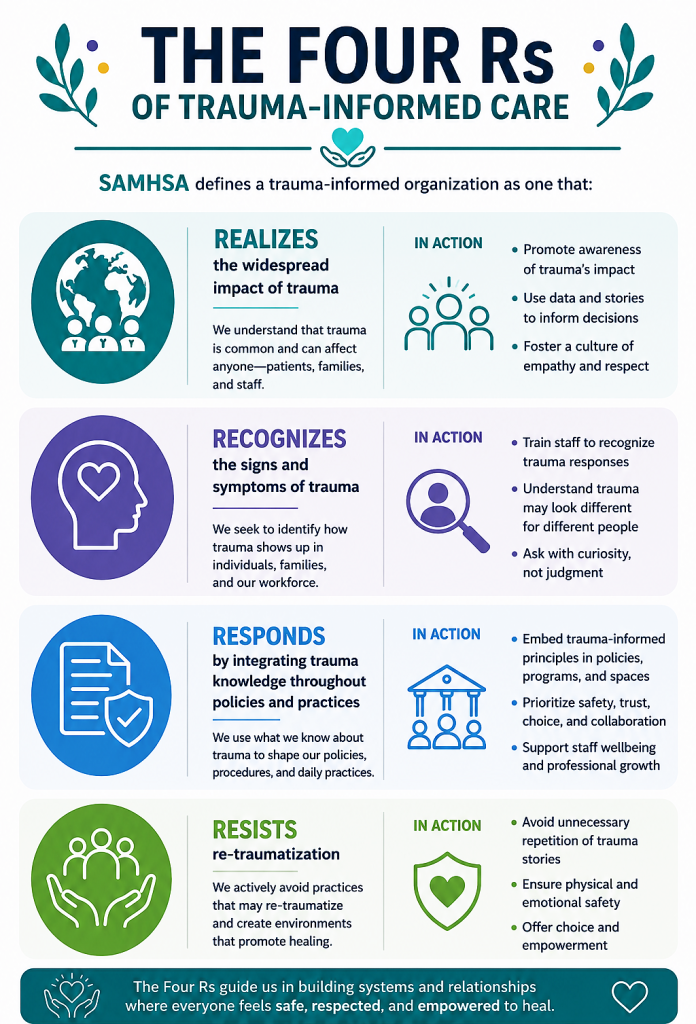
SAMHSA defines a trauma-informed organization as one that:
- realizes the widespread impact of trauma
- recognizes the signs and symptoms of trauma
- responds by integrating trauma knowledge throughout policies and practices
- actively works to prevent re-traumatization
These are often called the Four Rs of trauma-informed care.
The approach extends well beyond behavioral health. Modern trauma-informed care is now being implemented across emergency departments, primary care, hospitals, maternal health, pediatrics, public health agencies, schools, correctional settings, and community organizations.
The Six Principles of Trauma-Informed Care
Although implementation differs by setting, six principles consistently guide trauma-informed organizations:
1. Safety
Patients and staff should feel physically and psychologically safe.
2. Trustworthiness and Transparency
Organizations communicate clearly and consistently to build trust.
3. Peer Support
Individuals with lived experience help promote hope, engagement, and recovery.
4. Collaboration and Mutuality
Power differences between providers and patients are intentionally reduced whenever possible.
5. Empowerment, Voice, and Choice
Patients participate actively in decisions affecting their care.
6. Cultural, Historical, and Gender Responsiveness
Modern trauma-informed care recognizes that trauma is shaped not only by personal experiences but also by culture, historical injustice, discrimination, and structural inequities.
Trauma-Informed Care Is an Organizational Change Strategy
One of the biggest developments over the past several years is the recognition that trauma-informed care cannot succeed through staff education alone. Recent systematic reviews consistently conclude that successful implementation requires organizational transformation, including:
- visible leadership commitment
- ongoing workforce training
- supportive organizational policies
- collaboration across agencies
- continuous quality improvement
- patient and family engagement
- routine measurement of implementation progress
- adequate staffing and financial resources
Organizations that simply provide a one-time trauma training rarely sustain meaningful change. Successful systems embed trauma-informed principles into hiring, supervision, policy development, physical environments, and quality improvement efforts.
Why Seclusion and Restraint Continue to Matter
Trauma-informed care has become closely linked with efforts to reduce seclusion and restraint. Research consistently shows these interventions can:
- re-traumatize patients
- increase psychological distress
- increase injuries to patients and staff
- damage trust
- prolong recovery
Many organizations have successfully reduced (or nearly eliminated) the use of coercive interventions by adopting trauma-informed practices that emphasize de-escalation, patient engagement, staff training, and organizational learning after critical incidents.
Trauma-Informed Care Also Protects Healthcare Workers
Modern trauma-informed care is no longer viewed as benefiting only patients. Healthcare professionals themselves often experience:
- secondary traumatic stress
- compassion fatigue
- workplace violence
- burnout
Organizations that support staff wellbeing, psychological safety, reflective supervision, and peer support may improve workforce resilience while also improving patient care.
What Does the Latest Research Say?
Three major reviews published over the past two years paint a remarkably consistent picture. Researchers found that trauma-informed care is associated with improvements in:
- patient experience
- staff knowledge and confidence
- collaboration
- organizational culture
- reductions in coercive practices
However, they also identified ongoing challenges. Implementation remains inconsistent because organizations define trauma-informed care differently, use different outcome measures, and vary widely in leadership support and available resources. Experts continue to call for more standardized evaluation and implementation frameworks.
So, how do you create a Trauma-Informed Organization?
1. Establish a Dedicated Trauma-Informed Care Leadership Team
One of the clearest lessons from the implementation literature is that trauma-informed care cannot be delegated to a single champion or folded into someone’s existing responsibilities. Successful organizations establish a formal implementation team that includes executive leadership, frontline staff, quality improvement personnel, and individuals with lived experience of trauma. This group meets regularly, sets implementation priorities, monitors progress, and ensures that trauma-informed care remains a strategic organizational priority rather than a temporary initiative. Organizations that involved staff at every level—and particularly consumers—were far more likely to sustain change over time.
2. Integrate Trauma-Informed Care Into Organizational Policies and Strategic Planning
Organizations that successfully implemented trauma-informed care did far more than educate staff—they rewrote the rules that governed daily practice. Trauma-informed principles were embedded into strategic plans, clinical protocols, employee orientation, hiring practices, crisis response procedures, and quality improvement initiatives. Rather than existing as a standalone program, trauma-informed care became part of how the organization defined quality care. This systems-level integration helped maintain momentum even when leadership or staff changed.
3. Replace One-Time Training With Continuous Workforce Development
The evidence consistently shows that a single training session rarely produces lasting organizational change. High-performing organizations treat trauma-informed care as an ongoing professional development process that begins during employee orientation and continues throughout employment. Successful strategies include annual competency training, case consultations, booster sessions, expert coaching, mentoring, and train-the-trainer programs. Interactive learning methods, including role-playing, videos, and practical case discussions, appear to build greater staff confidence than lecture-based education alone.
4. Build a Data-Informed Quality Improvement System
Organizations that sustained trauma-informed care treated implementation as an ongoing quality improvement effort rather than a one-time project. They routinely collected data on patient outcomes, staff wellbeing, trauma screening rates, restraint use, patient satisfaction, and implementation fidelity. These metrics were reviewed regularly by leadership and used to identify barriers, celebrate successes, and guide course corrections. Continuous monitoring enabled organizations to demonstrate progress while identifying areas needing additional support or training.
5. Conduct Structured Debriefings After Critical Incidents
Rather than viewing restraints, seclusions, aggressive incidents, or staff injuries as isolated events, trauma-informed organizations use them as opportunities for organizational learning. Following critical incidents, multidisciplinary teams conduct structured debriefings to understand what occurred, identify potential trauma triggers, evaluate whether different approaches might have prevented escalation, and develop specific system improvements. Regular debriefing emerged repeatedly in the implementation literature as one of the strongest predictors of successful organizational change, as it transforms adverse events into opportunities for continuous improvement.
6. Design Clinical Environments That Promote Psychological Safety
Trauma-informed care extends beyond provider behavior to include the physical spaces where care is delivered. Several successful implementations redesigned waiting rooms, interview spaces, and inpatient environments to reduce noise, improve privacy, enhance comfort, and increase patients’ sense of control and safety. Environmental modifications may seem minor, but they communicate respect, reduce stress, and can help prevent unnecessary escalation among individuals with trauma histories.
7. Standardize Trauma Screening and Referral Pathways
Successful organizations did not rely on clinicians to recognize trauma solely on the basis of intuition or experience. Instead, they implemented standardized screening tools into routine clinical workflows and paired them with clear referral pathways and clinical protocols. Visual reminders, structured documentation, and ongoing coaching helped ensure that trauma screening became a routine part of care rather than an optional activity. Standardization reduced variation across providers and improved consistency in identifying individuals who could benefit from additional support.
8. Invest in Staff Wellbeing Alongside Patient Care
The literature increasingly recognizes that organizations cannot become trauma-informed if they ignore the wellbeing of their own workforce. Providers who routinely care for individuals with significant trauma histories may experience burnout, compassion fatigue, or secondary traumatic stress. Successful organizations intentionally supported staff through reflective supervision, peer support, recognition programs, flexible work environments, and dedicated self-care initiatives. By protecting staff resilience, organizations strengthened their capacity to deliver compassionate, consistent, trauma-informed care.
9. Engage People With Lived Experience as Partners
One of the strongest implementation strategies identified across studies was the meaningful involvement of individuals with lived experience of trauma. Rather than simply seeking patient feedback after programs were implemented, successful organizations invited trauma survivors to help design services, participate on advisory committees, co-facilitate staff training, and shape organizational policies. This collaborative approach ensured that implementation efforts reflected the needs and perspectives of those the organization intended to serve while reinforcing the core trauma-informed principles of empowerment and shared decision-making.
10. Develop Community Partnerships to Extend Trauma-Informed Care
Trauma rarely exists within the boundaries of a single healthcare organization, and neither should trauma-informed care. High-performing organizations developed formal partnerships with behavioral health providers, primary care clinics, schools, domestic violence agencies, child welfare organizations, and other community partners to create coordinated systems of care. Shared training opportunities, interagency committees, standardized referral pathways, and collaborative case management helped ensure that individuals encountered trauma-informed practices across multiple service points rather than only within a single organization.
The Future of Trauma-Informed Care
The next phase of trauma-informed care is moving beyond awareness. Healthcare organizations are increasingly asking:
- How do we measure whether we are truly trauma-informed?
- How do we sustain change over years rather than months?
- How do we improve staff wellbeing alongside patient care?
- How do we address structural trauma and health inequities?
Recent evidence suggests the most successful organizations treat trauma-informed care not as a single initiative, but as an ongoing quality improvement process supported by leadership, data, and continuous learning.
Key Takeaways
Trauma-informed care has evolved from a clinical philosophy into a systems-level strategy for improving healthcare delivery. While the principles of safety, trust, collaboration, and empowerment remain unchanged, today’s evidence emphasizes that meaningful implementation requires organizational commitment, not just individual clinician training.
For public health agencies, hospitals, behavioral health organizations, and community providers, becoming trauma-informed is increasingly recognized as an investment in better patient experiences, healthier workplaces, and more equitable care.