

Why Completeness in EHRs Isn’t Just About Data Presence
Imagine a community health clinic bustling with activity. Patient records are logged into electronic health systems, yet the clinic director faces a persistent question: Are these electronic health records (EHRs) truly complete and reliable for research and decision-making? This uncertainty is more common than you might think, echoing through health systems globally.
The Public Health Challenge
As health systems increasingly rely on EHRs for research and the development of artificial intelligence, assessing data quality becomes crucial. However, understanding how to measure this quality in fast-paced real-world settings remains elusive. These gaps are felt most acutely in healthcare systems serving under-resourced communities, where data completeness can directly impact care quality.
The Study’s Inquiry
Amid these challenges, a recent study sought to address a key aspect of data quality: EHR completeness in medical research. Conducted in South Korea, the study explored how to meaningfully assess EHR completeness, looking beyond mere data presence to consider structural and contextual factors.
What the Researchers Did
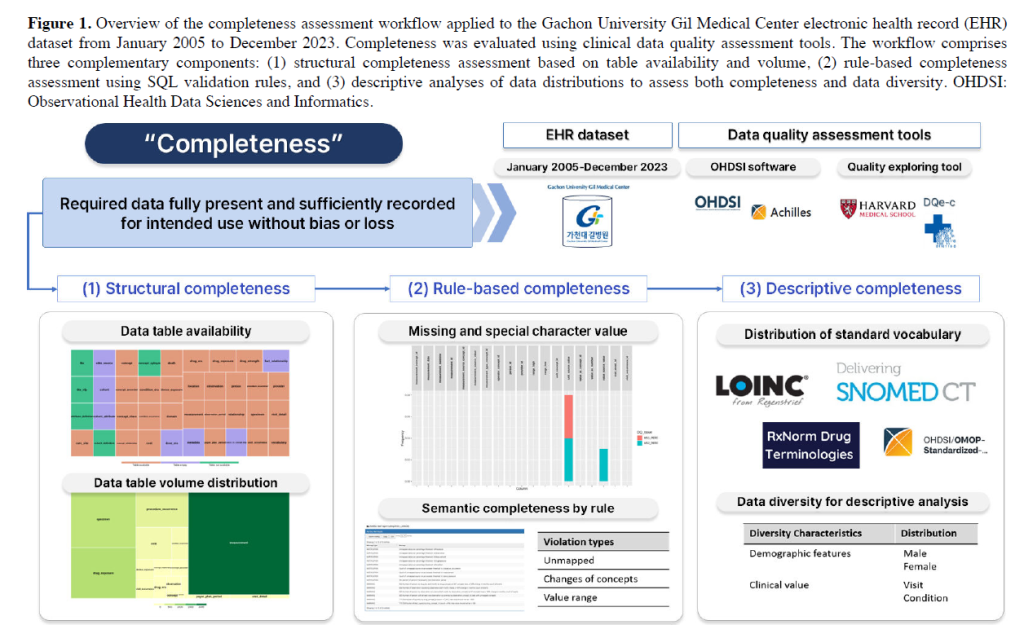
Researchers analyzed a massive EHR dataset from Gachon University Gil Medical Center, comprising over 1.7 million patient records spanning nearly two decades. The study employed a three-pronged approach:
- Structural completeness assessed the availability and characteristics of data tables.
- Rule-based assessment used SQL rules to detect missing, invalid, or incomplete data.
- Descriptive analyses explored the diversity and distribution of data elements.
This holistic assessment aimed to quantify and interpret the overall data quality for medical research purposes.
Key Findings
The results highlighted several critical insights. Interestingly, while large volumes of data were present, key data tables related to clinician notes were absent. This missingness limits the dataset’s utility for studies relying on natural language processing. The rule-based assessments identified significant gaps in data recording, such as 23.8% missing entries in observation tables.
Why It Matters
For public health leaders and researchers, these findings underscore a pivotal point: data quality assessments must encompass both availability and context. Especially in systems serving marginalized communities, incomplete EHRs can skew health insights, exacerbate disparities, and lead to ineffective policies.
What This Means in Practice
- Local health departments should assess not only data volume but also context to ensure robust datasets.
- Health systems must advocate for the collection of complete, standardized clinician notes.
- Policymakers must understand the contextual barriers that affect data completeness, from inadequate infrastructure to a lack of standardization.
The Hard Part: Turning Evidence Into Action
While the study provides a framework for assessing EHR completeness, practical challenges remain. Funding constraints, infrastructure limitations, and the sheer complexity of integrating standardized clinical notes into EHR systems present significant barriers. Moreover, the research highlights a need for interdisciplinary expertise to interpret rule-based assessments meaningfully.
Additionally, understanding these gaps offers a pathway toward improving the comprehensiveness and utility of health data, especially in diverse patient populations.
Conclusion
The opening scene in the bustling clinic returns to mind, emphasizing the critical need for actionable insights into data completeness. As public health systems evolve, understanding and addressing EHR completeness will be key to equitable health research and effective policy development. It’s not just about data; it’s about making that data work for our communities and us.
Discussion Questions
- How would this finding change the way your agency designs data collection protocols?
- Who might still be missed if these completeness assessments were prioritized?
- What would need to change in funding or policy to improve data completeness in your system?