A New Framework for Transforming AI and Implementation Science
Picture this: A public health team is drowning in data, trying to determine the most effective way to implement a life-saving intervention in a resource-constrained setting. As the information piles up, decisions become muddled, and time is running short. Enter Artificial Intelligence (AI), offering a potential lifeline to sift through the deluge of data efficiently.
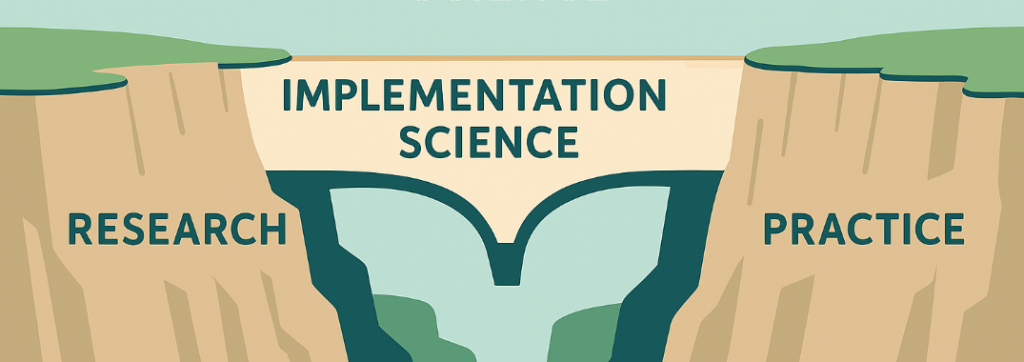
In the rapidly evolving landscape of public health, the need to bridge the gap between research and real-world application is more urgent than ever.
Amidst this complexity, the AI Methods for Implementation Science (AIM-IS) project shows promise, offering a structured approach to integrating AI into implementation science practices.
The Problem: A Persistent Know–Do Gap
Health systems globally continue to face the challenge of the ‘know–do’ gap—a situation in which effective interventions are adopted slowly and inconsistently, preventing their timely application in critical situations. These challenges encompass implementation burdens, inequities, and systemic inefficiencies.
According to Fontaine et al., much of this stems from the burden on implementation teams to process vast amounts of diverse data, ranging from research evidence to local needs, a task where AI’s capabilities might shine.
AI to the Rescue: Evidence and Insights
AI in implementation science isn’t about replacing human judgment; rather, it’s about enhancing the capacity to process and act on information effectively. The AIM-IS program is pioneering this by developing an innovative framework, toolkit, and reporting standard that support responsible AI integration into public health protocols.
This comprehensive initiative is not just about theoretical development—it’s a systematic, multi-phased effort involving:
- Phase 1: Mapping AI use cases, identifying evaluation methods, and revealing risks.
- Phase 2: Engaging with stakeholders to refine the AI use cases and constraints.
- Phase 3: Integrating findings into a draft framework and toolkit.
- Phase 4: Employing a consensus-building eDelphi process to finalize products.
- Phase 5: Usability testing to ensure practical application in real-world settings.
Key Insights from the Research
A major takeaway from the AIM-IS initiative is recognizing the AI-for-implementation use case, rather than the AI model alone, as the principal unit of analysis. This approach stresses the importance of task-specific AI integration.
By focusing on how AI supports specific tasks within defined workflows, the AIM-IS aims to provide clarity, improve governance, and ensure equity in AI applications, thereby promoting transparency and accountability.
What This Means in Practice
- For Local Health Departments: Leverage AI to streamline data analysis and optimize intervention strategies, especially in under-resourced settings.
- For NGOs and Community Programs: Use the AIM-IS toolkit to enhance monitoring and evaluation processes and ensure interventions reach those most in need.
- For Researchers: Apply the reporting standards to enhance study comparability and contribute to a cumulative evidence base in AI-driven implementation science.
What’s Next & Potential Barriers
The journey to integrating AI fully into implementation practices is fraught with challenges, including:
- Policy Adoption: Ensuring policymakers are on board and understand the value proposition.
- Financial and Structural Constraints: Securing funding and resources necessary to leverage AI technologies at scale.
- Community Trust: Overcoming fears and building trust within communities regarding AI applications.
Call to Action: Building Reflective Dialogue
As we move forward, consider these questions:
- How might your agency adapt the AIM-IS framework to local challenges?
- What resource constraints might hinder the full implementation of AI tools in your practice?
- Does this challenge your assumptions about the role AI can play in public health interventions?
AI holds the potential to transform implementation science; the key lies in coupling technological advances with practical, user-centered applications that maintain and build trust in our communities.
Editorial Aside: I mean, using AI for implementation science is pretty much EXACTLY what we are doing here.