Drones and AEDs: Aerial Response for OHCA Gains Traction
In the quiet towns of rural Sweden, when a sudden cardiac arrest occurs, the race against time begins. As the minutes tick by, reaching far-flung homes with emergency medical services can be challenging. Enter drone-delivered automated external defibrillators (AEDs), a cutting-edge innovation that promises to bridge gaps in time-critical emergencies, especially in underserved and geographically isolated areas.
Drone: not just for war or Amazon. For public health, too.
OHCA: The Public Health Challenge
Out-of-hospital cardiac arrest (OHCA) is a severe and urgent public health issue globally. With survival rates of less than 10%, the provision of immediate CPR and defibrillation can spell the difference between life and death. Traditional methods, such as public-access defibrillation programs, often fall short in rural or private settings due to static deployment limitations. Moreover, statistics indicate that OHCAs occur more frequently in private residences, places inherently beyond the reach of these conventional strategies.
Socioeconomic disparities compound these issues, with underinvested communities experiencing poorer survival rates and reduced access to essential emergency tools. Drone technology, with its promise of faster delivery of AEDs, offers a potential lifeline in narrowing these inequities in emergency care.
From The Lab To The Field
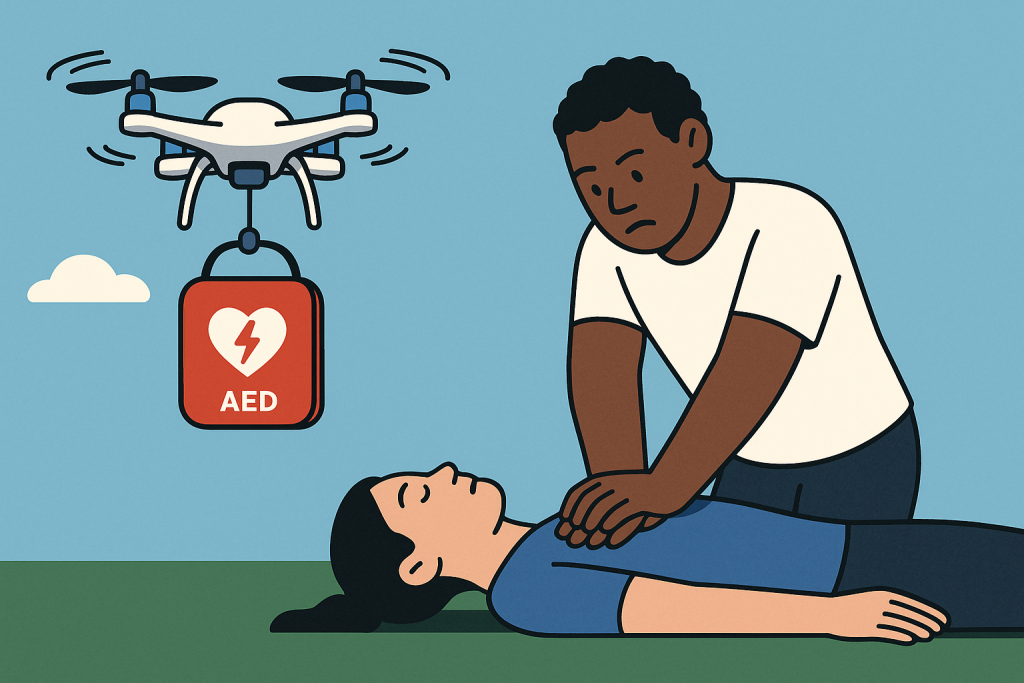
A recent study by a team across several institutions in China examines the deployment of drones equipped with AEDs. The study synthesizes evidence across various domains—real-world applications, simulations, and economic viability evaluations. While drone delivery significantly reduced the time to AED arrival—up to three minutes quicker than traditional ambulance services—the ‘therapeutic drop-off’ remains a pressing challenge. This term describes the critical period between an AED’s arrival and its actual use, where human factors, unfamiliar device handling, and operational conditions contribute to delays.
Implementation Challenges
Despite promising gains in speed, converting this into life-saving interventions requires overcoming several obstacles.
Aviation and Operational Barriers. Drones face operational constraints due to payload capacity, endurance, and weather conditions. Heavier AEDs limit flight range, while adverse weather can foil even the best-planned missions.
Regulatory and Human-Machine Interaction. Success depends on navigating complex airspace regulations, especially beyond-visual-line-of-sight operations, and addressing human-machine interface challenges. Single-bystander scenarios can increase cognitive load, interrupting CPR as efforts shift to retrieving and deploying the drone-delivered AED.
Why This Matters: The Equity Imperative
Integrating AI and drones into emergency medical response frameworks has implications that stretch far beyond technological feats. These systems could disproportionately benefit communities often left underserved by traditional emergency services. However, without targeted efforts to build a workforce of first responders and ensure access across all geographies, including rural and low-income areas, the risk of exacerbating existing inequalities remains.
What This Means in Practice
- Enhance Emergency Infrastructure: Policymakers and health departments should invest in infrastructure that supports integrating drone technology while maintaining effective ground-based responses.
- Community Training Programs: Expand CPR and AED training, including specific modules on interacting with drone technology, to create a community ecosystem ready to act.
- Equity-Oriented Implementation: Analyze and address geographic, socioeconomic, and digital divides to ensure equitable access to drone technologies in emergencies.
The Hard Part: Turning Evidence Into Action
The journey from faster AED delivery to saved lives is strewn with challenges. Regulatory approval varies by region, and without adequate telecommunications, AI-supported dispatch may face resistance. Moreover, robust community engagement is needed to ensure the system’s usability.
Real-world application requires coordinated efforts—investment in real-time data systems, improved public health literacy, and the development of a network of trained community responders.
Conclusion
Drone-delivered AED systems herald a new frontier in emergency care, promising faster and potentially more equitable responses to cardiac emergencies. However, realizing their full potential demands rigorous validation, grounded in real-world trial outcomes, and a commitment to ensuring system integration at all levels of society.