
Social Support and Mental Health: How Relationships Help Us Cope and Thrive
When people are struggling, we often assume the goal is simple: be supportive.
The problem is that support is not one thing. Listening can be supportive. Giving advice can be supportive. Driving someone to an appointment can be supportive. Telling a friend that they are being too hard on themselves can also be supportive. Yet each of those responses can fail spectacularly if it is offered to the wrong person, at the wrong time, or in the wrong way.
That makes social support considerably more interesting than the familiar advice to simply “be there” for someone.
Social support is one of the major pathways through which our relationships influence stress, coping, mental health, physical health, recovery, belonging, identity, and hope. At a basic level, it involves the perception or experience that we are loved, cared for, valued, and part of a network of people.
But understanding social support requires us to look beyond whether someone has friends or family. We need to ask what those relationships actually do, whether the support fits the situation, whether people believe support will be available when needed, and whether the broader environments around them make meaningful connection possible in the first place.
Build Your Public Health Issue
Tell us a little about your work, and we’ll build a personalized issue with five things worth knowing.
The First Rule of Social Support: Listen Before You Fix
Before discussing social support in class, I asked students a straightforward question: When you need support, what do you most want someone else to do?
Their answers converged around a useful theme. People wanted space to talk before receiving advice. They appreciated perspective, but generally after they felt heard. They did not necessarily want someone jumping immediately into problem-solving mode, and several emphasized that knowing someone was “in their corner” could matter as much as actually solving the problem.
The responses also illustrated a central difficulty: support is individual. What helps depends on the person, the situation, the relationship, and what is happening at that particular moment.
This may sound obvious, but many of us routinely get it wrong.
Someone tells us something painful, and we immediately search for a solution. A friend complains about work, so we start telling them what they should say to their boss. Someone goes through a breakup, and we reassure them that they will “find someone better.” A student fails an exam, and we start constructing a study plan.
All of those responses may eventually be useful. The question is whether that is what the person needs right now.
Effective social support depends on fit.
What Is Social Support?
Social support is sometimes treated as if it simply means having people around you, but that is too narrow.
There is a difference between the structure of a social network and the function of that network. Structural support refers to the relationships, roles, and connections around a person. Functional support describes what those connections actually provide.
You can therefore have a huge network and relatively little meaningful support. Someone might have thousands of social-media or professional connections while having very few people they would call during a crisis. Another person may have only a handful of close relationships but experience tremendous emotional safety and dependability within them.
The number of connections and the quality of support are not the same thing. A network tells us who is connected. Social support tells us more about what happens through those connections.
That distinction becomes especially important in public health. Simply placing people in proximity to one another does not guarantee that meaningful relationships, trust, or assistance will follow.
The Four Types of Social Support
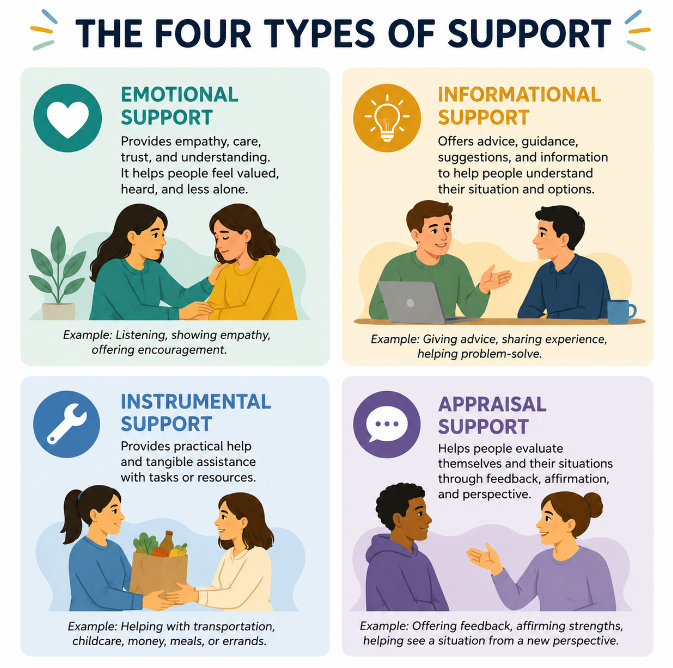
One useful way to understand what relationships provide is to divide social support into four broad categories: emotional, informational, instrumental, and appraisal support. These categories overlap in real life, but they give us a useful vocabulary for recognizing what someone may actually need.
Emotional Support: “You Don’t Have to Handle This Alone”
Emotional support helps someone feel understood, valued, cared for, and less alone. It involves warmth, reassurance, empathy, listening, and creating enough psychological safety for someone to be vulnerable.
Sometimes this is exactly what a person is asking for when they say, “I just need to vent.”
The goal is not necessarily to solve anything. The support comes from communicating that the person’s experience matters and that they do not have to carry it entirely on their own.
This may be why students so consistently emphasized listening before advice. Emotional support often creates the conditions under which other forms of support become useful. If someone does not feel understood, even excellent advice can sound dismissive.
Informational Support: “Here Are Your Options”
Informational support helps someone understand a situation, make sense of what is happening, and determine what to do next.
This might involve advice, guidance, explanations, referrals, sharing relevant experience, or identifying possible options. It can be especially valuable when someone is overwhelmed by an unfamiliar system or when uncertainty itself is contributing to distress.
Imagine receiving a confusing letter from your health insurer or financial-aid office. You may not primarily need someone to reassure you that everything will be okay. You may need a person who understands the system to sit beside you and say, “Here’s what this means, and here’s what we need to do next.”
During periods of extreme distress, informational support can also help narrow an overwhelming situation into manageable steps. When everything feels chaotic, having someone help identify the next concrete action can itself reduce distress.
Instrumental Support: “I’ll Help You Do It”
Instrumental support is tangible help.
It includes things like transportation, childcare, food, money, housing, assistance with paperwork, making a phone call, or physically helping someone complete a task.
If your friend’s car breaks down and you drive them to work, that is social support. If a neighbor watches your children while you attend a medical appointment, that is social support. If a mutual-aid organization delivers groceries to someone who cannot leave their home, that is social support too.
This matters because psychological well-being is often discussed in ways that separate emotional experiences from material circumstances. In real life, the two are constantly interacting.
Sometimes the most supportive thing you can do is listen.
Sometimes it is helping someone move a couch.
Appraisal Support: “Am I Seeing This Clearly?”
Appraisal support helps people evaluate themselves, their circumstances, or the way they are responding to a situation.
It includes encouragement, feedback, reality checking, perspective, affirming strengths, and helping someone judge whether they are coping effectively. It answers questions such as: Am I overreacting? Am I handling this okay? What am I missing? What does this experience say about me?
Imagine a college student saying, “I failed my first exam. Maybe I don’t belong here.”
They may eventually need informational support about better study strategies or instrumental help creating a study schedule. But first, they may need someone to challenge the leap from I failed an exam to I do not belong in college.
That is appraisal support.
A helpful response might recognize the disappointment while also providing perspective. One bad exam contains information about one bad exam. It does not necessarily provide a verdict on someone’s ability, intelligence, or future.
Good Support Changes During the Conversation
The four categories are useful, but human conversations do not stay neatly inside them.
Someone might initially need emotional support: “I just need to get this out.”
Five minutes later, they may shift toward appraisal support: “Am I being unreasonable?”
Then informational support: “What do you think my options are?”
Eventually, they might ask for instrumental support: “Can you help me make a plan?”
Needs can change during the same conversation. Supporting someone well therefore requires attention and flexibility rather than selecting a single support strategy and sticking with it.
This leads to perhaps the most useful question in the entire discussion.
Instead of asking: Am I being supportive?
Ask: Is this the kind of support this person needs right now?
That small shift moves the focus from our intentions to the other person’s needs.
Why Good Intentions Sometimes Produce Bad Support
Almost everyone has experienced a moment when another person was clearly trying to help and somehow made things worse.
That does not necessarily mean the person was uncaring. Often, the problem is a mismatch between the support offered and the support needed.
A person needs emotional support and receives advice. Someone needs practical help and receives reassurance. Someone wants perspective and gets a lecture.
There are at least three common reasons support can misfire.
The first is a matching problem. The support itself might be perfectly reasonable, but it doesn’t fit the need in that moment.
The second is an autonomy problem. Help can unintentionally communicate, “You can’t handle this,” “I know better than you,” or “You need me to rescue you.” Effective support should generally preserve a person’s sense of competence and agency rather than making them feel helpless.
The third is a cultural fit problem. Families and cultures differ in their expectations around asking for help, providing help, privacy, independence, obligation, and reciprocity. In some environments, requesting help is routine. In others, it may feel like burdening someone, losing face, or violating expectations about self-reliance.
The important lesson is that support cannot be separated from context.
The Value of Being a “Critical Friend”

One particularly useful model for thinking about supportive relationships comes from program evaluator David Fetterman’s concept of the critical friend.
A critical friend is on your side without necessarily agreeing with you.
That distinction is important because support does not mean endless affirmation. Sometimes supporting someone requires raising a difficult question, challenging an assumption, or pointing out something they would rather not hear.
The critical friend listens before directing, believes in your capacity to succeed, asks thoughtful questions, offers perspective rather than commands, uses evidence rather than judgment, respects your autonomy, and can sometimes tell you a hard truth with care.
The relationship is what makes that possible.
A stranger probably has not earned the right to walk up after your presentation and explain everything you did poorly. A trusted colleague who has repeatedly demonstrated that they want you to succeed may be able to offer the exact same feedback and have it received very differently.
Good criticism therefore depends partly on what we might call relational credit. Trust accumulated over time makes difficult conversations possible.
This is a useful principle in friendship, supervision, teaching, leadership, peer support, and public health practice.
Sometimes Knowing Support Exists Matters More Than Using It
One of the most fascinating distinctions in social-support research is between received support and perceived support.
Received support is what actually happens: someone drives you to an appointment, talks with you after a breakup, lends you money, helps solve a problem, or gives advice.
Perceived support is the belief that reliable people would be there if you needed them.
Imagine two students.
One has visited a teacher or counselor eight times during the past month. Another has not needed help at all, but is completely confident that several trusted friends or adults would show up immediately if something went wrong.
Who is better supported?
We cannot answer that question simply by counting how often help was received.
The second student’s belief may itself be protective. Stress looks different when you approach it thinking, I can handle this, and if I cannot, I know who will help me.
That perception can reduce the sense of threat, strengthen confidence, and make stressful experiences seem more manageable before any actual help is provided.
Support can therefore matter even while sitting unused in the background.
Two Ways Social Support Can Protect Health
This distinction connects to two classic ways researchers think about the effects of social support: the direct effects model and the stress-buffering model.
The direct effects model suggests that relationships are beneficial even when nothing is particularly wrong. Regular social connection contributes to belonging, identity, meaning, routine, accountability, purpose, positive social roles, and opportunities to help others.
In that sense, social support is a little like nourishment. We do not only need it during emergencies. Healthy relationships contribute to well-being through ordinary, repeated interactions.
The stress-buffering model focuses more specifically on difficult circumstances.
When stress becomes intense, social support can help reduce how threatening the situation feels, provide coping resources, help regulate emotions, encourage help-seeking, and mobilize practical resources. Two people can therefore experience similarly stressful circumstances while experiencing very different levels of psychological distress depending partly on the support available around them.
These models are not really competing explanations. Social support can help in everyday life and becomes especially valuable during periods of high stress.
Relationships Are Not Just for Surviving Bad Things
We notice social support most easily during crises.
Someone dies. A relationship ends. A person becomes ill. A job disappears. An exam goes terribly. A family enters a period of crisis.
But that focus can make us miss half of what supportive relationships do.
Relationships do not only help people endure adversity. They can help people pursue opportunities, take risks, explore new possibilities, and grow. Support can create enough safety for someone to leave their comfort zone because they know failure will not leave them completely alone.
A supportive partner may encourage you to apply for a job you are not sure you can get. A mentor may convince you to submit work you are nervous about sharing. A friend may challenge you to take something seriously because they see potential that you are overlooking.
That moves the goal beyond simply returning someone to baseline after something goes wrong.
Relationships can contribute to thriving.
They can help people become more capable, confident, resilient, and willing to explore what comes next.
For public health, this distinction is crucial. Our goal should not only be helping people become less distressed. We should also be interested in the conditions that allow people to grow.
Social Support Does Not Exist Only Between Two People
Up to this point, most examples involve one person helping another. But community psychology pushes us to zoom out.
The social ecological model asks us to understand people as existing within nested levels of influence. Social support is shaped by individual characteristics, interpersonal relationships, organizations, communities, and the broader society.
At the individual level, people’s experiences, coping skills, beliefs, identities, previous trauma, stigma, and comfort with help-seeking can influence whether they seek or accept support.
At the interpersonal level, family members, partners, friends, coworkers, classmates, mentors, and peers may provide—or fail to provide—different kinds of assistance.
At the organizational level, schools, workplaces, healthcare systems, clubs, and treatment programs can make support easier or harder to access.
At the community level, neighborhoods, libraries, parks, community centers, social organizations, and even digital spaces can create opportunities for connection and belonging—or produce isolation.
Finally, at the societal level, policies and social determinants of health influence what kinds of support people can realistically access. Housing, transportation, healthcare access, poverty, discrimination, cultural norms, internet access, and social safety nets all shape the possibilities available to people.
That wider perspective dramatically changes the questions we ask.
Stop Asking Only, “Why Didn’t They Reach Out?”
Consider someone who appears socially isolated.
An individual-level explanation might ask:
Why don’t they reach out for help?
Legitimate individual factors may be involved. Perhaps they feel uncomfortable asking. Perhaps previous experiences have made them distrustful. Perhaps they fear stigma.
But the ecological perspective asks additional questions.
Is there anyone trustworthy to reach out to?
Can they physically get to the services they need?
Does their workplace allow time away?
Does their community have spaces where people can meet?
Are services affordable?
Does the organization they are dealing with treat them with dignity?
Would asking for help threaten their housing, employment, immigration status, reputation, or sense of safety?
Are culturally appropriate services available?
At some point, a lack of support stops being merely a personal deficit and becomes structural isolation.
The lecture captured this distinction well: if we focus only on the individual, we may ask why someone does not seek help. Looking ecologically allows us to ask what conditions make support safe, trustworthy, available, and useful.
That is a much more powerful question for community mental health.
Social Support Is a Public Health Issue
Public health often focuses on behaviors and outcomes that are easy to see and measure: smoking, vaccination, physical activity, hospitalization, substance use, mortality, or disease prevalence.
Relationships can feel harder to pin down.
Yet social support helps connect the individual to almost every level of public health practice. It affects how people cope with illness, whether they seek help, how they navigate systems, whether they feel they belong, how communities respond to crises, and whether people have the resources necessary to sustain difficult changes.
The practical lesson is not simply that everyone needs more friends.
It is that good social support has quality, fit, availability, and context.
A large network is not necessarily a supportive network. Good intentions do not guarantee helpful support. Support that removes autonomy can undermine the person receiving it. The belief that help is available can matter even before help is needed. Relationships can protect us when life goes badly, but they also help us take chances and grow when life is going well.
And whether those relationships can flourish depends partly on environments far beyond the individual.
That is why social support belongs in a conversation about public health.
The question is not only who supports you.
It is also what they provide, when they provide it, and what conditions make that support possible.
Those questions take us naturally to the next topic in this series: what happens when the connections we need are absent, insufficient, or do not feel meaningful—and why loneliness and social isolation are not actually the same thing