Sense of Community: Why Belonging Matters for Health and Well-Being
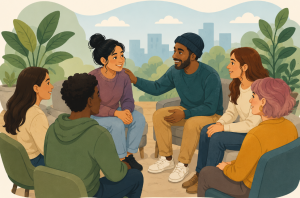
There is a particular feeling that happens when you find yourself somewhere and think, these are my people. It might happen with your neighbors, coworkers, a sports team, a recovery group, a religious congregation, an online community, or a group of friends you have known for decades. The specific setting almost does not matter. What matters is that being there feels different from merely being surrounded by other people.
That difference is what community psychologists have spent decades trying to understand through the idea of sense of community. The concept builds naturally from two questions we have already explored in this series. Social support asks what our relationships provide, while loneliness asks what happens when the connections we want are not being met. Sense of community adds another layer: Do we feel that we belong somewhere?
That turns out to be a surprisingly powerful question for understanding mental health, well-being, identity, collective action, and the environments in which people thrive.
Build Your Public Health Issue
Tell us a little about your work, and we’ll build a personalized issue with five things worth knowing.
Build Your Public Health Issue
Tell us a little about your work, and we’ll build a personalized issue with five things worth knowing.
Community Is More Than Proximity
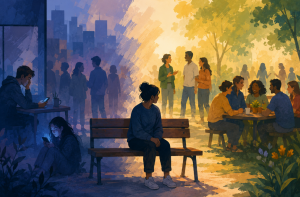
Put 100 people in a room and you have a crowd. You do not necessarily have a community.
The same is true of a neighborhood, workplace, classroom, apartment building, or dormitory. People can occupy the same space without feeling any meaningful connection to one another. Physical proximity helps because repeated exposure creates familiarity, and we are more likely to develop relationships with people we encounter regularly than with strangers we never see again. But proximity by itself is neither necessary nor sufficient for community.
That distinction is especially important now that many communities are not geographic at all. Professional groups, religious communities, fandoms, recovery groups, gaming communities, cultural communities, and online support networks can all create meaningful belonging among people who may rarely or never occupy the same physical space.
Community, then, is partly about a setting or network, while sense of community is the psychological experience of being part of it.
What Is a Psychological Sense of Community?
Community psychologist Seymour Sarason described a psychological sense of community as the experience of belonging to a mutually supportive network of relationships. Later, David McMillan and David Chavis developed one of the field’s most influential frameworks for explaining what creates that experience.
Their model can be reduced to a few deceptively simple ideas: I belong here. I matter here. Being part of this group gives me something I value. We have something together.
Underneath those ideas are four components: membership, influence, integration and fulfillment of needs, and shared emotional connection. Together, these ingredients help explain why one workplace can feel like a community while another feels like a place you endure until quitting time.
Membership: “I Have a Place Here”
The first component is membership. Membership involves belonging, identification, emotional safety, personal investment, and boundaries. Eventually, it produces the feeling that I have a place here.
Some communities have very obvious boundaries. A sports team has a roster. A classroom has enrolled students. A neighborhood may have geographic boundaries. A workplace has employees.
Other communities have boundaries that are much harder to see. You might become one of the regulars at a coffee shop. A friend group develops its own jokes. A professional community develops jargon that immediately signals whether someone understands the field. A fandom has traditions, references, symbols, and unwritten expectations.
Often, you discover a community’s boundaries by learning its norms. Who understands the references? Who knows the traditions? Who knows what is acceptable? Who gets the joke? Those small markers communicate something much larger: you are one of us.
Being a Member Is Not the Same as Belonging
Formal membership does not guarantee psychological membership. You can be on the roster without feeling accepted, work for the company without feeling valued, or sit in the classroom without feeling known. A person can technically be included while still experiencing themselves as an outsider.
This distinction matters because many efforts to increase belonging focus primarily on access. Access is important, but admitting someone into a setting is not the same as creating the conditions under which that person feels their presence is legitimate and valued. There is a meaningful psychological difference between I am allowed to be here and I belong here.
That difference also leads directly to the second element of sense of community: whether a person’s presence actually matters.
Influence: “What I Do Here Matters”
A strong community influences its members, but that relationship cannot run in only one direction. Members also need some ability to influence the community itself.
That reciprocity is central to the idea of influence. The group affects your behavior, identity, expectations, and choices, but your participation should also leave some imprint on the group.
Imagine two workplaces. At the first, leaders routinely say, “We value your feedback.” Employees fill out surveys, attend listening sessions, and submit suggestions, but decisions have already been made and nothing changes. At the second, colleagues sometimes disagree with you and your ideas do not always win, but occasionally something changes because you spoke up.
The second workplace is more likely to produce a genuine sense of community. Being heard does not require always getting your way. It requires knowing that your participation is real rather than decorative.
A useful way to diagnose influence is to ask two questions: If you disappeared, would anyone notice? If you spoke up, could anything change? Those questions get surprisingly close to the difference between occupying a space and actually mattering within it.
Fulfillment of Needs: “Being Here Gives Me Something”
Why join a community in the first place? Usually because participation gives us access to something we value.
That could be friendship, enjoyment, safety, information, practical help, encouragement, identity, professional opportunities, companionship, or something else entirely. This connects directly to the social support concepts discussed earlier in this series.
A healthy community may provide emotional support by surrounding people with others who understand them. It may provide informational support by sharing knowledge and experience. It may provide instrumental support when members help one another with tangible needs, and appraisal support when other members offer feedback, encouragement, or perspective.
Communities tend to survive when participation is rewarding, but that does not mean every member must get the same thing from the group. A neighborhood association may give one person friendship, another information, and another a sense of security. A recovery group may provide hope to one member, practical guidance to another, and the relief of being understood to someone else.
The important question is whether membership provides something that makes participation worth sustaining.
Shared Emotional Connection: “We Have Been Through Something Together”
The fourth element is perhaps the hardest to quantify and the easiest to recognize when you experience it. Communities develop a shared emotional connection through repeated interactions, successes, failures, difficult experiences, celebrations, traditions, rituals, stories, and memories.
Sometimes the shared event is enormous. Sometimes it is almost comically trivial. Coworkers may become close because they survived an awful shift together. Neighbors remember the storm when everyone lost power. A sports team remembers a championship. A recovery group remembers people reaching milestones. A family tells the same story every Thanksgiving.
Over time, these experiences become part of the group’s history. Rituals help preserve that history. Graduations, team chants, annual festivals, birthday traditions, holiday meals, tailgates, orientations, and 12-step meeting practices may look unnecessary from the outside. From inside the community, they communicate identity: this is what we do because this is who we are.
Ritual turns memory into something people can reenact together, which is one reason communities can outlast the individuals who originally created them.
The Four Parts Reinforce One Another
Membership, influence, fulfillment of needs, and shared emotional connection are not four independent boxes. They tend to reinforce one another.
If I feel that I belong, I am more likely to participate. If my participation matters, I invest more in the community. If the community meets important needs, I have more reason to remain involved. Repeated participation creates shared experiences, and those experiences deepen my feeling of membership.
The reverse can happen as well. If people feel peripheral, believe their voice does not matter, receive little of value from participation, and have no meaningful shared experiences, simply calling them “members” will accomplish very little.
This is why a strong sense of community cannot be manufactured through slogans alone. It develops through ongoing relationships between people and the systems around them.
Sense of Community Is Not Just Having Friends
Friendship matters enormously, but sense of community operates at a different level. Friendship is fundamentally relational: me and another person. Sense of community is more systemic: me as part of us.
That “us” changes how we understand ourselves. We stop thinking exclusively in terms of what I can do and begin thinking, at least sometimes, in terms of what we can do.
That is one reason community membership can become a psychological resource. Research reviewed in the lecture generally finds positive relationships between sense of community and different forms of well-being across age groups, settings, and countries. The findings are not perfectly uniform, but the larger pattern suggests that a meaningful sense of community can contribute positively to psychological, social, physical, and spiritual well-being.
Importantly, community does not matter simply because it is the opposite of loneliness. A strong community can actively add positive resources to people’s lives.
The “Social Cure”: When Groups Become Psychological Resources
One idea in social psychology, sometimes referred to as the social cure, proposes that meaningful group identities can become resources people draw upon. Group membership can provide identity, belonging, social support, coping resources, and a sense of collective efficacy.
That last concept is particularly interesting. Self-efficacy asks whether I can do something, while collective efficacy asks whether we can do it.
That difference forms part of the psychological foundation for collective action. One person may have very limited ability to influence a powerful organization or institution, while a group of people acting together can have considerably more influence. Community changes the perceived scale of what is possible because people no longer understand themselves solely as isolated individuals.
That matters for mental health, but it also matters organizationally, socially, and politically. Community can provide both support and power.
Community Identity May Protect Against Loneliness
Sense of community also connects directly to the loneliness problem discussed earlier in this series. Simply identifying with a meaningful group may reduce loneliness even apart from the specific social support someone receives. In other cases, identification brings people into settings where social support becomes available.
Sports fandom offers a simple example. Someone may identify strongly as a fan without personally knowing most other fans, but that identity can still create a feeling of belonging to something larger. Identification can then produce interaction: you go to a bar where other fans gather, someone scores, and suddenly everyone is cheering, high-fiving, yelling, and celebrating together.
Now identity has generated contact, emotion, ritual, and shared experience.
The lecture discussed research suggesting pathways from community identification through social support and reduced loneliness toward better well-being.
This gives public health a more precise language for what it might mean to “strengthen community.” The goal is not simply to put more people in the same place. We want to create conditions for membership, influence, fulfillment, and shared emotional connection.
Places Can Make Community Easier—or Harder
Community is psychological, but it is not detached from the physical and social environments around us. Transportation matters. Safety matters. Public spaces matter. Repeated opportunities for interaction matter.
A park, library, café, campus, recreation center, or neighborhood gathering space does not automatically create community, but it can create opportunities for the repeated encounters from which relationships grow. The same space can also produce completely different experiences for different people.
Walking into a busy school cafeteria when you know everyone may feel energizing. Walking into the same cafeteria as the new student who knows nobody can feel brutally lonely. The physical room has not changed, but the relational meaning of the room has.
The lecture emphasized that places become socially meaningful when they contain recurring activities, routines, familiar people, and opportunities for low-stakes interaction. A stranger becomes a familiar face. A familiar face becomes someone you recognize. Recognition becomes conversation, and conversation may eventually become relationship.
This is one reason public spaces matter for community health: they create opportunities for relationships to emerge without forcing them.
Familiarity Is an Underrated Ingredient of Community
Not every community connection has to start with deep disclosure. Sometimes it starts with seeing the same person every Tuesday.
Maybe you recognize the person working behind the counter. Maybe you pass the same neighbor walking a dog. Maybe the same few people arrive early to a weekly meeting. Those encounters barely qualify as relationships at first, but they create familiarity.
Familiarity reduces uncertainty. Recognition makes interaction easier, and repeated interaction can gradually create trust.
This suggests that some of the most important community infrastructure may look surprisingly mundane: a walkable street, a neighborhood café, a playground, a library, a recreation league, or a recurring public event. None of those automatically produce belonging, but they provide repeated opportunities for connection to become familiar enough for relationships to form.
Strong Communities Can Also Become Exclusive
So far, this all sounds extremely positive. There is a catch.
Every community creates boundaries. If there is an us, there is implicitly some version of not us.
Boundaries help create identity and belonging, but they can also create gatekeeping, conformity, exclusion, prejudice, and ostracism. This is where the humorous No True Scotsman fallacy becomes psychologically interesting.
Someone says, “No true fan would believe that.” Or, “No real member of this profession would use that method.” Another person says, “No true supporter of this cause would disagree.”
These statements protect the imagined purity of the group by redefining anyone who violates its expectations as an outsider. The same boundaries that tell members you belong here can therefore tell someone else you never belonged at all.
That tension deserves more attention than it often receives.
Belonging Can Have a Cost
A community can score highly on traditional measures of sense of community and still be deeply problematic. Members may feel enormous solidarity, support one another, share traditions and history, and have real influence while simultaneously excluding outsiders or punishing internal disagreement.
That means community psychology cannot evaluate community only by asking whether people feel connected. We also need to ask about power, voice, diversity, and inclusion.
Who gets heard? Who sets the norms? Who benefits from membership? Who has to change themselves to remain part of the group? Who is being kept out? What happens when someone disagrees?
A strong sense of community is not automatically a just community.
That distinction becomes especially important whenever organizations say they want to build “culture” or “belonging.” The goal should not be producing conformity under a friendlier name.
The Community-Diversity Dilemma
This creates one of the hardest problems in community life: How do we create a strong “we” without requiring everyone to become the same?
Community depends partly on shared identities, norms, experiences, and values, while diversity depends partly on allowing meaningful differences in identities, histories, perspectives, and beliefs. Those goals can sometimes pull against one another.
The lecture described this as a community-diversity dialectic, meaning the tension between creating cohesion and preserving difference.
There is no simple formula for resolving that tension. Too little shared identity and the community may feel meaningless. Too much pressure toward sameness and belonging becomes conditional on conformity.
Healthy communities therefore have to develop enough common ground to sustain connection while retaining enough flexibility to tolerate disagreement and difference. That is difficult work, but it may be one of the central tasks of community building.
We Belong to More Than One Community
Another reason belonging is complicated is that nobody belongs to just one group.
We have territorial communities, organized around place: neighborhoods, apartment buildings, towns, campuses. We also have relational communities, organized around shared identities or interests: professions, religions, cultures, recovery communities, hobbies, fandoms, social movements, and online groups.
These communities can overlap, nest inside one another, complement each other, or conflict. Someone may feel expectations from their family that differ sharply from expectations in their profession. A cultural community may emphasize one identity while a workplace rewards another. A person’s community of origin may remain important even as they establish belonging somewhere new.
Migration makes this particularly visible. People may maintain strong relationships and identities connected to a community of origin while simultaneously developing membership in a receiving community. Cultural organizations and informal networks can sometimes bridge the two.
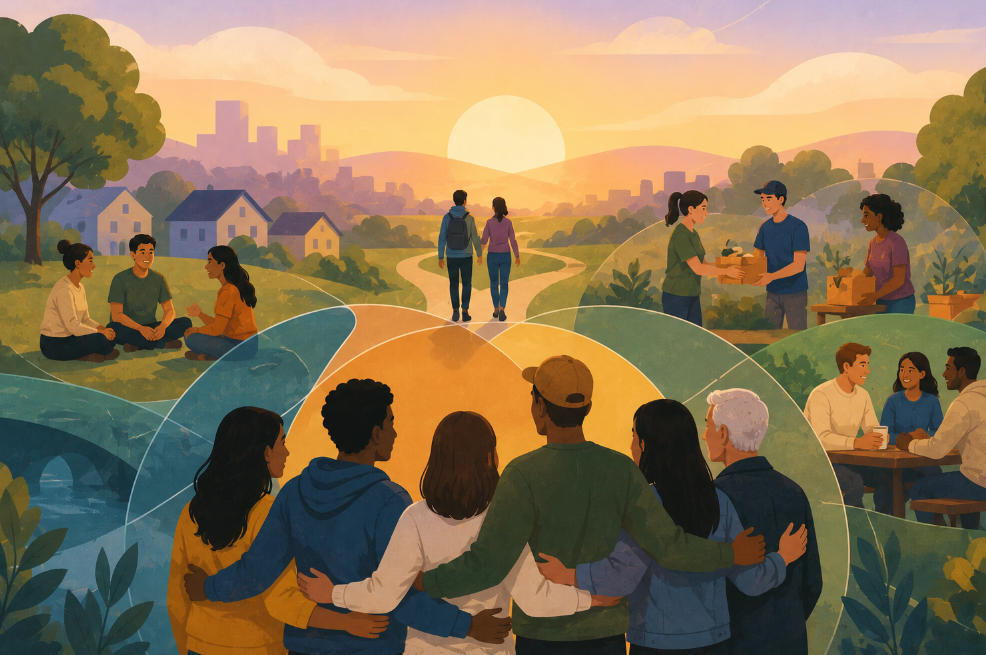
Belonging, then, is less like one circle around a person and more like a complicated set of overlapping circles.
Multiple Communities Can Be Protective
That complexity can actually be useful. If someone’s entire sense of identity and support is concentrated in a single community, losing access to that community can be devastating.
A job ends. A relationship dissolves. A team breaks up. Someone leaves school. A religious identity changes. A person moves.
If the person has other meaningful communities in their life, those memberships may provide continuity, alternative sources of support, and additional identities. One community does not have to meet every need.
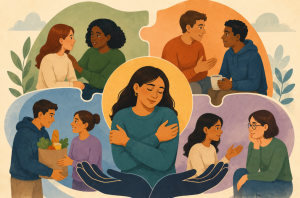
A family may provide emotional security. A professional community may provide identity and intellectual stimulation. A neighborhood may provide practical support. A recreational group may provide fun. A recovery community may provide understanding that none of the other groups can offer.
The healthiest social ecosystem may not require one perfect community. It may involve several imperfect but meaningful ones.
Communities Can Also Become Engines of Collective Action
One of the most important insights that emerged during the class discussion was that sense of community does not stop at feeling good. People who share an identity and shared needs can pool resources, and that can become collective action.
Members may advocate for better services, create organizations, build mutual aid, protect one another, challenge institutions, or build spaces where previously marginalized people can participate safely. Historically, many communities have developed precisely because existing institutions failed to provide safety, recognition, or voice.
These communities can provide immediate support while also creating the collective power necessary to change the conditions that made the support necessary in the first place.
The lecture discussion pushed this point further by emphasizing that communities evolve across the lifespan and across historical periods. Divisions within groups can weaken a community, strengthen it, or generate new forms of collective action. People can leave communities that no longer meet their needs and create new ones around shared concerns.
That makes community more than a psychological resource. It can also become a vehicle for social change.
What Does It Mean to Build Community?
If we want stronger communities, the answer is not simply “bring people together.” We need to ask more specific questions about the quality of the experience people are actually having.
Do people know whether they belong? Do they feel accepted rather than merely admitted? Does their voice have some influence? Does participation provide something valuable? Are there repeated opportunities for shared experiences? Are traditions and rituals helping reinforce a collective identity?
We also have to ask harder questions. Can people disagree without losing membership? Are some people systematically excluded? Does the community make room for multiple identities? Are physical and digital environments creating realistic opportunities for interaction and familiarity?
Those questions turn “build community” from a vague aspiration into something we can actually investigate.
Community Is Something People Experience
A neighborhood is not automatically a community. Neither is a workplace, classroom, church, club, online forum, fan base, recovery meeting, or professional organization.
Those places and groups become communities when people experience themselves as part of something larger: when they belong, when they matter, when they receive something valuable, and when they develop a history with others. That experience can improve well-being, reduce loneliness, create social support, strengthen identity, and increase people’s sense that they can accomplish something together.
But the same processes can also create exclusion, conformity, and gatekeeping. That is why the goal for public health and community psychology should not simply be more community. It should be better community: communities in which people can belong without disappearing into the group, contribute without needing to conform completely, and receive support while also having the power to shape the systems around them.
The most useful question, then, may not simply be Do you belong somewhere? A better question is: What kind of community have you been invited to belong to, and what does that community make possible?