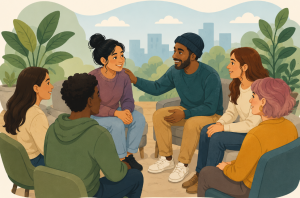

Loneliness, Social Isolation, and Belonging: Why Connection Is a Public Health Issue
Think about the last time you felt lonely.
What, exactly, was missing?
Maybe you wanted someone to talk to. Maybe there were plenty of people around, but no one seemed to understand what you were going through. Perhaps you wanted a group where you felt like you belonged, a person you trusted, or simply the feeling that somebody really knew you.
That distinction matters because loneliness is not the same thing as being alone.
A person can spend considerable time by themselves and feel perfectly content. Another person can go to work, attend classes, go out every weekend, maintain a large social network, and still feel profoundly lonely.
Understanding that difference changes how we think about loneliness. It also changes what we should do about it.
Loneliness is often treated as a private emotional problem, something individuals should solve by making friends, joining a club, or getting out of the house. But a public health perspective asks a broader question: What happens when people’s need for meaningful connection is not being met, and what conditions make that connection easier or harder to achieve?
Build Your Public Health Issue
Tell us a little about your work, and we’ll build a personalized issue with five things worth knowing.
Loneliness, Social Isolation, and Belonging Are Different Things
Three concepts are easy to blend together: loneliness, social isolation, and belonging.
Loneliness is subjective. It is the distressing experience that occurs when there is a gap between the connection we want and the connection we believe we have. Someone may have many relationships but still feel those relationships do not meet important emotional or social needs.
Social isolation is more objective. It refers to having relatively few relationships, roles, interactions, or social contacts. We can observe at least some elements of isolation, but we cannot directly observe loneliness.
Belonging is different again. It reflects a deeper sense of connection to people, groups, places, communities, or shared experiences. It is not simply about contact. It involves feeling that we fit somewhere and that our presence matters.
These distinctions create several possibilities.
A person can have plenty of social contact and little loneliness. They can also have relatively little social contact and be perfectly satisfied with that arrangement. Someone can be surrounded by people and feel deeply lonely, while another person may spend long periods alone without experiencing loneliness at all.
At the most concerning end, a person can experience both high social isolation and high loneliness: few opportunities for meaningful contact combined with a strong desire for connection that is not being met.
This is why counting someone’s friends, coworkers, social events, or followers tells us relatively little about whether they are lonely.
You Cannot See Loneliness
One difficulty with loneliness is that it can be almost invisible.
Someone who lives alone and rarely attends social events may appear lonely to outsiders but be entirely content. At the same time, someone who is socially active may be experiencing substantial loneliness because none of those interactions provide the depth, trust, intimacy, or sense of belonging they need.
That person can be particularly easy to miss.
We see the parties.
We see the workplace interactions.
We see the social-media posts.
We do not necessarily see the experience underneath them.
In the lecture, this distinction emerged repeatedly in the class discussion. Students pointed out that someone sitting quietly by themselves might be unfairly assumed to be lonely, while a person who appears socially successful could have unmet relational needs that nobody notices.
The practical lesson is straightforward: social presence is not the same as social connection.
Connection Is More Than the Number of People You Know
A useful way to understand social connection is to think about three dimensions: structure, function, and quality.
Structure asks who is actually in your life. How many relationships do you have? What roles do those people occupy? How often do you interact?
Function asks what those relationships provide. Do they offer emotional support, information, practical assistance, companionship, affirmation, or some combination of these things?
Quality asks what those relationships feel like. Are they trusting? Satisfying? Conflictual? Strained? Safe?
These dimensions help explain why a large social network does not necessarily protect against loneliness. Someone can have plenty of structure without receiving the functions they need or experiencing relationships of sufficient quality.
Social support has to live somewhere. Before someone can receive emotional, informational, instrumental, or appraisal support, there has to be a relationship through which that support can occur. And that relationship also has to feel safe enough to use.
The absence of meaningful connection, therefore, cannot always be solved merely by putting more people into someone’s life.
Why Loneliness Became a Public Health Issue
In 2023, then-U.S. Surgeon General Vivek Murthy issued a national advisory on loneliness and social connection. The framing mattered: social disconnection was treated not merely as an unpleasant emotion, but as a population health concern.
The lecture highlighted the advisory’s argument that loneliness was widespread even before the COVID-19 pandemic and that changes in American social life had been occurring for years. The larger concern was not a single statistic but a pattern across several dimensions of social life: time spent with friends, participation in community organizations, religious participation, civic engagement, household composition, and other indicators of connection.
That framing changes the question.
If loneliness is purely an individual problem, then the solution is largely individual: go out more, meet people, develop social skills, get therapy.
Those interventions may certainly help some people.
But if loneliness and isolation are also shaped by housing, transportation, work schedules, neighborhood design, discrimination, technology, public spaces, community organizations, and social norms, then individual behavior is only part of the story.
Loneliness becomes a question about the environments in which relationships have to form.
Risk for Loneliness Is Not Distributed Equally
Anyone can experience loneliness, but the opportunities and barriers to connection are not evenly distributed.
The lecture drew attention to several circumstances that may increase vulnerability to social disconnection, including poor physical or mental health, disability, financial insecurity, living alone, single parenthood, age, and experiences of discrimination or marginalization. Survey data on loneliness also highlighted young adults as a particularly important group.
The important point is not to turn those associations into stereotypes.
Saying that a group has elevated risk is not the same as saying that everyone in that group is lonely. Risk factors should not become a way to blame individuals for having inadequate social connections.
A community psychology perspective asks a different question:
What produces opportunities for connection, and what creates barriers to it?
Income affects where people can live. Transportation affects where they can go. Disability affects which environments are accessible. Work schedules determine how much discretionary time people have. Neighborhood design affects whether people naturally encounter one another. Discrimination affects whether people feel psychologically and physically safe enough to participate.
Those conditions exist outside the individual, but they shape the individual’s social world.
Loneliness and Isolation Can Affect Physical Health
The consequences of social disconnection extend beyond sadness.
The lecture reviewed several pathways linking social relationships with health, including biological, psychological, and behavioral processes.
At the biological level, relationships interact with our stress-response systems. Social connection can influence physiological processes such as cardiovascular reactivity and neuroendocrine functioning. When people experience supportive relationships, those relationships can help regulate the body’s stress response.
Psychologically, connection can provide meaning, purpose, emotional security, and coping resources. This connects directly to the stress-buffering idea discussed in the previous lecture: knowing that people are available can change how threatening a stressful situation feels, even when the stressful event itself has not changed.
Behaviorally, relationships shape what people actually do. Connected people may have someone who notices changes in their health, encourages them to seek care, gives them a ride to an appointment, supports healthier routines, discourages risky behavior, or helps them maintain a difficult behavior change.
Health behavior, in other words, does not occur in a vacuum.
It occurs inside relationships.
Loneliness Can Become a Feedback Loop
One particularly important feature of loneliness is that it can reinforce itself.
Imagine someone who feels disconnected from other people. Because social interaction has become painful or disappointing, they become more guarded. They withdraw a little.
That withdrawal creates fewer opportunities for positive social interactions.
With fewer interactions, they receive less emotional support, less affirmation, and fewer opportunities to strengthen relationships.
Their relationships may gradually weaken.
That, in turn, produces more loneliness.
The lecture described this as a cycle involving loneliness or isolation, followed by stress, vigilance, and withdrawal; then fewer positive interactions; then less support and weaker relationships; and ultimately more loneliness.
This is important because advice such as “just get out there and talk to people” assumes that someone struggling with loneliness is starting from the same psychological position as everyone else.
They may not be.
If repeated rejection, exclusion, embarrassment, or loss has made social situations feel threatening, withdrawal can become understandable as a form of self-protection.
Unfortunately, that protection can gradually make meaningful reconnection harder.
Hikikomori: An Extreme Case of Social Withdrawal
An especially striking example comes from the Japanese phenomenon commonly called hikikomori.
Hikikomori has historically been used to describe severe and prolonged social withdrawal in which a person largely disengages from major social institutions such as work or school and spends most of their time at home. Proposed descriptions often include sustained isolation, substantial impairment or distress, and major reductions in social participation.
The stories examined in class showed people who had withdrawn for years, sometimes following bullying, academic problems, employment difficulties, shame, or other social experiences. Some depended heavily on family members while having extremely limited contact with the outside world.
It would be easy to interpret hikikomori entirely as an individual mental health problem.
But that misses much of what makes it interesting.
A Socio-Ecological View of Hikikomori
Consider a hypothetical person who has difficulty at university, struggles to establish stable employment, loses confidence, withdraws socially, and gradually begins to believe that they have failed to reach the milestones expected of an adult.
At the individual level, we might see anxiety, distress, low self-efficacy, avoidance, or depression.
At the relationship level, we might see bullying, ostracism, family conflict, difficulty reconnecting with friends, or shame about falling behind peers.
At the institutional level, there may be academic failure, precarious employment, difficulty re-entering the labor market, or structural penalties associated with a long absence from work.
At the cultural level, expectations around employment, adulthood, marriage, status, and productivity may intensify a sense of failure.
Those influences can reinforce one another.
The resulting pattern may look like an individual choosing isolation, but the social environment is helping produce and maintain that withdrawal.
That makes hikikomori useful as more than an unusual cultural example. It forces us to ask how societies define a successful life, what happens to people who fall outside those expectations, and whether our institutions provide realistic pathways back into participation.
Hikikomori Also Shows Why Isolation Is Not Loneliness
There is another important caution.
Hikikomori primarily describes withdrawal and isolation. That does not automatically tell us how lonely someone feels.
Some socially withdrawn people may desperately want relationships and experience considerable loneliness. Others may experience relatively little subjective loneliness despite very limited social contact.
This distinction becomes even more interesting when we look at people who appear socially integrated.
The lecture discussed research suggesting that some people reporting high loneliness were not necessarily those staying home the most. Instead, loneliness could be especially pronounced among people who went to work or school but lacked meaningful relationships elsewhere.
They were socially present but relationally disconnected.
That may describe a surprisingly familiar experience far beyond Japan.
You can go to work every day and be lonely.
You can sit in a classroom full of people and be lonely.
You can live with other people and be lonely.
You can attend parties and be lonely.
The key issue is not simply whether people are nearby. It is whether the relationships available to us satisfy the kinds of connection we actually need.
Is Hikikomori Really a Japanese Phenomenon?
Hikikomori was initially described in Japan, where particular cultural expectations around school, employment, social roles, and group participation helped shape how researchers understood it.
But the lecture raised an important possibility: severe social withdrawal may not be uniquely Japanese.
Similar patterns have increasingly been documented elsewhere. It may be more useful to think of hikikomori as a phenomenon that can emerge within certain features of contemporary society rather than something belonging exclusively to one national culture.
Modern life provides several conditions that may make sustained withdrawal easier than it once was. People can work remotely. Food can be delivered. Entertainment is nearly limitless. Social interaction can be mediated entirely through screens. Goods and services can arrive without anyone leaving home.
None of those technologies inherently produce social isolation.
But they change what isolation can look like.
A person can now function in ways that would have been almost impossible several decades ago while having very little face-to-face contact.
That makes the next question unavoidable.
Does Technology Make Us Lonely?
The most accurate answer is unsatisfying but important: It depends.
Technology can strengthen connection. It lets geographically separated friends stay in contact, helps people discover communities they could never find locally, reduces barriers for people with disabilities, and lets people with rare identities or experiences find others who understand them. It can be particularly valuable for people who are marginalized in their immediate geographic communities.
But technology can also weaken certain forms of connection.
Online interaction may displace face-to-face contact. It can fragment attention. Some nuances of interaction are harder to reproduce digitally. Casual conversations before and after meetings disappear. Online environments can also facilitate comparison, exclusion, harassment, or participation in unhealthy communities.
The mistake is treating “technology” as one exposure with one effect.
Texting an old friend, participating in a supportive online community, scrolling passively through strangers’ lives, playing games with close friends, attending a virtual support group, and being harassed on social media are all technologically mediated experiences.
Psychologically, they are not the same experience.
The better question is not whether technology connects or isolates us.
It is what kinds of interaction a technology makes more likely, for whom, and under what conditions.
Loneliness Is Not Just an Individual Failure
Once loneliness is viewed ecologically, some common responses start to look inadequate.
Imagine someone living in an area without sidewalks, public transportation, accessible community spaces, or nearby services. Their work schedule leaves little free time. They cannot afford many recreational activities. The nearest social opportunities require a car they do not own.
Telling that person to “get out more” does not solve the structural problem.
Or imagine someone who has repeatedly experienced discrimination in local institutions. They technically have places to go, but those places do not feel safe or welcoming.
Again, the number of available buildings or activities does not tell us whether meaningful connection is realistically available.
This is where loneliness becomes a public health issue rather than solely a psychological one.
If the causes of social disconnection exist partly at the community and societal levels, some of our solutions must exist there too.
What Would a Public Health Response to Loneliness Look Like?
The Surgeon General’s framework discussed in class identifies several broad areas for action. The common theme is that improving social connection requires more than telling individuals to make better choices.
Communities can strengthen social infrastructure: parks, libraries, community centers, recreational organizations, faith communities, clubs, public gathering spaces, and other places where repeated interaction can occur.
Public policy can also be designed with connection in mind. Transportation, housing, work arrangements, land use, and public-space design can either facilitate or discourage everyday interaction.
The healthcare sector can take social health more seriously by recognizing isolation and loneliness as relevant to overall well-being rather than treating relationships as unrelated to health.
Digital environments can be designed and moderated with greater attention to whether they promote meaningful connection, safety, and healthy participation.
Researchers can continue improving our understanding of who experiences loneliness, what kinds of connection different people need, and which interventions actually help.
Finally, communities can cultivate cultural norms that make connection ordinary: checking on neighbors, inviting people in, participating in local organizations, and treating relationships as infrastructure rather than an optional extra.
This is not a six-step cure for loneliness. It is a shift in what we consider a legitimate target for public health intervention.
We Should Be Careful About Trying to “Fix” Solitude
There is also a danger in becoming so concerned about loneliness that we begin treating time alone as inherently unhealthy.
It is not.
Some people genuinely prefer less social interaction. Solitude can be restorative, creative, peaceful, or spiritually meaningful. A person who spends Friday evening alone reading a book is not necessarily experiencing a public health crisis.
That is why the distinction between loneliness and isolation matters so much.
If we confuse the two, we can impose connection on people who do not want it while simultaneously overlooking socially active people who desperately need more meaningful relationships.
The goal should not be maximizing the amount of social contact in everyone’s life.
The goal is creating the conditions in which people can obtain the kind and amount of connection that is meaningful to them.
Belonging May Be the More Important Goal
Thinking only about loneliness keeps the focus on what is missing.
Belonging gives us a more constructive question.
What makes someone feel like they have a place?
It could be a family.
A group of friends.
A neighborhood.
A classroom.
A workplace.
A recovery community.
A religious congregation.
A soccer club.
An online community.
A volunteer organization.
The exact setting will vary tremendously. What matters is that people experience themselves as recognized participants rather than anonymous bodies occupying the same physical or digital space.
This is where loneliness connects back to peer support and social support. Relationships provide emotional support, information, practical assistance, perspective, identity, and hope. But those supports cannot be delivered through relationships that do not exist or relationships people do not feel safe using.
So the public health question becomes larger than simply reducing loneliness.
How do we build communities in which meaningful connection and belonging are easier to find?
That question naturally leads us to the next part of this series: sense of community—what makes a collection of people feel like an actual community, why that feeling matters, and what happens when belonging becomes too exclusive.