

The End of Childhood? Why the World Is Running Out of Children
What Happens When Children Become a Minority?
For nearly all of human history, societies have been built around children. That assumption is quietly disappearing.
Across parts of Japan, elementary schools are closing because there are no longer enough children to fill their classrooms. Some former schools have been converted into community centers, apartment complexes, or facilities serving older adults. Similar conversations are unfolding in Italy, South Korea, Spain, and rural Germany, where declining enrollment has forced communities to rethink institutions that once seemed permanent.
At first glance, these appear to be isolated local stories. Together, they point to something much larger.
According to the latest United Nations population projections, humanity is entering one of the most consequential demographic transitions in modern history. The transformation will unfold gradually—almost imperceptibly from one year to the next—but by the end of the century it will reshape the age structure of societies across much of the world. Governments will rethink schools, healthcare systems, housing, transportation, labor markets, and community design as populations continue to age and birth rates remain low. For public health, the implications extend far beyond longer life expectancy, influencing everything from vaccination programs and school-based health services to chronic disease prevention, long-term care, and healthy aging.
Most headlines describe this trend as population aging. While accurate, that description tells only half the story. Longer life expectancy is only one side of the demographic equation. Equally important is the steady decline in the number of children entering each new generation. The defining demographic story of the twenty-first century is not simply that societies are growing older. It is that childhood is becoming a much smaller share of human experience.
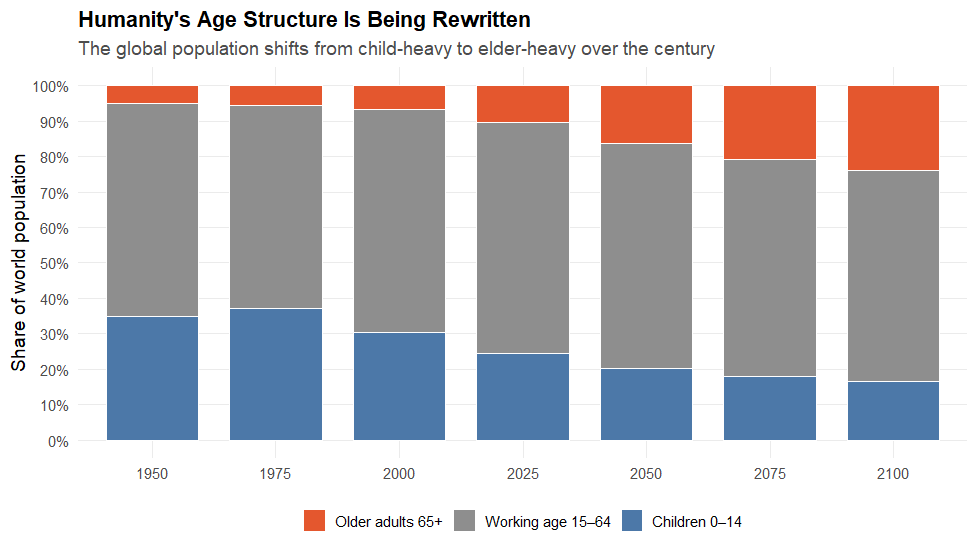
By the end of the century, children younger than 15 are projected to account for just 16.5 percent of the world’s population, down from 24.4 percent today and less than half the proportion observed during the middle of the twentieth century. During the same period, adults aged 65 and older are projected to increase from 10.4 percent of humanity to nearly one-quarter of the global population, while the world’s median age rises from 30.9 to 42.1 years.
For most of recorded history, societies were organized around children because they represented one of the largest segments of the population. By 2100, that assumption will no longer hold true across much of the world. Older adults are projected to outnumber children under 15 in 180 countries—a demographic milestone that would have been almost unimaginable for previous generations.
This shift reaches far beyond demography. It changes who our healthcare systems serve, how communities invest public resources, and what challenges define public health in the decades ahead. Understanding that the future begins with recognizing a simple but profound reality: this is not just the story of a world growing older. It is the story of a world with far fewer children.
A Demographic Revolution Hidden in Plain Sight
One of the remarkable features of demographic change is how quietly it unfolds. Wars begin on specific days, pandemics spread in recognizable waves, and economic recessions arrive with alarming headlines. Population aging follows a very different path. It advances one birthday at a time. Every year, millions of children are born, millions of adults celebrate another birthday, and more people survive into older age than ever before. No single year feels revolutionary. Yet over decades, those individual birthdays accumulate into a transformation that reshapes entire societies.
For most of human history, high birth rates were matched by high mortality. Families often had many children because many never survived to adulthood. Infectious disease, famine, unsafe childbirth, poor sanitation, and violence kept life expectancy low, making large families both common and necessary.
Over the past century, advances in public health have changed that equation. Clean drinking water, vaccination, antibiotics, improved nutrition, safer childbirth, and modern medicine have dramatically reduced childhood mortality while extending life expectancy worldwide. At the same time, fertility declined as countries urbanized, educational attainment increased, women gained greater educational and economic opportunities, and families chose to have fewer children.
The result is a demographic transition unlike any in human history: each new generation is smaller than the one before it, while more people survive into old age. The world’s population is not simply growing older. It is becoming progressively less centered on childhood.
Why Are Families Having Fewer Children?
One of the most common questions surrounding population aging is also one of the simplest: why are birth rates falling in so many countries at the same time? There is no single explanation. Instead, declining fertility reflects a broad transformation that has accompanied improvements in health, education, and economic development across much of the world.
Perhaps the most important factor is one of public health’s greatest successes. For most of human history, parents had many children because many children did not survive. Infant and childhood mortality were tragically common, and large families provided a measure of security in an uncertain world. As vaccination, sanitation, improved nutrition, clean drinking water, and modern medicine dramatically increased child survival, families no longer needed to have as many children to expect that most would reach adulthood. In many countries, falling fertility closely followed declining childhood mortality.
Economic development has reinforced that transition. As countries urbanize, children become less essential as contributors to family labor and more expensive to raise. Housing costs increase, education lasts longer, and the financial investment required to raise a child grows substantially. Parents increasingly prioritize providing more opportunities for fewer children, reflecting a shift in both economic realities and family aspirations.
Education has also transformed fertility patterns, particularly through expanded educational opportunities for girls and women. Higher educational attainment is associated with later marriage, delayed parenthood, greater participation in the workforce, and increased access to reproductive healthcare. These changes have given families a greater ability to decide when to have children and how many they wish to have. Around the world, women today have more choices about family planning than at any previous point in history, and those choices are reflected in declining fertility rates.
Declining fertility is therefore not the result of a single policy or cultural change. It reflects decades of improvements in child survival, education, urbanization, and economic development that have fundamentally reshaped family life. The result is not simply an older population—it is a world in which each new generation is smaller than the one before it, setting the stage for the demographic transformation explored throughout the rest of this article.
When Childhood Stops Being the Norm
Statistics describe demographic change, but they do not always capture what it looks like in everyday life. Its effects become visible in the institutions that communities build. During the second half of the twentieth century, countries expanded schools, playgrounds, pediatric practices, maternity wards, and family housing to serve rapidly growing child populations. These investments reflected a world in which children were among the largest and fastest-growing segments of society.
That world is beginning to change. Today, 67 countries already have more adults aged 65 and older than children younger than 15. By 2100, that number is projected to reach 180, with 113 countries expected to cross this demographic threshold during the century. In many places, the age balance that shaped communities for generations is steadily shifting toward older adulthood.
The consequences are already becoming visible. Communities in Japan, Italy, South Korea, Germany, and elsewhere have consolidated schools because there are fewer students to enroll. Some former school buildings have been converted into community centers, housing, or healthcare facilities, while hospitals continue to expand geriatric services, memory clinics, rehabilitation programs, and long-term care. These changes rarely occur all at once. They emerge gradually as each generation becomes slightly smaller than the one before it.
For public health and public policy, this shift changes more than population statistics. It changes what communities must build and whom their institutions are designed to serve. Governments that once planned for expanding childhood populations must increasingly balance investments in schools and pediatric services with growing demand for chronic disease management, long-term care, age-friendly transportation, and housing that supports older adults. The demographic transition is no longer a distant projection—it is already reshaping communities around the world..
Five Windows to the Future
Although population aging is a global phenomenon, it is unfolding at dramatically different speeds. Looking at five countries side by side illustrates just how diverse the demographic future may become.
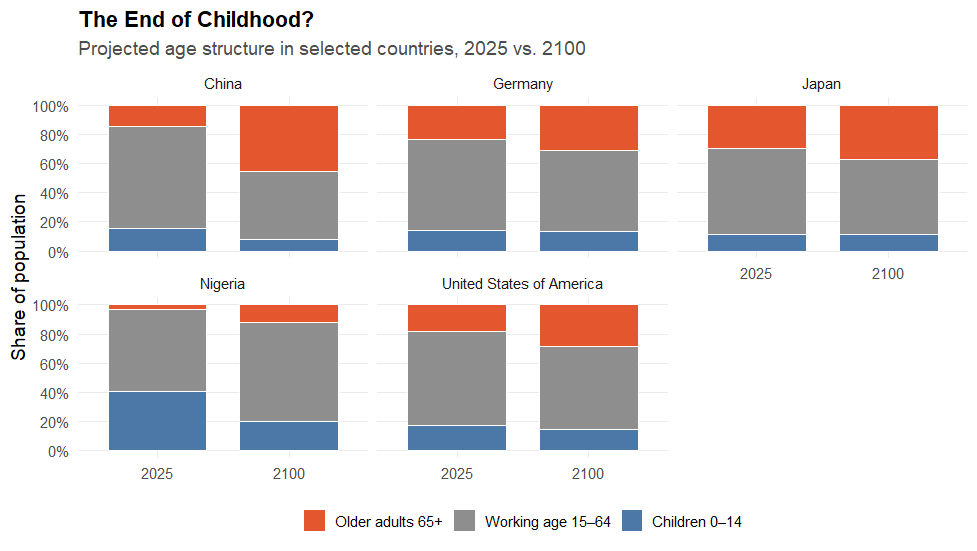
Although population aging is a global phenomenon, it is unfolding at very different speeds. Some countries have already entered an era in which older adults substantially outnumber children. Others are only beginning that transition, while a handful will remain among the world’s youngest societies well into the next century. Comparing Japan, Germany, the United States, China, and Nigeria illustrates how demographic change can follow remarkably different paths despite being driven by many of the same underlying forces.
Japan
Japan has long been viewed as the world’s demographic bellwether. Few countries have aged as rapidly or as completely. Today, only about 11 percent of Japan’s population is younger than 15, while nearly 30 percent is 65 or older. By 2100, more than 37 percent of the population is projected to be over age 65, with a median age approaching 53 years. In practical terms, the typical Japanese resident would be older than many Americans are when they retire today.
Japan has become an early example of the opportunities and challenges associated with an aging society, including declining school enrollment, growing demand for long-term care, persistent workforce shortages, and increasing investment in robotics and age-friendly technologies.
Germany
Germany illustrates that profound demographic aging does not require a dramatic demographic collapse. Today, children account for about 14 percent of the population, while nearly one in four Germans is already 65 or older. By the end of the century, the share of children is projected to remain remarkably stable at 13.7 percent, yet the proportion of older adults will climb to more than 31 percent as the large generations born after World War II continue to age and people live longer.
The result is a society in which there will be more than two older adults for every child (2.3 to 1), compared with fewer than two today. Germany demonstrates that even modest changes, sustained over decades, can fundamentally reshape a nation’s age structure. Those gradual shifts are already influencing healthcare demand, pension systems, housing, and the labor force, and they offer a glimpse of the demographic future facing many other European countries.
The United States
The United States occupies a middle ground. Higher fertility rates and sustained immigration have slowed population aging compared with much of Europe and East Asia, but the overall trajectory remains the same. By 2100, children are projected to account for 14.4 percent of the population, while adults aged 65 and older will comprise 28.4 percent. The United States is aging more slowly than many wealthy nations—not escaping the demographic transition, only delaying it.
China
China represents perhaps the most striking demographic transformation among the world’s largest countries. Just one generation ago, China was characterized by an enormous number of primary schools, expanding cities, and one of the largest youth populations on Earth. Today, children and older adults each account for roughly 15 percent of the population. By 2100, however, those two generations are projected to diverge dramatically. Only 7.8 percent of the population will be younger than 15, while nearly 46 percent will be at least 65. The country’s median age is projected to exceed 60 years, making China one of the oldest large societies ever recorded.
The absolute numbers are equally remarkable. Between 2025 and 2100, China is projected to lose approximately 173 million children, a decline larger than the current populations of most countries. Few demographic transitions of this magnitude have occurred so rapidly within such a large population, making China one of the defining case studies of twenty-first-century population aging.
Nigeria
Nigeria illustrates a very different future. While much of Europe and East Asia continues to age rapidly, Nigeria is projected to remain one of the world’s youngest major countries. Today, more than 40 percent of Nigerians are younger than 15 years old. Even by 2100, children are expected to account for approximately one-fifth of the population, a level considerably higher than that projected for most high-income countries. Nigeria’s demographic profile reflects both continued population growth and a much younger age structure, creating a different set of public health priorities centered on maternal health, childhood nutrition, education, vaccination, and expanding workforce opportunities.
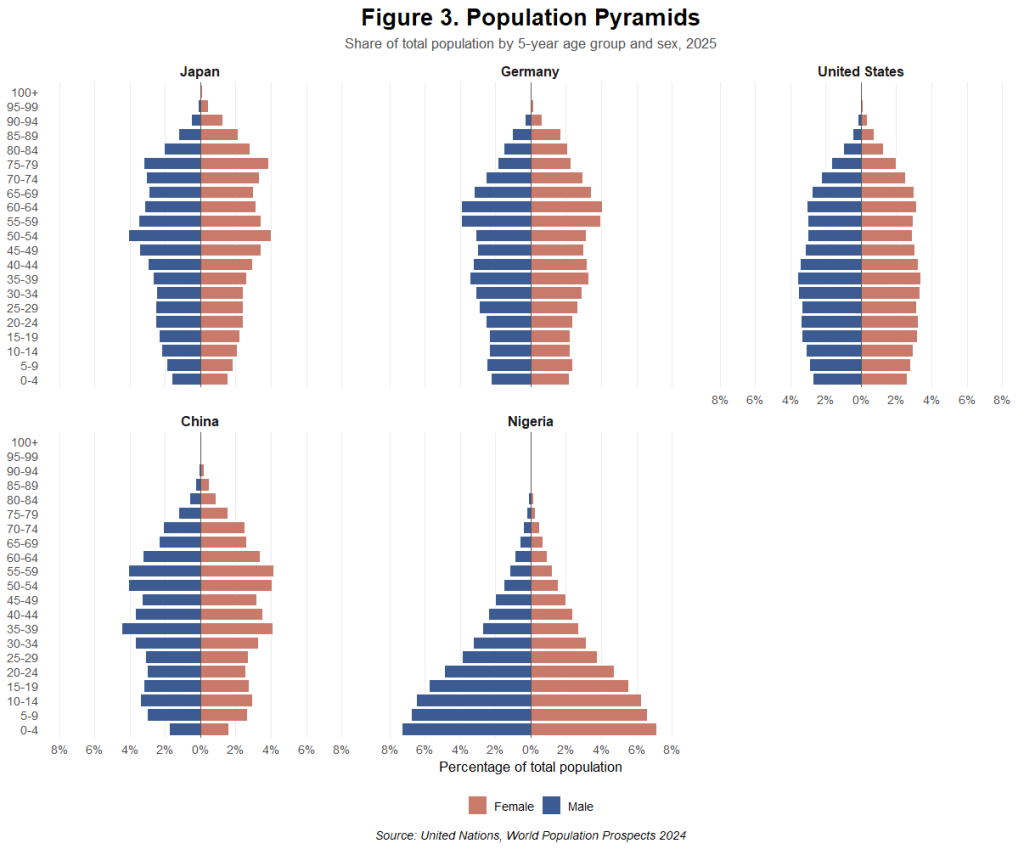
These five countries demonstrate that there is no single demographic future. Instead, the coming century is likely to produce an increasingly diverse world in which some societies are organized around the needs of growing older populations, while others continue to invest heavily in children and young families. Those differences will shape migration, healthcare systems, labor markets, and economic development for decades to come. From a public health perspective, understanding where countries fall along this demographic continuum may be just as important as understanding their burden of infectious or chronic disease.
The Vanishing Classroom
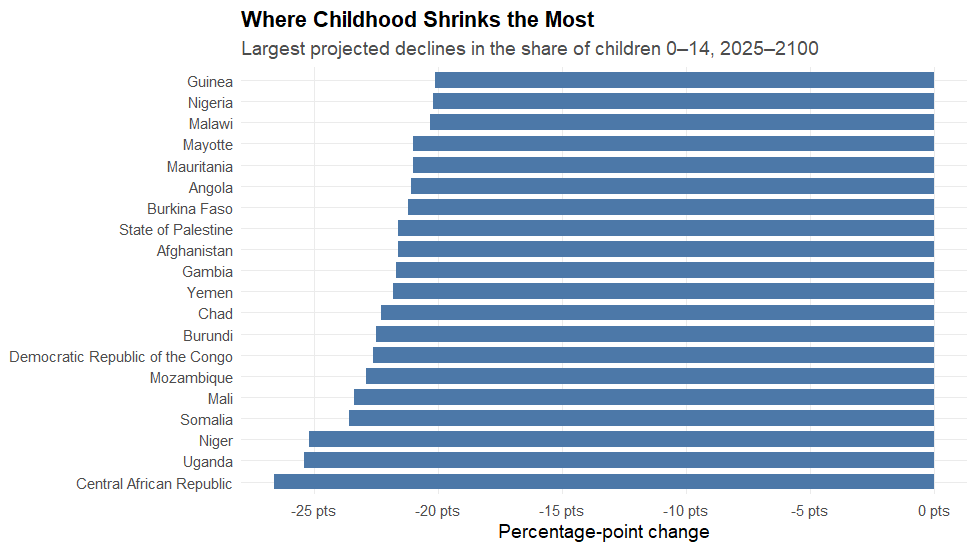
China alone is projected to have approximately 173 million fewer children under the age of 15 by the end of this century than it does today—a decline larger than the current populations of most countries. India is projected to have roughly 148 million fewer children, while Indonesia, Brazil, Bangladesh, Mexico, the Philippines, and Türkiye are each expected to lose millions more. Collectively, these declines represent one of the largest demographic shifts in human history.
These numbers do not reflect a public health crisis or rising childhood mortality. In fact, children born during the coming decades are likely to live longer and healthier lives than any previous generation. The difference is simply that fewer children are being born. As each generation becomes smaller than the last, the institutions built to serve them begin to change.
That change is already visible. During much of the twentieth century, governments raced to build schools, pediatric hospitals, playgrounds, and childcare facilities for rapidly growing child populations. Today, many communities are asking a different question: not where new schools should be built, but which existing schools should remain open. Japan has already closed hundreds of schools because of declining enrollment, and similar conversations are underway in Italy, South Korea, Spain, Germany, and parts of Eastern Europe. At the same time, demand continues to grow for rehabilitation centers, memory clinics, assisted living facilities, home health services, and long-term care. The physical landscape of communities is gradually evolving to reflect a world with fewer children and more older adults.
The Moment Older Adults Outnumber Children
Population aging is often described as a slow, continuous process, but demographic transitions frequently have recognizable tipping points. For decades, the proportion of children has gradually declined while the number of older adults has steadily grown. Eventually, those two trends intersect, and a country reaches a milestone that would have been almost unimaginable for most of human history: older adults outnumber children.
That transition has already begun. Sixteen countries had already crossed this threshold by the 2020s, and the pace is projected to accelerate over the next several decades. The 2030s alone are expected to see another 25 countries make the transition, followed by 15 more during the 2040s. By the middle of the century, what was once considered a demographic curiosity will have become commonplace across much of Europe, East Asia, and other rapidly aging regions. In total, 113 countries are projected to move from having more children than older adults today to having more older adults than children by 2100.
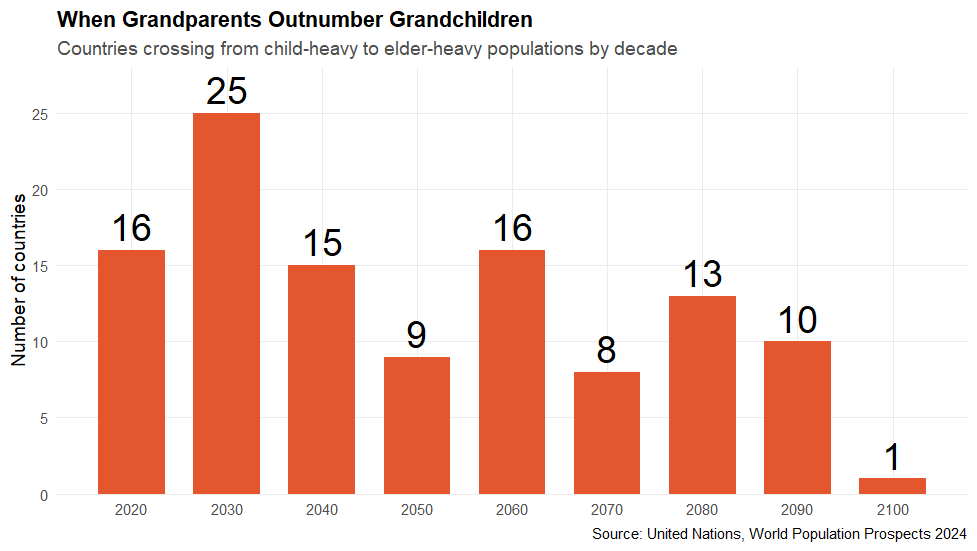
The timing of these transitions is significant because it illustrates that demographic aging is not a distant problem reserved for future generations. Many countries are expected to experience this reversal within the next two or three decades, well within the planning horizon for today’s policymakers, healthcare systems, and local governments. Decisions about schools, hospitals, transportation systems, housing, and workforce development are being made now, yet many will shape communities after these demographic thresholds have already been crossed.
Crossing this milestone does not mean that childhood has disappeared or that societies are in decline. Instead, it marks a fundamental shift in the balance between generations. For centuries, communities were organized around expanding child populations because children represented the largest and fastest-growing segment of society. As that balance changes, institutions designed for younger populations will increasingly need to adapt to the needs of older adults. Public health systems, in particular, will face the challenge of maintaining strong investments in maternal and child health while simultaneously expanding services for chronic disease management, dementia care, rehabilitation, and healthy aging. The decades ahead will not simply bring older populations. They will require a new way of thinking about how societies allocate resources across the entire life course.
The decline in school-aged children may prove especially important for public health because schools have become one of society’s most effective platforms for delivering health services. Beyond education, schools provide vaccinations, vision and hearing screenings, nutrition programs, mental health support, speech and occupational therapy, physical activity, and health education. For millions of children, they also provide the first opportunity to identify developmental delays, learning disabilities, anxiety, depression, abuse, or chronic health conditions. As the number of students gradually declines, these systems will inevitably change. Some services may become easier to deliver because there are fewer children to reach, while others may become more difficult as rural schools consolidate, transportation distances increase, and pediatric specialists become concentrated in fewer locations. Maintaining equitable access to these services will remain a central challenge for public health, even as the populations they serve become smaller.
A New Balance Between Generations
One of the clearest ways to understand the demographic transition is to compare two groups that have long defined the beginning and end of the human lifespan: children younger than 15 years of age and adults aged 65 years and older. Throughout most of history, children substantially outnumbered older adults because relatively few people survived into advanced age. Improvements in medicine, sanitation, nutrition, and living conditions have steadily increased life expectancy, while declining fertility has reduced the number of children entering each new generation. Together, these trends are reversing a demographic relationship that persisted for centuries.
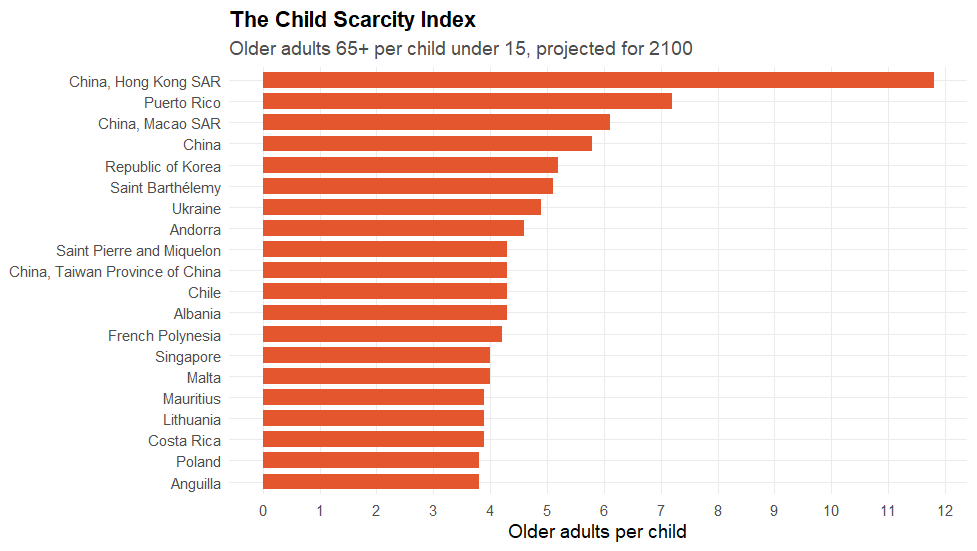
The projected differences among countries are striking. By the end of the century, Hong Kong is projected to have nearly 12 older adults for every child under 15. Puerto Rico approaches seven, mainland China nearly six, and South Korea exceeds five. Even countries that many people would not immediately associate with population aging, including Costa Rica, Chile, Mauritius, Singapore, and Poland, are projected to have four or more older adults for every child. These figures illustrate how dramatically the balance between generations is changing.
Although these ratios may initially seem abstract, they represent tangible changes in everyday life. Communities with relatively few children may operate fewer schools, youth sports leagues, and pediatric practices, while demand grows for memory clinics, rehabilitation services, assisted living facilities, and long-term care. Consumer markets, transportation systems, housing, and public spaces all evolve in response to the age structure of the populations they serve. Demography does not simply describe who lives in a society. It shapes the institutions that society builds.
Public Health Enters a New Era
Population aging is often discussed in economic terms, with attention focused on retirement systems, labor markets, and government spending. Those issues are important, but they tell only part of the story. From a public health perspective, demographic change represents a fundamental shift in the health challenges societies will face and the services healthcare systems must provide.
Many of the greatest public health achievements of the twentieth century focused on helping children survive and thrive. Clean drinking water, vaccination, improved maternal care, better nutrition, and advances in infectious disease control dramatically reduced childhood mortality and extended life expectancy. Ironically, those successes helped create the demographic transition now unfolding.
The next century will require an equally ambitious commitment to healthy aging. As populations age, public health will increasingly focus on preventing chronic disease, preserving mobility and cognitive health, reducing frailty, and helping people remain healthy and independent for longer.
Vaccination priorities will evolve as well. Childhood immunization will remain essential, but aging populations will increase demand for vaccines that protect older adults against influenza, respiratory syncytial virus, shingles, and pneumococcal disease. Preventing illness later in life will become an increasingly important public health strategy.
Emergency preparedness will also change. Older adults are disproportionately vulnerable during disasters because they are more likely to have chronic medical conditions, mobility limitations, and dependence on medications or medical equipment. Protecting aging populations will become an increasingly central part of emergency planning.
Mental health presents a similar challenge. As populations age, healthcare systems will devote greater attention to dementia, depression, loneliness, caregiver stress, and social isolation. Supporting older adults—and the family members who care for them—will become an increasingly important component of population health.
Healthcare systems themselves will evolve. Hospitals and clinics will increasingly care for patients with multiple chronic conditions, cognitive impairment, and complex care needs, placing greater emphasis on rehabilitation, coordinated care, home-based services, and age-friendly health systems.
Taken together, these changes represent more than an expansion of geriatric medicine. They reflect a broader evolution in the mission of public health. The twentieth century focused on helping people live longer. The twenty-first century will increasingly focus on helping them live those additional years well.
A Different Kind of Workforce Challenge
One consequence of population aging receives far less public attention than retirement systems or healthcare costs. Every older adult who requires medical care ultimately depends on a workforce capable of providing it. Physicians, nurses, pharmacists, therapists, laboratory professionals, emergency responders, home health aides, and countless other healthcare workers form the foundation of healthy aging. As populations continue to age, maintaining that workforce may become one of the defining public health challenges of the century.
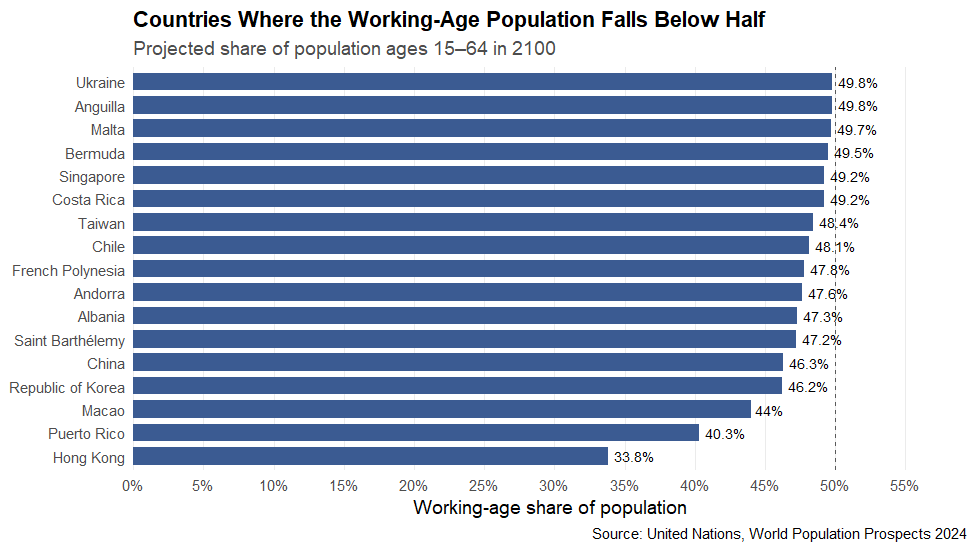
By 2100, 17 countries are projected to have working-age populations that account for less than half of their populations. China, South Korea, Hong Kong, Puerto Rico, and several European and Pacific nations fall into this category. As dependency ratios increase, societies may require substantially more healthcare workers even as the proportion of adults available to fill those roles shrinks. Advances in artificial intelligence, robotics, remote monitoring, and assistive technologies will likely improve efficiency and help address some workforce shortages. Even so, healthcare remains fundamentally dependent on human relationships. Compassion, clinical judgment, communication, and caregiving cannot be fully automated, making workforce planning an essential component of healthy aging.
Childhood Is Not Disappearing Everywhere
One of the most important conclusions from these projections is that demographic aging will not occur uniformly worldwide. While much of Europe and East Asia continues to grow older, many countries in sub-Saharan Africa are expected to remain comparatively young throughout the century.
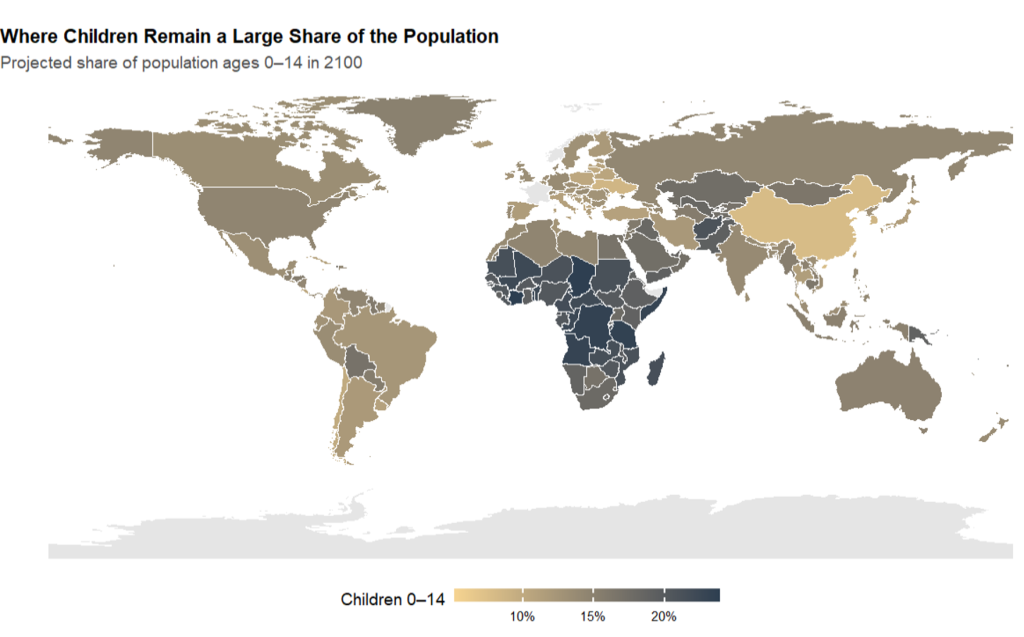
Nigeria illustrates this contrast particularly well. Today, approximately 40 percent of Nigerians are younger than 15 years of age. Even by 2100, children are projected to comprise roughly one-fifth of the country’s population, a proportion substantially higher than that projected for most high-income countries. These differences suggest that demographic aging will increasingly divide the world into regions with very different public health priorities. Some countries will continue to expand maternal health services, childhood vaccination programs, schools, and workforce development initiatives, while others devote increasing resources to chronic disease management, dementia care, and long-term support for older adults.
These contrasting demographic trajectories may also reshape migration, economic development, and global healthcare. Countries with younger populations may become important sources of future healthcare workers, engineers, educators, and entrepreneurs for aging societies experiencing persistent labor shortages. Public health will become increasingly interconnected, and many of the challenges associated with demographic aging will require international cooperation rather than purely national solutions.
Beyond Population Aging
The phrase “population aging” can sometimes make this transformation seem like a problem to be solved. In reality, it reflects one of humanity’s greatest accomplishments. The average child born today has a far greater chance of surviving infancy, avoiding infectious diseases, receiving vaccinations, and living well into older adulthood than almost any previous generation in history. Longer lives are one of the defining successes of modern medicine and public health.
Those successes also create new responsibilities. The institutions that shaped the twentieth century were designed for populations in which children represented a much larger share of society. During the coming decades, healthcare systems, housing, transportation, education, workforce planning, and community design will continue to adapt to populations older than at any previous point in human history. These changes should not be viewed as evidence of demographic decline. They represent the natural consequences of longer lives and smaller families.
The coming century is unlikely to mark the end of childhood. Children will continue to occupy the center of families and remain essential to the future of every society. Their demographic role, however, is changing. For the first time in human history, many countries will have more grandparents than grandchildren, more older adults than children, and communities in which healthy aging becomes as important a public health priority as childhood once was. Preparing for that future may prove to be one of the defining responsibilities of public health in the twenty-first century. The challenge is no longer just about extending life expectancy. It is ensuring that societies evolve just as successfully as the remarkable gains in longevity that made this demographic transformation possible.