When AI Becomes a Divider in Health Systems
The Future of Health Systems Will Depend on Who Has the Capacity to Use It
Artificial intelligence is often described as the next great transformation in health. The story usually goes something like this: AI will reduce paperwork, improve clinical decisions, predict disease outbreaks, personalize care, and help overburdened systems do more with less.
That future is possible. But it is not the whole story.
The more immediate reality is less dramatic and more consequential. AI is not arriving evenly across the health system. It is being adopted first by organizations that already have the money, data infrastructure, technical staff, and leadership capacity to use it well. These systems can experiment, learn, iterate, and scale. Meanwhile, many local health departments, community-based organizations, safety-net providers, and smaller public health agencies are still working with outdated data systems, limited staff capacity, and competing operational fires.
That means AI can improve health systems, and may also widen the gap between organizations that are already strong and those that are already stretched thin.
In the future of health, the more urgent question is: who has the capacity to benefit from AI?
The Promise of AI in Health Systems
Artificial intelligence is not one single technology, and it is not limited to chatbots or large language models like ChatGPT. At its simplest, AI refers to computer systems that can perform tasks that usually require human judgment, pattern recognition, prediction, language understanding, or decision support. This includes tools that analyze images, predict risk, detect unusual patterns in data, recommend next steps, automate routine processes, summarize text, or help people search large bodies of information. Large language models are one important form of AI, but they are only part of a much larger field that includes machine learning, natural language processing, computer vision, predictive analytics, robotics, and automation.
AI should also not be understood as human intelligence in digital form. These systems do not “know” things the way people do. They identify patterns in data and generate outputs based on those patterns, so their usefulness depends heavily on the quality of the data, the system’s design, and the judgment of the people using it.
There is a good reason for excitement. AI and advanced analytics can help health systems work faster and smarter. These tools can automate routine tasks, summarize large amounts of information, support predictive modeling, improve scheduling, reduce documentation burden, and help leaders make sense of complex population health data.
For large health systems and well-resourced public agencies, these benefits can be substantial. AI can help identify patients at risk of hospitalization, detect patterns in disease surveillance data, streamline administrative processes, and support more targeted community health interventions.
In a world where health organizations are facing workforce shortages, rising costs, and increasing demand, this matters. If AI reduces the time staff spend on repetitive paperwork, it could free people to focus on higher-value work, including patient engagement, community partnership, and strategic planning.
But the promise of AI depends on the conditions around it.
AI depends on clean data, interoperable systems, trained staff, thoughtful governance, and leadership that understands how to integrate technology into real work. Without those conditions, AI can become another expensive tool layered on top of a fragile system.
That is where the equity concern begins.
Why AI Adoption Will Be Uneven
Health systems have never started from the same place. Some have modern data platforms, analytics teams, flexible budgets, and strong vendor relationships. Others still rely on spreadsheets, fragmented databases, manual reporting processes, and staff already stretched beyond capacity.
AI can magnify and exacerbate those differences.
Organizations with strong infrastructure can use AI as a force multiplier. They can analyze more data, respond more quickly, reduce administrative workload, and make better use of staff time. Over time, those gains compound. A system that saves time through automation can redirect staff toward improvement work. A system with better data can make better decisions. A system with technical expertise can test tools, refine them, and mitigate some of the risks associated with poor implementation.
Organizations without those advantages face a very different reality. They may not have the money to purchase AI-enabled tools. They may lack staff capable of evaluating vendors, managing data quality, or interpreting model outputs. Their data may be scattered across systems that do not talk to each other. Their day-to-day demands may leave little room for experimentation.
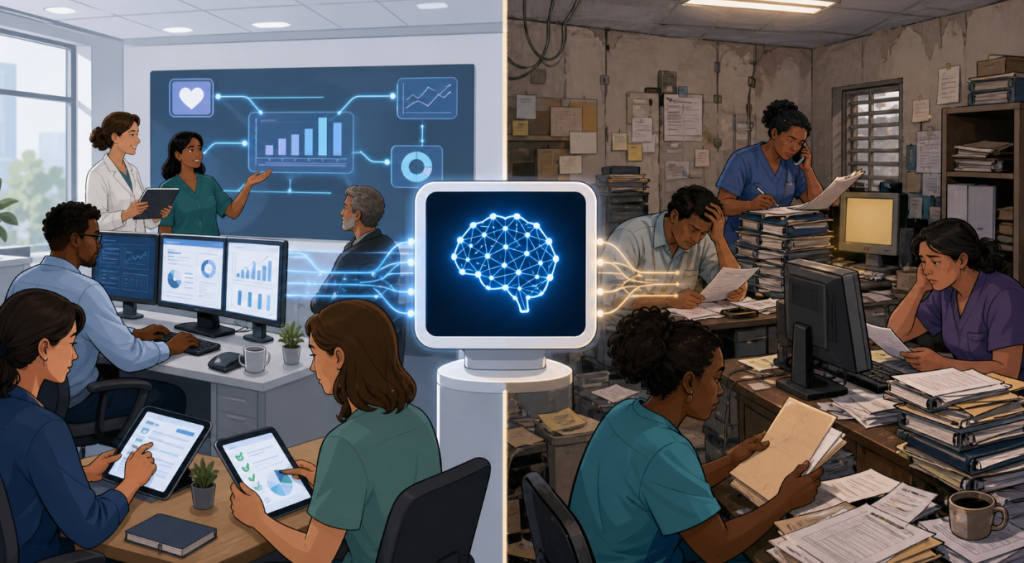
The result is an emerging divide between AI-enabled and AI-limited organizations.
This divide is technological AND is organizational. It reflects differences in funding, leadership, workforce, infrastructure, data governance, and strategic capacity. In other words, AI is becoming a mirror that reflects existing inequalities in the health system while also amplifying them.
The Data Problem Behind the AI Problem
One of the biggest barriers to equitable AI adoption is data fragmentation. Health-related data often lives in separate systems. Clinical data may sit inside electronic health records. Public health data may be held by state or local agencies. Social service data may be managed by nonprofit organizations or government departments. Community-generated data may exist in surveys, stories, mutual aid networks, or local advocacy efforts. These systems often use different definitions, standards, platforms, and governance rules.
AI depends on data. If the data are incomplete, inconsistent, biased, or disconnected, the outputs will reflect those limitations.
This is especially important in public health and community health settings. AI tools may appear objective, but they can only learn from the information they are given. If some communities are underrepresented in the data, if social needs are poorly captured, or if historical inequities are embedded in institutional records, AI can reproduce and even amplify those patterns.
This means that AI will not automatically solve health inequities. In some cases, it may make inequities harder to see because the technology can give flawed outputs the appearance of precision.
High-capacity systems with integrated, high-quality data can generate more useful insights. Lower-capacity systems with fragmented or incomplete data may get weaker results, even if they serve communities with greater needs. That creates a troubling possibility: the communities that could benefit most from better data and smarter tools may be the least likely to receive them.
AI and the Future of the Health Workforce
The workforce implications of AI are also more complicated than the usual headlines suggest.
It is unlikely that AI will cause widespread job displacement across health systems in the near term. A more plausible future is selective transformation. Some tasks will be automated. Some roles will change. Some administrative functions may shrink. Other roles will become more important.
For example, AI may reduce time spent on documentation, scheduling, basic reporting, and routine data processing. At the same time, health systems may need more people who can interpret data, manage AI-supported workflows, oversee technology vendors, ensure ethical use, and translate insights into action.
This creates a major workforce challenge. The future health workforce will need more than technical skills. It will need people who can ask good questions, understand local context, interpret AI outputs carefully, and decide when human judgment should override automated recommendations.
The risk is that high-capacity systems will be able to train, recruit, and retain this workforce, while lower-capacity systems struggle to keep up. That would deepen the divide between organizations augmented by technology and those overwhelmed by manual processes.
The Equity Stakes Are High
The greatest concern is that AI could change the distribution of power across the health ecosystem.
Organizations that use AI effectively may become faster, more efficient, more visible, and more influential. They may attract more funding, shape best practices, set standards, and define what innovation looks like. Their success may make them even more attractive to funders and policymakers.
Meanwhile, under-resourced organizations may fall further behind. They may spend more time managing reporting burdens, responding to crises, and maintaining basic services. Even if they have deep community trust and strong local knowledge, they may lack the infrastructure needed to compete in an increasingly data-driven environment.
This matters because technology benefits often flow toward populations already better served. If advanced tools are concentrated in large health systems, affluent regions, or well-funded agencies, the benefits of AI may bypass the communities facing the greatest barriers to care.
Without intentional action, AI could reinforce disparities in access, responsiveness, prevention, and health outcomes. AI adoption must be guided by equity, governance, and capacity building from the outset.
The Rise of Vendor-Driven AI
Another major signal of change is the rapid growth of vendor-driven AI tools.
Health systems are being offered AI-enabled products for documentation, scheduling, analytics, patient communication, risk prediction, and operational management. These tools can lower barriers to entry, especially for organizations that lack the capacity to build their own systems.
But vendor-driven solutions also create risks.
They can be expensive. They may not integrate well with existing systems. They may use data in ways that are difficult to understand. They may create long-term dependence on private companies. They may not be designed for the realities of public health, community health, or safety-net care.
For under-resourced organizations, the danger is especially acute. A tool that seems affordable at first may come with hidden costs related to implementation, training, customization, data migration, and ongoing maintenance. If the tool does not fit the organization’s context, it may add burden rather than reduce it.
This is why AI adoption is more than a purchasing decision. It is a governance decision, a workforce decision, and an equity decision.
Community-Centered Technology Is Possible
There is another path. AI and data systems can be designed to support community priorities, not just institutional efficiency. Models such as Community Information Exchange, participatory data systems, and locally governed data platforms point toward a different future.
In these approaches, data infrastructure is built around relationships, trust, shared governance, and community benefit. Communities have a stronger voice in what data are collected, how data are interpreted, who can access them, and how insights are used.
This matters because health is shaped across sectors. Housing, food access, transportation, schools, employment, environmental conditions, and social services all influence health outcomes. Better data integration across these areas could support more coordinated and preventive action.
But integration alone is not enough. Shared data systems must be governed responsibly. They must avoid becoming extractive. They must return value to communities. They must protect privacy while still enabling action. They must recognize that data are never just technical assets. They are also about power.
The future of AI in health should also help to build shared capacity across the ecosystem.
What Leaders Should Do Now
The most important step is to stop treating AI as a magic solution. AI is a capacity amplifier. It strengthens what is already present. If an organization has strong data, skilled staff, clear governance, and a learning culture, AI can help it move faster. If an organization has fragmented systems, unclear workflows, weak data quality, and limited staff capacity, AI may amplify confusion.
Health leaders should begin with capacity.
That means asking practical questions before adopting AI. What problem are we trying to solve? Do we have the data needed to address it? Who will interpret the outputs? How will we know whether the tool is improving outcomes? Who might be harmed if the tool is wrong? How will communities be involved in governance and accountability?
Public agencies, funders, and health systems also need to invest in the organizations most likely to be left behind. This includes local health departments, rural providers, community-based organizations, and safety-net institutions. The goal should be to build the underlying capacity needed to use technology well.
That includes data infrastructure, staff training, governance frameworks, technical assistance, and funding models that do not only reward organizations already positioned to succeed.
AI Is a Choice About the Future of Health
AI will shape the future of health systems. But it will not do so in a single, uniform way.
In one future, AI accelerates the organizations that are already powerful. It improves efficiency for well-resourced systems while leaving others behind. It concentrates influence, deepens capacity gaps, and reinforces inequities.
In another future, AI is used as part of a broader effort to build shared infrastructure, strengthen local capacity, support community governance, and improve coordination across the health ecosystem.
The difference between those futures will not be determined by the technology alone. It will be determined by choices about investment, governance, workforce development, data stewardship, and equity.
AI is not just a tool. It is becoming a capacity divider. Whether it widens or narrows the gap in health systems depends on what leaders do next.