
When Everything Is a Barrier, Nothing Is
This article is part of Decision-Useful Implementation Science, an ongoing series exploring what implementation research actually tells us about putting evidence into practice. Using large-scale text analysis, natural language processing, and bibliometric methods, the project examines nearly 1.5 million PubMed-indexed publications from 1980 to 2025.
Rather than reviewing individual studies, the series steps back to ask bigger questions. How has implementation science evolved? What kinds of evidence does it produce? And, most importantly, does it generate knowledge that helps leaders make better implementation decisions?
Every analysis is fully reproducible. The complete technical report, code, and data processing workflow are openly available.
Previous articles
Technical resources
Before we go on, if you haven’t signed up for our weekly newsletter, please do. We distill the most hot-off-the presses science and why it matters for public health practice and policy.
Implementation science has a familiar rhythm.
A study asks why a program, policy, or evidence-based practice is difficult to implement. Researchers interview stakeholders, survey providers, review organizational documents, or synthesize prior studies. The findings are organized into barriers and facilitators. The barriers are often recognizable. Time. Staffing. Funding. Training. Leadership. Workflow. Communication. Organizational culture. Stakeholder buy-in.
None of these is trivial. Each represents a genuine challenge organizations face when translating evidence into practice.
Yet after reading hundreds, if not thousands, of implementation studies, a question begins to emerge.
Why do implementation studies keep finding the same things?
In the first post in this series, I showed that implementation science has experienced extraordinary growth. The implementation-relevant corpus expanded from just over one thousand PubMed-indexed publications in 1980 to more than 210,000 in 2025. That growth suggests a thriving scientific field with increasing attention, funding, and methodological sophistication.
One might reasonably expect such rapid expansion to produce an equally dramatic expansion in the language researchers use to describe implementation problems.
This second post asks whether that has actually happened. Has the vocabulary of implementation science become richer as the field has matured?
Or has an increasingly large literature continued to revisit the same conceptual territory using largely the same language?
To explore this question, I examined three complementary measures of language across barrier-related abstracts published between 1980 and 2025: lexical diversity, normalized entropy, and concentration of the most frequently used terms. Each measure captures a different aspect of how varied the literature has become, but together they tell a remarkably consistent story.
A Growing Literature That Speaks in Familiar Ways
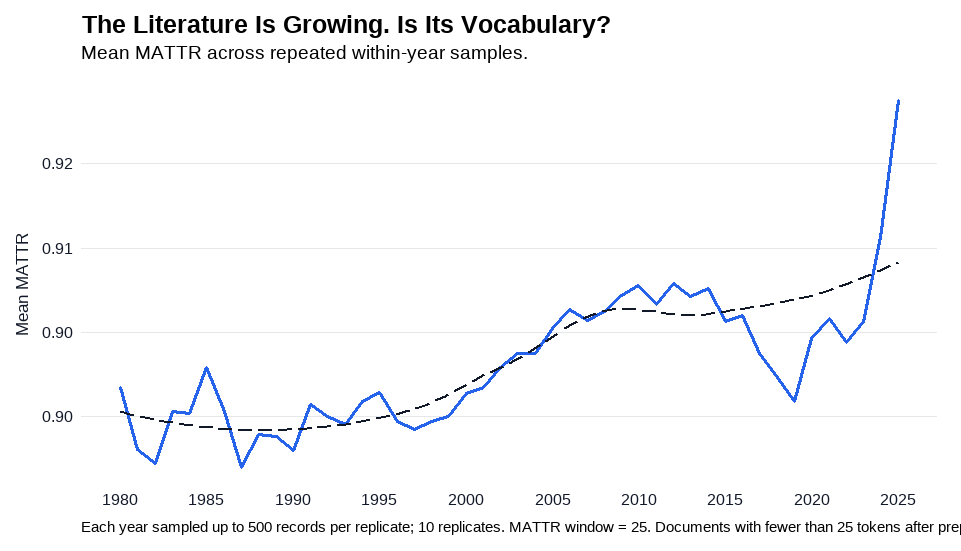
Figure 1. Lexical diversity among barrier-language abstracts, 1980-2025.
The first measure I examined is lexical diversity, which is simply a way of asking: How varied is the language that researchers use?
Imagine reading one hundred implementation papers. If every paper relies on the same handful of words and phrases, the literature has relatively low lexical diversity. If each paper introduces new concepts, new terminology, and different ways of describing implementation problems, lexical diversity is higher.
Measuring that is a little more complicated than simply counting unique words because longer documents naturally contain more vocabulary than shorter ones. A 10-page article will almost always use more distinct words than a one-page abstract, even if the writing style is equally repetitive.
To avoid that problem, I used a metric called the Moving-Average Type Token Ratio (MATTR). Rather than looking at an entire document at once, MATTR examines many small text windows, calculates how many unique words appear in each window, and then averages those values. This approach produces a much more stable estimate of vocabulary diversity because it is far less influenced by document length. In other words, MATTR tells us how much linguistic variety a reader would encounter as they move through the literature.
The results were surprisingly stable across repeated within-year samples. Mean MATTR increased only slightly, from 0.902 in 1980 to 0.919 in 2025. On its face, that is good news. The implementation science literature is not becoming repetitive in the sense that every paper is using exactly the same words. Researchers continue to introduce new ideas and new terminology, and the vocabulary has expanded modestly over time.
The more interesting finding is not that MATTR changed. It is how little it changed.
During the same period, the implementation literature grew from just over 1,000 papers to more than 200,000. The field expanded by orders of magnitude. Thousands of new researchers entered the conversation. New journals appeared. New frameworks were proposed. Entire areas of implementation science emerged.
Yet the overall diversity of the language used to describe implementation problems barely moved.
That distinction matters because scientific growth is usually accompanied by conceptual growth. As disciplines mature, researchers often develop increasingly specialized vocabularies that allow them to distinguish between different mechanisms, theories, contexts, and types of interventions. Fields such as genetics, machine learning, and climate science have all seen their terminology become dramatically more nuanced as knowledge has accumulated.
One might expect implementation science to follow a similar path. If the literature is hundreds of times larger than it was four decades ago, we might also expect it to be describing implementation challenges in hundreds of increasingly precise ways.
Instead, the MATTR results suggest something different. The language has become slightly more diverse, but not nearly enough to keep pace with the field’s explosive growth. The vocabulary appears to have reached something close to equilibrium. Researchers are producing many more studies, but they are often describing implementation using much the same conceptual language.
More papers, in other words, do not necessarily mean more ways of thinking about implementation.
The Vocabulary Is Becoming More Concentrated
The second measure examines something slightly different. Instead of asking how many different words appear in the literature, it asks how evenly those words are used.
To answer that question, I calculated normalized Shannon entropy, a statistic borrowed from information theory. Shannon entropy was originally developed to measure the amount of uncertainty or information contained in a message. When applied to text, it measures how evenly words are distributed throughout a body of writing.
Imagine two conversations, each containing 1,000 different words.
In the first conversation, those words are used fairly evenly. No small group of words dominates the discussion, and the language feels varied. This conversation would have high entropy because there is considerable uncertainty about which word might come next.
In the second conversation, a handful of words recur while the remaining vocabulary appears only occasionally. Even though the total vocabulary is the same, the language feels much more repetitive. This conversation would have lower entropy because the next word is much easier to predict.
Because vocabulary size naturally changes as the literature grows, I used normalized Shannon entropy. Normalization rescales the measure so that values range from 0 to 1, allowing fair comparisons across years even though the number of published papers and unique words increased dramatically over time. Values closer to 1 indicate that word use is spread relatively evenly across the vocabulary. Lower values indicate that a smaller group of words accounts for an increasing share of the language.
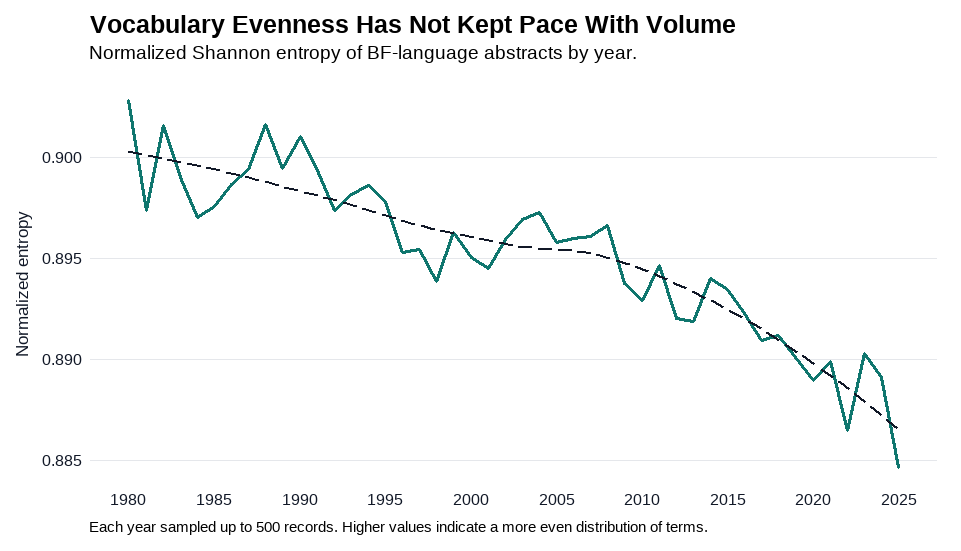
Figure 2. Normalized entropy of barrier-language vocabulary, 1980-2025.
Here, the trend runs in the opposite direction to lexical diversity.
Normalized entropy declined from 0.903 in 1980 to 0.885 in 2025. The numerical change is modest, but it is remarkably consistent across more than four decades of publication.
This finding does not mean that implementation papers are becoming identical or that researchers have stopped introducing new terminology. The MATTR analysis showed that new vocabulary continues to appear.
Instead, entropy tells us something subtler. As the implementation literature has grown, a relatively small collection of familiar words has come to account for a larger share of what researchers write. The vocabulary continues to expand, but the conversation increasingly revolves around the same recurring concepts and descriptors. Some words have become the workhorses of implementation science.
In practical terms, this means that if you opened a random implementation paper today, the language you encountered would probably feel quite familiar if you had been reading the literature for years. The field has developed a stable way of talking about implementation challenges, and that vocabulary is being reused across an ever-growing body of research.
There are good reasons for this. Mature scientific disciplines often converge on a common vocabulary because shared language makes findings easier to compare, synthesize, and build upon. Researchers no longer need to invent new terms for every study because everyone understands what concepts like leadership, training, organizational culture, workflow, and stakeholder engagement mean.
The important question is whether that stability has reached the point of diminishing returns.
A shared vocabulary helps a field communicate efficiently. But if the same collection of concepts comes to dominate every discussion, it becomes harder to distinguish fundamentally different kinds of implementation problems. The literature may become increasingly fluent in describing barriers while becoming less precise about their nature and what should be done about them.
When Barriers Become the Universal Explanation
The barriers and facilitators framework has been enormously successful, and for good reason.
Before implementation science emerged as a distinct discipline, many studies evaluated whether an intervention worked but paid far less attention to what happened during implementation. A new clinical guideline might improve patient outcomes in one hospital but fail completely in another. A school-based intervention might succeed in one district but never gain traction elsewhere. Researchers could observe these differences, but they often lacked a systematic way to explain them.
The barriers and facilitators framework helped solve that problem. Instead of treating implementation as a black box, it encouraged researchers to ask the people actually doing the work. What made this intervention easier to adopt? What got in the way? What resources were missing? Which organizational conditions helped, and which ones slowed progress?
That shift was transformative because it acknowledged something practitioners had known all along. Implementation rarely succeeds or fails because of a single factor. Organizations are complicated systems. Staff is balancing competing priorities. Leaders face financial constraints. Policies change. Workflows evolve. Different stakeholders have different incentives and different definitions of success.
The barriers and facilitators framework gave researchers a practical language for organizing that complexity. It provided a structure that could be used across healthcare, public health, education, behavioral health, social services, and virtually any setting where evidence needed to be translated into practice. It also elevated practitioners’ voices by recognizing that the people implementing an intervention often understand its challenges better than anyone else.
That was a major conceptual advance for the field. Yet every successful framework eventually encounters the same challenge. The more useful a framework becomes, the more broadly people begin to apply it. Over time, it stops being one way of understanding a problem and gradually becomes the default way of understanding almost every problem. When that happens, categories that were once illuminating begin to stretch.
- A missing training module becomes a barrier.
- A broken reimbursement system becomes a barrier.
- A lack of trust becomes a barrier.
- A governance failure becomes a barrier.
- A staffing shortage becomes a barrier.
- A political conflict becomes a barrier.
- A power imbalance becomes a barrier.
None of these descriptions is wrong. Each of these issues can absolutely prevent successful implementation. The problem is that they represent fundamentally different kinds of challenges.
- Some arise because organizations lack resources.
- Some reflect misaligned incentives.
- Some are consequences of institutional rules that were established years earlier.
- Some stem from organizational culture or interpersonal relationships.
- Others reflect broader political struggles, historical inequities, or structural features of the systems in which organizations operate.
Calling each of these a “barrier” is a useful starting point because it identifies that something is standing in the way of implementation. It is not always a useful ending point.
Imagine visiting a physician because you have a persistent cough. Simply being told that you have “a respiratory problem” is technically accurate, but it is not sufficient for deciding what treatment you need. Viral infections, asthma, pneumonia, allergies, and heart failure can all produce similar symptoms while requiring completely different responses.
Implementation barriers are much the same.
Knowing that something is a barrier indicates that implementation is obstructed. It does not tell us whether the obstacle is logistical or political, temporary or structural, local or systemic, inexpensive to solve or impossible for a single organization to change. Those distinctions matter because they determine what organizations should actually do next.
As implementation science has matured, it has become increasingly effective at identifying barriers. The challenge now is becoming equally effective at distinguishing among different kinds of barriers and determining which ones deserve attention first.
That is where simple lists begin to reach their limits. They are excellent at describing complexity, but they are not always designed to help practitioners navigate it.
The Same Words Continue to Dominate
The first two analyses suggested that the vocabulary of implementation science has become surprisingly stable over time. Lexical diversity changed only modestly, while entropy indicated that word use has become slightly more concentrated around familiar terms.
A third analysis asks an even simpler question. How much of the conversation is dominated by the words that researchers use most often?
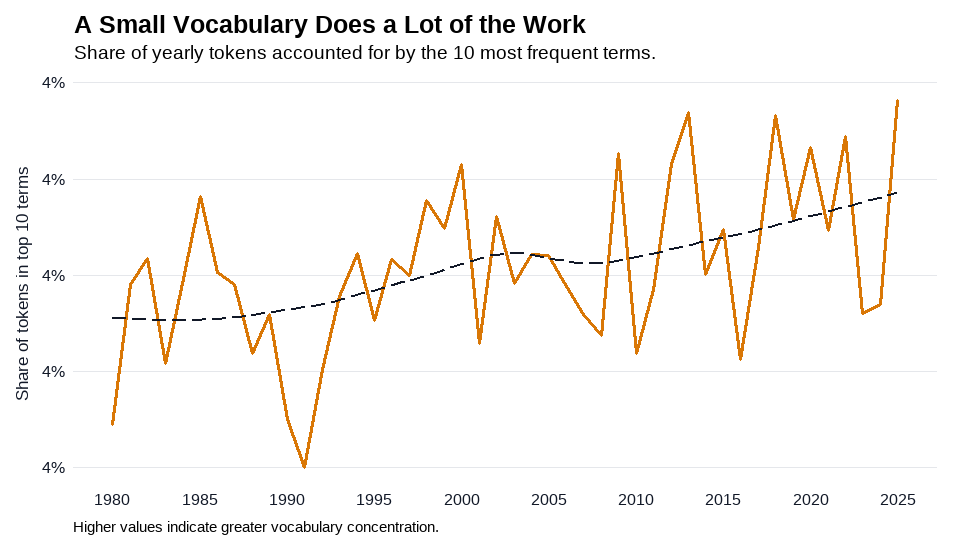
Figure 3. Top-term concentration in barrier-language abstracts, 1980-2025.
To answer this question, I calculated the proportion of all words in each year that came from the twenty-five most frequently used terms. Think of it as measuring how much of the literature is carried by its “greatest hits.”
If a scientific field is continually expanding its conceptual vocabulary, we might expect those most common words to become a smaller part of the overall conversation. As researchers develop more specialized language, new concepts begin to share the spotlight. The field becomes more linguistically diverse, and no small collection of words dominates the literature.
That is not what we observe. In 1980, the twenty-five most common terms accounted for 3.59 percent of all words appearing in the abstracts I analyzed.
By 2025, those same twenty-five positions accounted for 4.26 percent of all yearly tokens.
The numerical increase is modest, but the direction is important. Rather than becoming less dependent on its most familiar vocabulary as the literature expanded, implementation science became slightly more so.
Looking across decades reinforces this impression. Words such as patients, health, clinical, care, treatment, research, and challenge remain among the most common terms regardless of whether we examine the literature from the 1980s, the early 2000s, or the most recent years. Even as tens of thousands of additional papers entered the field, many of the same words continued to anchor the conversation.
Of course, this finding should not be overinterpreted. Every scientific discipline has core vocabulary. Physicists repeatedly talk about energy and force. Economists repeatedly discuss markets and incentives. Epidemiologists repeatedly write about risk, exposure, and disease. Stable terminology is one way a scientific community develops a shared language.
The question is not whether implementation science has common terminology. The question is whether that common terminology has become so broad that it begins to obscure important distinctions.
Words like barrier, facilitator, challenge, support, and context are useful because they allow researchers to communicate across different settings and disciplines. But their very flexibility also means they can be used to describe an enormous range of fundamentally different problems.
As those broad terms come to occupy a larger share of the literature, they risk becoming conceptual containers rather than precise explanations. They tell us that implementation is difficult, but they often tell us less about why it is difficult, which mechanisms are responsible, or where intervention efforts should be focused.
Taken together, the three analyses point toward the same conclusion. The implementation science literature continues to grow at an extraordinary pace, but much of that growth is occurring within a remarkably stable vocabulary. Researchers are publishing more papers than ever before, yet many of those papers continue to describe implementation using the same familiar conceptual language.
Description Has Become Easier Than Prioritization
One of the greatest accomplishments of implementation science has been demonstrating that implementation challenges are neither random nor mysterious.
Across thousands of studies, researchers have shown that organizations face many of the same obstacles when adopting evidence-based practices. Staffing shortages, inadequate training, limited leadership support, competing priorities, workflow disruptions, communication breakdowns, organizational culture, funding limitations, and stakeholder engagement recur across different settings.
That consistency has been enormously valuable. It reassured practitioners that implementation failure is rarely the result of individual incompetence or poor motivation. More often, organizations navigate a predictable set of constraints documented across healthcare, education, public health, behavioral health, and social services.
In many ways, implementation science has succeeded in building a shared understanding of what commonly gets in the way.
But the field now faces a different challenge. We no longer lack descriptions of implementation barriers. We have thousands of them. For someone beginning a new implementation effort, there is no shortage of studies identifying potential obstacles. If anything, the opposite problem now exists. The literature has become so effective at cataloging implementation challenges that practitioners can easily find themselves confronted with dozens of possible barriers before they have even started their project.
That creates a practical dilemma. Organizations almost never have the resources to address every problem they identify.
- Budgets are limited.
- Staff time is limited.
- Leadership attention is limited.
- Political capital is limited.
Every hour spent improving one aspect of implementation is an hour that cannot be spent somewhere else. As a result, implementation is fundamentally an exercise in prioritization. Practitioners rarely ask whether barriers exist. Instead, they are asking much harder questions.
- Which barriers deserve immediate attention?
- Which are merely symptoms of deeper organizational problems?
- Which are root causes that create multiple downstream challenges?
- Which can be addressed with relatively simple changes to workflows or training?
- Which require changes in reimbursement policy, organizational governance, or institutional incentives?
- Which interventions are likely to produce the greatest improvement for the effort invested?
These are fundamentally decision-making questions. Simply labeling something as “another barrier” does not provide the information needed to answer them.
A staffing shortage and a lack of trust may both obstruct implementation, but they differ dramatically in their causes, the people who can influence them, the resources required to address them, and the time horizon over which meaningful change is possible.
Treating them as equivalent barriers risks obscuring the strategic choices that organizations must make.
Implementation succeeds not because organizations eliminate every obstacle. That is almost never possible. Success comes from identifying the constraints that matter most and investing scarce resources where they are most likely to improve implementation.
The challenge facing implementation science, then, is no longer simply to identify barriers. It is to help practitioners distinguish among them. As the literature continues to grow, the greatest opportunity may lie not in producing longer lists of implementation challenges, but in developing better ways to prioritize, classify, and act on them.
That is the question the next post in this series takes up.
Why This Matters for Implementation Science
Every scientific field evolves. Early in its development, the most important task is often descriptive. Researchers identify new phenomena, develop a shared vocabulary, and build frameworks that help others see patterns that were previously invisible.
Implementation science has accomplished exactly that.
Over the past four decades, it has transformed the way we think about putting evidence into practice. Its methods have become more rigorous. Its theoretical frameworks have become more sophisticated. Its influence on healthcare, public health, education, and countless other fields continues to grow.
The text analyses presented here suggest that this success has also produced something unexpected.
As the literature has expanded, its descriptive language has become increasingly stable. Lexical diversity has grown only modestly. Word use has become slightly more concentrated. A familiar collection of concepts continues to organize an ever-larger body of research.
These are not signs that implementation science has stopped advancing.
If anything, they may be signs of a field that has reached scientific maturity.
Mature disciplines eventually develop a common language. Researchers begin to agree on terminology, frameworks, and recurring concepts. That shared vocabulary makes it easier to compare studies, synthesize evidence, and build cumulative knowledge.
But maturity also changes the questions that matter. The challenge is no longer discovering that barriers exist. The challenge is understanding which barriers are most consequential.
It is no longer enough to identify obstacles. We need to understand how different barriers interact, which ones are symptoms rather than causes, which ones can realistically be changed, and where organizations should invest their limited resources first.
In other words, implementation science may be approaching a transition from description to decision support. The field has become exceptionally good at helping us recognize implementation challenges.
Its next opportunity may be helping us decide what to do about them. That idea runs throughout this series. The first post asked why an explosion of implementation research has not necessarily made implementation easier. This post suggests one possible explanation. As the literature has grown, it has converged on a remarkably stable way of describing implementation problems. We have become increasingly skilled at identifying barriers, but not necessarily at distinguishing which barriers deserve our attention first.
So, next time: if organizations already know they face dozens of implementation barriers, how can they decide which ones are truly worth solving?