

Open Science Practices: A New Dawn for Behavioral Addiction Research
Charlotte, an early-career researcher at the University of British Columbia, sits at her desk immersed in her latest project on gambling addiction. Facing her screen, she contemplates the open science practices she just learned about at a recent conference. Like many in her field, Charlotte is part of a growing movement determined to make behavioral addiction research more transparent and reliable.
Understanding the Issue
The ‘replication crisis’ has rocked the field of psychology, stripping away trust in many foundational findings that proved difficult to reproduce. This has led to the emergence of the open science movement, advocating for research that is accessible, transparent, and reproducible. However, not all psychological fields, including behavioral addictions (a domain that includes excessive gaming and gambling), have fully embraced these practices. Given the high public health stakes, it’s crucial that the field advances its methods to ensure credible research outputs.
The Problem
Despite its relevance to public health and policy, behavioral addiction research hasn’t widely adopted open science practices. Concerns about data integrity, participant confidentiality, and the industry’s influence may contribute to this hesitancy. According to recent research by Eben et al. (2023), there’s a pressing need to understand current open science adoption rates, barriers, and support needs in the field.
The Evidence
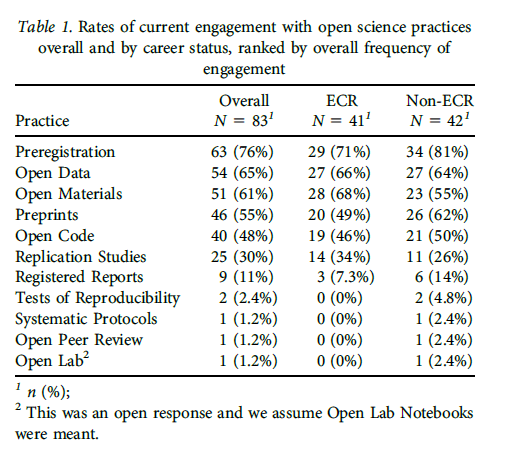
An exploratory survey by Eben et al. distributed to behavioral addiction researchers revealed key insights. Of the 83 eligible responses, 76% used preregistration, and 65% engaged in data sharing. Interestingly, early-career researchers (ECRs) valued open science practices more than their established counterparts—highlighting a possible generational shift (see Table 1 below). Established researchers cited workload and lack of incentives as barriers, while ECRs worried about insufficient knowledge and making errors.
What This Means in Practice
- For local health departments: Encourage collaborations with academic institutions to participate in open science training and workshops.
- For NGOs and researchers: Leverage open access platforms to share findings and methodologies, enhancing transparency and public trust.
- For policymakers: Support regulations that incentivize data sharing and preregistration to enhance the credibility of research in public health.
Barriers and Solutions
Key Barriers
- Resource constraints: Many researchers, especially ECRs, cited a lack of time and resources to implement open science practices.
- Cultural and institutional support: There is a need for a supportive culture and environment facilitated by institutions and professional associations.
Future Pathways
- Policy design: Develop policies that facilitate the adoption of open science by providing adequate training and infrastructure support.
- Funding opportunities: Allocate funding specifically to projects that incorporate open science practices to encourage widespread adoption.
Reflective Questions
As we push for broader adoption of open science practices in behavioral addiction research, consider the following:
- How might your agency or organization integrate open science practices locally?
- What resource constraints do you foresee in applying these practices?
- Does this challenge your previous assumptions about research transparency and reliability?
Engaging in these reflective questions can pave the way for actionable strategies and collaborations to foster a culture of openness and methodological rigor in behavioral addiction research.