
Rethinking Health Equity through Lifecourse, Technology, and Policy: Insights from Recent Public Health Studies
Public health today faces complex challenges from social determinants rooted in families and communities to the rapid adoption of new technologies and evolving policy landscapes. Recent studies illuminate how early life environments, emerging AI tools, lifestyle behaviors, and targeted policies intersect with health equity, shaping outcomes across the life course. This week’s blog unpacks these findings and discusses their implications for public health systems, policy design, and equitable health promotion.
Parental Prenatal Influences: Beyond Maternal Behaviors to Socioeconomic Contexts
A large multicohort study scrutinized how prenatal parental behaviors like smoking, alcohol, caffeine consumption, and socioeconomic position (SEP) relate to a broad set of child health outcomes up to age 11. Drawing on data from over 230,000 UK and Norwegian children, the research is notable for including paternal behaviors alongside maternal factors and rigorously triangulating evidence through genetic and dose-response analyses. Key findings reveal only a few clear links between specific prenatal behaviors and child health. Maternal smoking was consistently associated with a higher risk of small-for-gestational-age births, elevated childhood BMI, depressive symptoms, and behavioral issues; partner smoking was related more to childhood BMI and social communication difficulties. More strikingly, low socioeconomic position showed a stronger and wider influence on child health outcomes than parental health behaviors during pregnancy. These results have important public health implications. They suggest that interventions focused narrowly on individual maternal behaviors may be less impactful than those addressing broader social inequalities. Equity-centered policies that target familial socioeconomic disadvantages, such as poverty, housing instability, and access to resources, could yield more substantial and durable improvements in maternal and child health. The study’s public web tool ‘EPoCH Explorer’ further encourages cross-study validation, emphasizing transparency and reproducibility in advancing population health knowledge.
Measuring the Equity Impact of AI in Healthcare Systems
Artificial intelligence is poised to be transformative in healthcare delivery, yet concerns about equity gaps persist. An insightful viewpoint introduces the AI in Healthcare Equity Index (AIHEI), a composite framework designed to quantify equity across five domains: data representation, algorithmic fairness, transparency, governance, and community impact. By generating a unified score, the AIHEI could help health systems and policymakers compare technologies and incentivize improvements geared toward underserved populations—especially in low- and middle-income countries where AI benefits have historically lagged. This initiative moves AI equity from abstract ethical commitments to tangible assessment and accountability mechanisms. For public health systems, instituting frameworks like AIHEI can mitigate the risk that biased datasets or opaque algorithms exacerbate existing disparities. It also calls for rigorous post-deployment monitoring and inclusive governance structures. Integrating health equity metrics into AI tool approval, procurement, and funding decisions aligns technology innovation with social justice imperatives, hopefully steering AI to narrow rather than widen health gaps.
Policies to Reduce Youth E-Cigarette Use: Enforcement is Key
Flavored e-cigarettes attract youth and young adults, prompting many U.S. states to enact flavor restrictions. A qualitative comparative analysis identifies the specific enforcement elements linked to declines in e-cigarette use among young adults (18–24 years): state authority to suspend licenses or confiscate products, local authority to fine violators, routine compliance checks, and involvement of local and health department enforcement. Interestingly, these enforcement configurations correlated with no reductions among adults aged 25 and older, suggesting that robust enforcement may deter initiation among youth while facilitating cessation or harm reduction among adults. No single enforcement condition was sufficient to reduce use among high school youth, indicating that complex, multi-component strategies are essential. The takeaway for policy advocates is clear: crafting effective tobacco control policies requires strong legal authority and monitoring infrastructure paired with community engagement. To maximize equity, states should ensure enforcement resources are adequate, and interventions do not disproportionately burden marginalized communities but rather protect them from targeted marketing of nicotine products.
Promoting Active School Travel: Balancing Benefits and Challenges
Traffic restriction schemes outside schools have been introduced to encourage walking and cycling, with aims to reduce pollution, congestion, and improve child safety. A qualitative study across UK regions reveals that increased inconvenience of car travel prompts many families to switch to hybrid or fully active travel modes. However, experiences vary widely depending on baseline travel habits, local infrastructure, and community acceptance. The study underscores that successful implementation depends on meaningful consultation, supportive infrastructure—like safe walking paths—and framing policies around children’s health and safety to build momentum. Unintended consequences such as displaced traffic and challenges for families needing motorized access caution against one-size-fits-all policies. From a health equity perspective, these findings highlight that infrastructural and social supports are fundamental to ensuring all families can benefit from active travel initiatives. Policymakers must engage communities continuously and align schemes with broader urban and environmental policies to sustainably improve health and reduce environmental inequities. –
Lifestyle, Age, and Health in Global Contexts
A 2026 cross-sectional study from the Kurdistan Region of Iraq reports that nearly two-thirds (65.4%) of adults surveyed exhibit unhealthy lifestyles, highlighting high NCD risk. Older adults and those reporting better health tended to have healthier lifestyles, whereas gender, BMI, and socioeconomic factors showed no independent association. Although sample limitations exist, these findings call for culturally tailored health promotion targeting young adults and underscore the global challenge of lifestyle-related diseases. Further, a systematic review linking adolescent smoking—though not conclusively adolescent alcohol use—to modestly increased breast cancer risk in adulthood reiterates the importance of early prevention efforts. This evidence emphasizes adolescence as a critical window for interventions to modify risk behaviors with potential long-term benefits. Finally, a qualitative study exploring premature ovarian insufficiency spotlights how gendered ageism and healthcare system misrecognition exacerbate challenges for women experiencing early menopause. This calls for more inclusive clinical frameworks and equity-aware healthcare policies that recognize diverse aging trajectories.
Conclusion
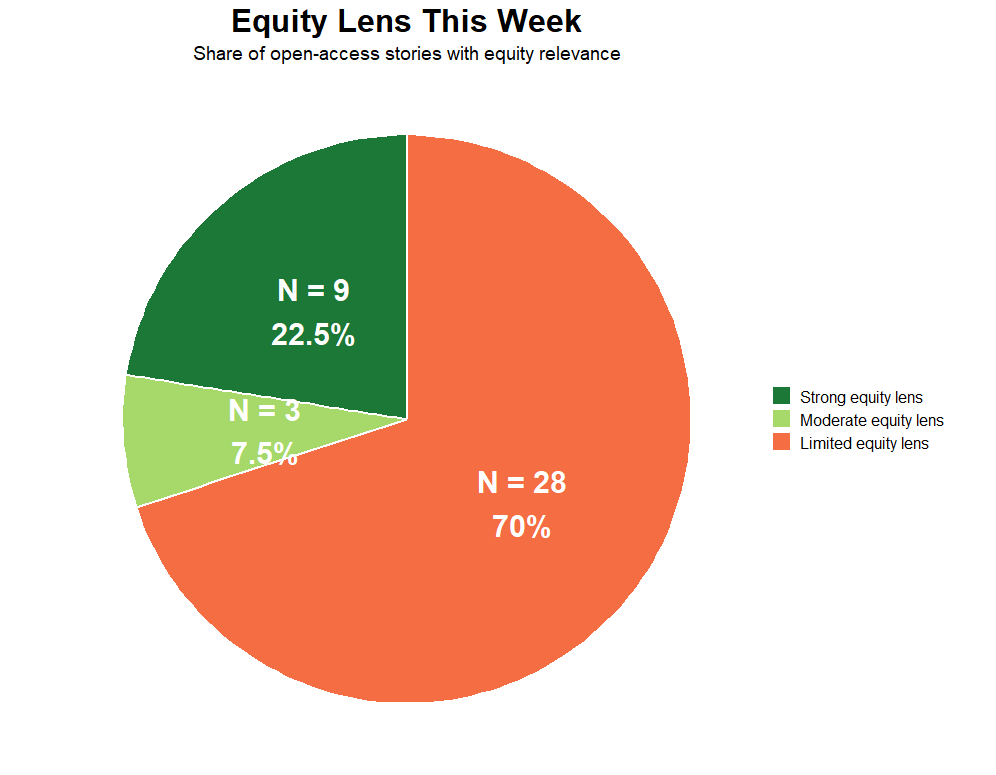
Together, these studies reinforce that achieving health equity requires multisectoral approaches addressing social determinants, robust policy enforcement, equitable technology deployment, and culturally sensitive health promotion. Public health systems must evolve to incorporate data transparency, community engagement, and rigorous evaluation tools that respect diverse life courses and lived experiences.