
NIH’s Unified Funding Strategy: Transparency Reform or Quiet Power Shift?
On February 23, 2026, leaders from across the National Institutes of Health (NIH) published a coordinated blog post in support of the agency’s new Unified Funding Strategy (UFS). The reform promises consistency, flexibility, and clearer decision-making across Institutes and Centers. It also eliminates one longstanding feature of NIH funding: paylines.
For public health researchers, implementation scientists, and early-stage investigators, this change deserves careful attention. On paper, the UFS appears to be administrative streamlining. In practice, it may reshape how billions of federal research dollars are allocated and how transparent that process truly is.
What Is the NIH Unified Funding Strategy?
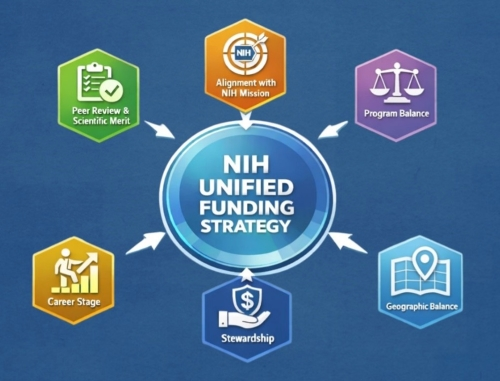
The UFS establishes a standardized set of principles across all NIH Institutes and Centers (ICs). Funding decisions will now formally rely on six core factors:
- Peer-reviewed scientific merit
- Alignment with NIH mission
- Program balance
- Geographic balance
- Career stage
- Stewardship of available funds
Applications still undergo two levels of peer review and Advisory Council input. Institute Directors retain final authority.
The most notable change is the elimination of paylines. Previously, many ICs published percentile thresholds below which grants were likely to be funded. Now, funding decisions will not rely on numerical cutoffs.
NIH leadership argues this codifies what many Institutes were already doing. But the shift from publicly visible paylines to discretionary balancing raises important questions.
The Case NIH Is Making
Across Institutes, directors emphasize three themes:
- Flexibility over rigid cutoffs
- Continity with past practices
- Commitment to peer review as foundational
Leaders at institutes such as the National Cancer Institute, the National Institute of Mental Health, the National Institute on Drug Abuse, and the National Institute on Minority Health and Health Disparities all stress that peer review remains central.
They argue that removing paylines allows Institutes to:
- Support innovative or interdisciplinary proposals that may not score perfectly
- Protect early-stage investigators
- Address geographic imbalances
- Fill strategic portfolio gaps
- Respond to emerging public health priorities
From a management perspective, this makes sense. Science funding is not mechanical. Percentile cutoffs can exclude transformative work. But flexibility always has a trade-off.
The Transparency Question
Paylines were imperfect. But they were legible.
Investigators could estimate their funding probability. Institutions could forecast. Early-career scientists could make informed decisions about resubmission, job searches, or bridge funding.
Under UFS, decisions rely on broader criteria and the Director’s discretion. NIH promises to document internally funded decisions. However, it does not promise publicly detailed explanations of why one application was selected over another at similar scores.
For an agency that distributes more than $45 billion annually, transparency is not a luxury. It is foundational to trust.
This matters particularly for public health fields that already experience funding volatility, including community-based research, health equity interventions, and implementation science.
Equity: Opportunity or Risk?
Several Institutes highlight geographic balance and career stage as explicit criteria. In theory, this could support:
- Underfunded institutions
- Rural research hubs
- Historically marginalized investigators
- Early-stage scientists
For example, NINDS notes it will apply greater stringency to applications from already well-funded investigators. NIGMS has long emphasized broadening geographic distribution.
If implemented rigorously, this could rebalance structural inequities in NIH funding.
But equity language without public reporting can also obscure power consolidation. Without published metrics, external observers cannot easily assess:
- Whether geographic balance improves
- Whether early-stage investigator funding rates rise
- Whether disparities narrow
In the era of heightened political scrutiny of federal agencies, removing numerical paylines may invite criticism from both sides: those who believe NIH is too bureaucratic and those who fear it may become too discretionary.
Investigator-Initiated Research Emphasis
Another major signal in the blog: NIH is shifting toward more investigator-initiated research and fewer solicited funding opportunities.
That could strengthen creativity and reduce administrative burden. Parent Announcements and broad FOAs may empower researchers to shape agendas rather than chase narrowly defined calls.
But again, the question is implementation. Will Institutes truly fund high-risk ideas? Or will programmatic discretion quietly favor proposals that align with Administration priorities or internal strategic shifts?
NCI explicitly notes alignment with “Administration priorities” in its decision-making. That phrase is subtle but important. NIH is a federal agency. Political winds shift.
Without paylines, political influence becomes harder to detect.
Public Health Implications
For public health researchers, several strategic adjustments are worth considering:
1. Relationships Matter More
NIH repeatedly encourages communication with program officers. In a discretionary system, these conversations become critical.
2. Mission Alignment Must Be Explicit
Applications should clearly articulate how they fit Institute priorities and portfolio balance.
3. Score Alone Is No Longer Predictive
A strong score helps, but does not guarantee funding. Investigators near traditional payline ranges may face more uncertainty.
4. Portfolio Framing May Influence Outcomes
Programmatic fit, cost considerations, and geographic distribution may increasingly shape decisions.
For implementation scientists and community-engaged researchers, this could be an opportunity. Institutes may have more flexibility to support real-world intervention science that does not always achieve perfect mechanistic clarity.
But uncertainty increases psychological strain in an already hyper-competitive funding environment.
Is This Reform Necessary?
NIH leadership frames UFS as modernization. In many ways, it formalizes existing informal practices.
However, the timing matters. Federal research funding faces political pressure. Fiscal constraints remain. Public trust in science institutions is fragile. In that context, removing publicly visible numeric guardrails is a bold choice. The UFS could:
- Enhance strategic coherence across Institutes
- Improve equity through deliberate balancing
- Strengthen support for early-career researchers
Or it could:
- Reduce predictability
- Concentrate discretionary authority
- Make bias harder to detect
The difference will lie in execution and transparency.
What Should We Watch?
Public health professionals should monitor:
- Funding rate trends for early-stage investigators
- Geographic distribution data
- Success rates by research type
- Changes in portfolio diversity
- Public reporting practices on decision rationales
If NIH pairs flexibility with robust reporting dashboards, trust may grow. If flexibility is not matched with measurable transparency, skepticism will deepen.
The Bottom Line
The NIH Unified Funding Strategy is not simply administrative reform. It is a structural shift in how federal science funding decisions are framed and justified.
Paylines are gone. Discretion is formalized. Equity and mission alignment are elevated.
For public health researchers, this moment calls for cautious optimism paired with vigilance.
The promise of flexibility is real. So is the risk of opacity.
In a funding ecosystem that shapes the future of cancer care, mental health treatment, infectious disease response, aging research, and health equity, clarity is not optional.
The next year will reveal whether the UFS becomes a model of modern stewardship or a case study in how transparency can quietly erode under the banner of efficiency.