Why 5G Matters for Bees, Birds, and Public Health
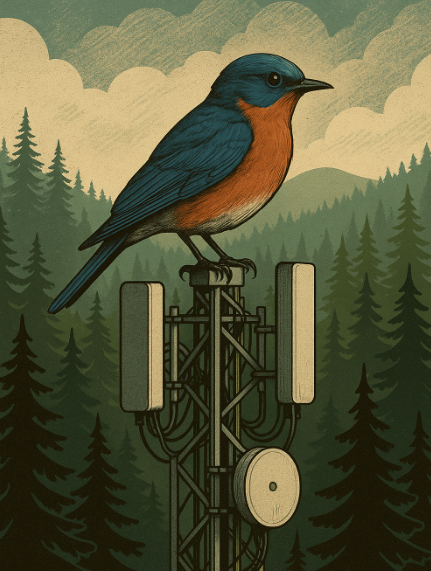
Just after sunrise, a small flock of migratory birds lifts from a patch of coastal marshland. They rise, circle, and attempt to orient—yet something is off. Their compass seems scrambled. Instead of settling into their usual migratory path, the birds loop again, drifting dangerously close to the new 5G small-cell transmitters mounted along a nearby road. Scenes like this are becoming more common—and more concerning.
A new Frontiers in Public Health review argues that our wireless infrastructure is creating a novel, 24/7 layer of electromagnetic exposure with no natural precedent, and that the ecological consequences may be far broader than most public health agencies realize.
This isn’t fear-mongering. It’s an emerging environmental health issue—one with direct implications for biodiversity, ecosystem stability, agriculture, and yes, human health.
What the Study Examined
The review synthesizes more than 1,000 studies on how nonionizing electromagnetic fields (EMF) from 0 to 300 GHz interact with plants, insects, birds, mammals, and aquatic species. It highlights a central truth:
Wildlife evolved within stable geomagnetic fields—not the pulsed, complex, multi-frequency signals now blanketing the planet.
The authors trace how exposures have grown exponentially over the last 60 years—from early telecommunications to 4G, and now to 5G and emerging 6G technologies—creating a constant, chronic “electromagnetic smog” that living systems were never designed to navigate.
They also note a critical regulatory gap: all existing EMF exposure standards are written only for humans, not wildlife.
Key Insight #1
Wildlife senses electromagnetic fields far more acutely than humans
Humans perceive only a narrow band of the electromagnetic spectrum—visible light. But many species rely on magnetoreception to migrate, find food, mate, and orient themselves. Birds, turtles, salmon, bats, insects, and even some plants use Earth’s magnetic fields as an internal GPS. Across species, researchers have identified:
- Magnetite-based receptors in beaks, antennae, and tissues
- Cryptochromes in the retina that act as chemical compasses
- Ultra-sensitive electroreceptors capable of detecting signals as low as 5 nV/cm—the electrical field of a shrimp’s muscle pulse
This evolutionary sensitivity makes low-intensity, human-made EMFs particularly disruptive.
Key Insight #2
Low-intensity EMFs—not just high-power signals—can trigger biological effects. A core misconception in EMF policy is that only high-power exposures cause harm.
The review shows the opposite: hundreds of studies document effects at intensities comparable to what wildlife experiences near cell towers, small cells, or even ambient background levels. Observed effects include:
- Disorientation in migratory birds
- Impaired pollination and stress reactions in bees
- Altered growth, germination failure, and dieback in trees
- Behavioral changes in mammals
- Disrupted circadian rhythms in plants and animals
- DNA damage, metabolic changes, and oxidative stress in insects and small vertebrates
- Potential links to colony collapse disorder in honey bees
These findings are not fringe. They appear repeatedly in peer-reviewed journals—and they match field observations near infrastructure.
Key Insight #3
5G is fundamentally different—and insects may be most at risk. The paper highlights a stark fact:
5G introduces signaling characteristics—beamforming, phased arrays, millimeter waves—that have never been used at this scale in civilian environments. Computer modeling studies show:
- A 10% shift of environmental signals from below 3 GHz to 5G frequencies can triple RF absorption in honey bees.
- In near-field exposures (where many insects live or fly), absorbed power can increase up to 53-fold.
- At just 1 mm from a transmitter, bees can absorb up to 26% of the antenna’s emitted power.
Insects already face steep declines due to habitat loss and climate change. Add strong EMF absorption—and poor thermoregulation—and the risk compounds. If pollinator species decline further, the cascading public health impacts on food security and ecosystems could be severe.
Key Insight #4
Trees and plants are responding—and not in a good way*
One of the most striking findings: trees near cell towers exhibit progressive defoliation and dieback, especially when 5G small cells are mounted on utility poles close to their canopies.
Plant cell walls contain large amounts of water, making them more likely to absorb RF energy. Unlike static or extremely low frequency fields—which sometimes enhance growth—RF tends to impair germination and vitality. Urban forestry initiatives may face a new but poorly recognized threat.
Policy Gap: Airspace as Habitat
The authors propose a transformative shift: Recognize airspace as habitat.
Birds, bats, and insects rely on the air column just as fish rely on water and mammals rely on land. Yet EMF is not regulated as a form of environmental pollution. By reframing airspace as ecological habitat, regulators could:
- Incorporate EMF into environmental impact assessments
- Protect migratory corridors
- Adjust infrastructure placement
- Create EMF-reduced zones during sensitive breeding and migration periods
This is a practical, public-health-oriented way forward—and one that aligns with NEPA, the Migratory Bird Treaty Act, and the Endangered Species Act.
What This Means in Practice
For local health departments
- Incorporate electromagnetic fields into environmental health scans.
- Consider EMF alongside climate, pollution, and land use factors in wildlife and ecosystem assessments.
- Collaborate with parks departments and wildlife agencies to identify sensitive habitats.
For state & federal agencies
- Update environmental review procedures to include EMF impacts.
- Re-establish expert review capacity at EPA and USFWS.
- Revisit exposure guidelines to include wildlife-specific thresholds.
For community-based organizations
- Track changes in pollinators, trees, and migratory birds and share observations with public agencies.
- Advocate for EMF considerations in local development reviews.
For researchers
- Expand cross-species modeling to understand resonance effects across taxa.
- Conduct long-term field studies near cell infrastructure.
Barriers Ahead
- Regulatory capture and industry resistance
- Lack of public awareness about EMF as an ecological pollutant
- Limited federal research infrastructure after decades of defunding
- Rapid rollout of 5G and 6G without environmental review
Despite these barriers, the paper offers a clear roadmap for science-based policy change.
What’s Next?
The authors call for:
- Large-scale, long-term ecological studies
- Wildlife-specific exposure limits
- Seasonal protections for migratory and sensitive species
- A national EMF monitoring system
- Interagency collaboration involving EPA, FCC, USFWS, NTIA, and others
This is a moment for public health to lead—not react.
Questions to Spark Discussion
- How might your agency integrate EMF considerations into environmental or wildlife assessments?
- What species or ecosystems in your region may be especially vulnerable?