
How “Gold-Standard Science” Has Been Weaponized in Public Health
As we close out the year, I want to revisit one of my least favorite trends. The misappropriation of scientific language.
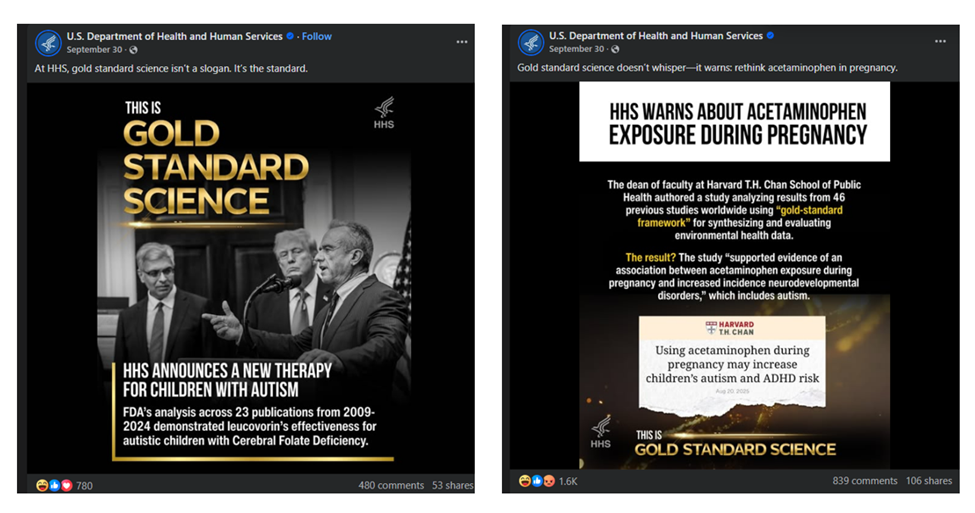
In public health, few phrases carry more authority than “gold-standard science.” It signals rigor, objectivity, and trustworthiness. But increasingly, this language is being repurposed—not to improve decisions, but to shut them down.
What was once a safeguard against bad policy is now often used as a rhetorical weapon: a way to delegitimize prevention, equity, community knowledge, and implementation work without engaging their substance.
This is not a crisis of science quality. It is a crisis of meaning.
When Rigor Stops Being Descriptive and Starts Being Strategic
“Gold-standard” is used to describe how evidence was produced. Today, it is often used to dictate which outcomes are allowed to exist. The shift looks subtle but has real consequences:
- Rigor becomes a binary label, not a spectrum
- Evidence becomes something you pass or fail, not interpret
- Context is treated as contamination rather than information
In this framing, science is no longer a tool for learning. It becomes a filter for exclusion.
The Narrowing of What Counts as Evidence
Weaponization begins with definition control. Only certain methods, typically randomized or highly controlled designs, are elevated as legitimate. Other forms of evidence are dismissed, regardless of relevance or necessity:
- Community-based data are labeled anecdotal
- Qualitative findings are treated as “preliminary” indefinitely
- Implementation evidence is deemed insufficiently causal
- Lived experience is excluded entirely
This narrowing is rarely neutral. It systematically privileges questions that can be answered cheaply, cleanly, and politically safely, while sidelining the kinds of questions public health actually needs to answer.
“Insufficient Evidence” as a Policy Tool
One of the most common misuses of gold-standard language is the phrase “the evidence isn’t strong enough yet.” On its surface, this sounds responsible. In practice, it often functions as:
- A justification for inaction in the face of known harm
- A reason to defund prevention while waiting for perfect certainty
- A way to avoid value-based decisions by disguising them as technical ones
This is not scientific humility. It is strategic delay. And delay, in public health, is rarely neutral.
How Meaning Gets Inverted
The most damaging aspect of weaponization is not exclusion—it is inversion. Terms that once expanded public health’s reach are turned against it:
- Rigor becomes a reason to ignore context
- Objectivity becomes a refusal to acknowledge power
- Neutrality becomes alignment with the status quo
- Evidence-based becomes justification for retrenchment
The language stays the same. The function flips.
Why This Hits Equity First
Equity-focused work is disproportionately vulnerable to this misuse of meaning. That’s because equity:
- Often depends on mixed methods
- Requires attention to history and power
- Produces benefits that unfold over long time horizons
- Prioritizes prevention over easily measurable outcomes
When gold-standard science is defined narrowly, equity is framed as unscientific by design, not because it lacks evidence, but because its evidence does not fit a constrained methodological box.
The Illusion of Neutral Science
Perhaps the most dangerous misconception is that this weaponization is apolitical. In reality, deciding what counts as valid evidence, which outcomes matter, how much uncertainty is acceptable, and when action is justified are value-laden decisions, even when expressed in technical language.
Invoking the gold standard of science does not remove politics from public health. It often conceals it.
What Gets Lost When Meaning Is Misused
When gold-standard language is weaponized, public health loses:
- Learning, because complexity is treated as failure
- Trust, because communities see evidence used selectively
- Prevention, because action is postponed until it’s too late
- Accountability, because harm is framed as methodological inevitability
Most critically, it loses its moral clarity.
Reclaiming Meaning Without Abandoning Rigor
This is not an argument against rigor. It is an argument against rigor as rhetoric.
Reclaiming gold-standard science requires restoring its original purpose:
- Rigor as a tool for understanding reality, not policing it
- Evidence as input to judgment, not a substitute for it
- Methods as means, not moral arbiters
Public health does not need less science. It needs science whose meaning has not been hollowed out.
The Bottom Line
When “gold-standard science” is used to narrow possibilities, delay action, or silence equity, it stops being a safeguard and starts being a weapon.
The danger is not bad evidence. It is good evidence used badly—precisely, selectively, and with authority.
And unless public health professionals confront how meaning is being misused, the language of rigor will continue to do work it was never meant to do.