A Conversation with Christopher Weatherly
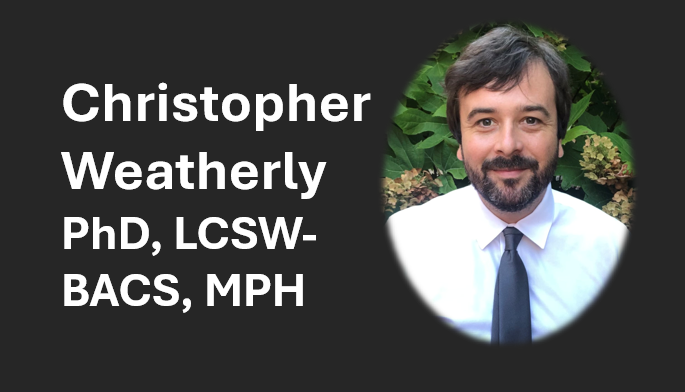
Chris Weatherly is a licensed clinical social worker and an Assistant Professor at the University of Georgia’s School of Social Work whose work sits at the intersection of rural mental health, climate change, and community resilience. With more than a decade of clinical experience across acute psychiatric settings, post-disaster environments, and rural communities, he brings a grounded, practice-informed lens to questions that often get swept into partisan debates. His research uses qualitative and participatory methods to understand how environmental change, species loss, and land degradation shape mental well-being, with a particular focus on farmers and other land-dependent populations. Chris is also expanding the mental health dimensions of the One Health framework and examining the structural inequities that leave rural residents especially vulnerable.
In addition to his academic work, Chris continues to practice as a mental health clinician and provides peer support for fathers in Athens, Georgia. His teaching centers on mental health, environmental justice, and preparing new social workers to navigate resource-depleted systems where burnout, high caseloads, and eroding safety nets are everyday realities. Across his roles as researcher, educator, and clinician, his commitment remains the same: reducing suffering, strengthening rural mental health systems, and amplifying the voices of communities who are too often left out of conversations about climate and care. It is from this lived and professional perspective that Chris joined us to talk about farmer mental health, ecological grief, and what a just climate response must look like for rural communities.
Farmers in your research said, “At some point, you just run out of road.” What does that phrase capture about the mental health crisis in rural and agricultural communities today?
Yeah, so for me, that phrase really captures a sense of helplessness…this feeling that farmers are more and more losing control over the viability of their operations. And there’s also this deeper helplessness that comes from knowing that no one outside their profession or their families, because so many farms are family-run, really understands what’s happening to them. That’s shocking when you think about how much we rely on food.
So when you put those two things together, “the end of the road” can mean a lot of things. It can mean selling the family farm, which is a very real possibility. And for many, that means selling something that’s been in the family for four or five generations. There’s a real sense of failure tied up in that. But “the end of the road” also speaks to another, much darker possibility: suicide.
Farmer suicide is a stark reality. Rates are two to five times higher than the general population, along with higher rates of depression, anxiety, and substance use. The question is why, and that’s what my research and a lot of other people’s research is trying to understand. It’s a complex problem. For one, rural areas in general have very limited mental health services. And farmers face so many compounding stressors: increasingly unpredictable weather, financial instability, labor shortages, rising input costs—just this economic landscape that keeps getting more uncertain. And on top of that, farming is just a stressful job. It always has been.
One thing I always want to note, because it’s important, is the incredible resilience in farming communities. I know “resiliency” is a buzzword, but it’s true. There’s a real pioneer spirit. Most people could not do this work. I worked on a farm for just a couple days and it was immediately obvious how hard it is. That resilience should be recognized and celebrated. But resilience also comes at a cost. Everyone has a breaking point. And when anything related to mental health is treated as weakness, stigma grows. Then suicide, unfortunately, becomes what some farmers see as the only option. This pattern is common among farmers, among men, and broadly in rural populations.
Additionally, and especially tied to the paper you mentioned, is that we should be careful about who we’re talking about when we say “farmer.” It’s a really broad category. It can include someone running a multimillion-dollar operation who rarely sets foot on the farm, or a small family farm where the income is mostly supplemental. A lot of my work focuses on mid-size farmers because these mid-level operations are incredibly important. They’re the backbone of the U.S. chain of family farms and rural communities. When that quote says “you just run out of road,” it really refers to those mid-size farms disappearing. They’re being swallowed up by large-scale operations because the economic system favors consolidation.
So, yeah, this is a real issue for farmers and for rural America. And just to underscore how tough things are, many adult children of farmers don’t want to inherit the family business. So now we’re also facing a succession crisis.
And that brings me to the real question underneath all of this, which is, what do we want our agricultural landscape to look like? Do we want it shaped by intergenerational farmers who carry institutional wisdom? Or do we want it dominated by large corporate conglomerates that prioritize efficiency and profit over community well-being and ecological care?
To zoom out a bit, my next question is about ecological grief. You’ve described how climate change, species loss, and environmental degradation affect mental well-being. What does that actually look like in the communities you work with?
Yeah, so I see this both as a researcher and as a mental health clinician, mm-hmm. In the mental health world, we have terms to describe how people express distress, symptoms, diagnoses, all of that. And now we’re seeing a whole set of newer terms emerging because of the very real changes happening to our planet.
One of those is eco-anxiety, which is the worry about the future of our planet. It can shape big life decisions, like whether someone chooses to have children. Another is sotia, which is a newer word combining solace and nostalgia. It’s essentially a form of eco-grief. These terms overlap a lot. They describe grieving the loss of connection to land and places where people find comfort and grounding, mm-hmm.
And it’s important to note that this grief isn’t only about climate change. It can also come from things like land-use changes, mining, or even gentrification. The term “sotia” actually originated in mining communities dealing with environmental disruption.
Eco-grief and sotia show up strongly in groups deeply connected to the land, farmers, Indigenous communities, and, honestly, these communities have been feeling this kind of grief for far longer than our current climate crisis.
To specifically answer your question: what does it look like? It varies. There’s no single clinical presentation because people express emotion differently. It can look like despair, nihilism, or depression. It can show up as substance use or numbing behaviors. Sometimes it’s a sense of disconnection or hopelessness around the future.
And the last thing I’ll say is that eco-grief is almost never about just one thing. It’s layered. Climate change is part of it, but so are financial instability, intergenerational trauma, racism, and self-stigma. All these contextual factors that shape how people experience and express grief.
You mentioned the generational challenges farmers face, the succession crisis in particular. More broadly, there’s also this disconnect between farmers and the general public. How does that gap make it harder to address both individual needs, like mental health, and the larger public health issues connected to farming?
Yeah, I was actually thinking about this as I was walking into the building a few minutes ago. <laugh> Before I answer directly, I want to note that when we talk about disconnects between farmers and rural populations, it is easy to forget that all of us live in our own contextual, algorithm-driven bubbles. So this dynamic affects everyone, but it shows up in very specific ways for farmers.
There are a lot of contributing factors. Social media, the broader media landscape, and our political environment profit from division. There is also a widening rural–urban divide, which comes up constantly in my conversations with farmers. And going back to the first question about mental health, farming is an isolating profession in general. It is becoming even more isolating because of technology and because midsize farms are being swallowed up. Combine all of that with the stigmatization of mental health, a shrinking rural mental health workforce, and a shrinking rural public health workforce, and you end up with a lot of barriers.
Building from that, my work focuses on climate change and mental health. Farmers consistently show up as an at-risk population because their work depends so directly on the land. They are also among the people who most clearly see and feel the impacts of climate change. And this relates to your question because although climate change has a scientific definition, it also carries a political connotation that is tied to identity. Most farmers in the United States are politically conservative, and many feel alienated from that political conversation.
In my interviews, farmers often say, “Don’t bring up climate change.” And I have found that to be the wrong assumption. Farmers do want to talk about climate change. What they are reacting to is a sense of blame or frustration. The agricultural sector is indeed a major contributor to climate change, but farmers will say that they are responding to market and public demand. They are working within systems that influence their choices, just like doctors work within an insurance system that shapes how they provide care.
So there are many layers at play here. It is frustrating because these dynamics deepen division at the exact moment when many people are suffering and when we need collective solutions for complex problems. Farmer voices are essential, yet these layers of division make them feel far from the conversation.
And I feel that distance too, in my role as an academic, a mental health professional, and someone who did not grow up in rural areas. I feel that physical and mental divide in my own work.
There’s this broader rural health crisis, with hospitals closing across many regions. I imagine that even basic prevention programs, especially those focused on suicide, are scarce, fragmented, and unevenly evaluated. Are there any community-based strategies that seem most promising for treating and preventing suicide in rural communities?
Yeah. So I will start by speaking to how I have been approaching this topic. I am a researcher now, but like I mentioned, I am also a mental health clinician. I have worked in rural areas at different points in my professional life. And while it is easy to say that rural areas are different from urban ones, it is a completely different experience to actually see that difference.
It is also easy to cast rural communities as places that are struggling or facing multiple crises. And while many rural areas are dealing with serious challenges, there is a lot of beauty and strength there too. The mental and physical health landscape in rural communities is simply very different, and it is an understudied context. I always want to name that.
To answer your question more directly, what rural communities need around suicide prevention are comprehensive, community-based approaches. No single strategy is enough on its own, especially in places where resources are scarce, stigma is high, and people tend to rely on informal support systems. And honestly, very few people like to go to therapy. That is true everywhere, but it is especially clear in rural areas.
So what effective strategies look like can include strengthening peer support networks. This is something I have worked on personally. It can mean offering suicide prevention training to trusted community members such as extension agents, agricultural lenders, feed store employees, clergy, teachers, and general health practitioners. These are the people rural residents naturally talk to when they are stressed. In my work with farmers, livestock veterinarians even came up as a kind of unofficial therapist. That was fascinating to see.
A couple more things feel important before concluding. First, rural is a helpful category, but it is extremely broad. Rural Alaska looks nothing like Appalachia, or the Louisiana bayou, or the rural Midwest. So there is no one-size-fits-all model. The most effective interventions are those that build on existing sources of resilience and strengthen the capacities that are already there. Top-down approaches from outsiders, including people like me sitting in an academic tower, rarely work.
And finally, people often talk about the value of informal care networks or family support. Those matter, but it is much easier to be resilient when there are strong and robust systems of care surrounding those informal networks. Right now, as you mentioned, rural healthcare systems are eroding. And while the political will for universal healthcare feels absent, increasing insurance availability and strengthening rural mental health systems will always be necessary.
As a clinician, one of the most beautiful things I witnessed was the impact of the Affordable Care Act and Medicaid expansion. I saw immediately how increased access to care could support people affected by the opioid crisis or those struggling with suicidality. Access matters. It is what allows all those existing forms of rural resilience to actually work.
You mentioned the defensiveness that can come up for farmers around climate change. The reality is that many rural communities contribute the least to emissions, yet they often face some of the greatest harms. These are not industrial areas pumping out CO₂. So what would a just climate response look like for these communities, and what would it need to include?
Yeah. Oh my God, that is the question. And the thing I keep noticing, over and over, is this: who gets the microphone? The people who are usually talking about climate change tend to look a lot like me, and maybe like you. <laugh> Well-intentioned, academically minded, bearded white guys.
One of the best examples of climate justice I have ever seen was actually something I was not involved with at all. I witnessed it at my alma mater, Washington University in St. Louis, through an environmental clinic in the law school. It was truly community-rooted work with impoverished residents of St. Louis, who for many reasons are predominantly Black.
I went to this presentation where they talked about slumlords, high energy bills, and having to choose between paying for electricity or air conditioning or buying food for your kids. They described environmental racism and the realities of living in degraded environments. And what struck me was that they never once mentioned climate change. I sat there thinking, this is climate change, this is exactly what climate change looks like. But they never said the phrase. And that is the point.
There is a lot of baggage around the term climate change. We have to find ways to talk about these issues that resonate with the people living them. And when I say “we,” I include myself in that, sitting in a very privileged position. We need to give the microphone to the people who are most affected and who contribute the least to the problem. Without that, we are not going to solve anything.
A just climate response is not about measuring individual carbon footprints. It is about addressing systemic factors like food insecurity, racism, and these for-profit or government-sanctioned utility monopolies. These systems are often designed to prioritize the bottom line and maintain division rather than support communities or reduce environmental harm.
So that is one very specific example, but it reflects a bigger truth. This is a complex issue. And I keep coming back to the same questions: who gets the microphone, and who are we listening to? That applies to impoverished Black residents in St. Louis, to farmers in the rural Midwest, and to so many others. Their voices are needed if we want to move toward any kind of just climate future.