
Digital Health, Cancer Triage, and Equity: What This Week’s Research Says About Building Health Systems That Work
Digital health keeps showing up in policy conversations—as a way to improve access, coordination, and efficiency. But this week’s research also reminds us that “digital” is only one piece of a much larger system. Across Medicare primary care spending, cancer triage in primary care, social media communication, and disability and infection prevention barriers, a clear theme emerges: health equity depends on the whole pathway—financing, workforce, infrastructure, communication, and accountability—not just new tools.
Build Your Public Health Issue
Tell us a little about your work, and we’ll build a personalized issue with five things worth knowing.
Digital readiness and Medicare spending: what changed—and what didn’t
A study in the Journal of Medical Internet Research looked at whether communities with better access to digital technology spend less on Medicare primary care, especially at federally qualified health centers and rural health clinics. Researchers studied nearly 3,000 U.S. counties from 2017 to 2023 and found that counties with stronger digital systems generally had lower Medicare spending on these services. However, an important detail emerged: counties that were already more digitally developed tended to spend less, while improvements in digitalization within the same county over time were not clearly linked to lower spending. Counties that developed their digital infrastructure early and maintained it also tended to have lower costs. Health care access showed an especially strong connection with lower spending. These findings do not prove that better technology directly causes health care costs to fall. Instead, digital readiness may be one sign of broader differences between communities, including health care access, infrastructure, and local resources. For policymakers, the lesson is that simply adding new technology may not be enough. Digital investments may work best when they are part of a larger effort to improve access and strengthen local health systems, especially in rural and safety net communities.
Cancer triage in primary care: trends add signal (with limits)
A study in PLOS Medicine looked at whether changes in routine blood tests could help doctors identify cancer in people experiencing unexpected weight loss. Researchers studied more than 275,000 adults in England who visited primary care with unexpected weight loss, about 5% of whom were later diagnosed with cancer. Instead of looking only at whether a patient’s latest blood test was abnormal, the researchers examined how results from 26 different blood tests changed over time. In many cases, these trends did a better job of distinguishing people with cancer from those without it. Certain patterns were especially useful for particular cancers, including changes in red blood cells for bowel cancer and lymphoma and changes in white blood cells and neutrophils for lung cancer. The study has important limitations, including differences in which patients received repeated blood tests, so the findings do not mean that blood test trends alone can diagnose cancer. However, tracking changes in routine lab results could eventually help primary care providers decide which patients with unexpected weight loss need more urgent testing. If these tools are developed, researchers will also need to make sure they work fairly across different populations and real-world health care settings.
Health communication online: sentiment isn’t enough
A review in the Journal of Medical Internet Research examined how people talk about the HPV vaccine across social media. Researchers reviewed 50 studies published between 2012 and 2026 covering eight platforms, with X, Weibo, and YouTube receiving the most research attention. They found that conversations about the HPV vaccine included much more than simply positive or negative opinions. People discussed the vaccine’s benefits, safety concerns, misinformation, distrust, personal experiences, access problems, and vaccination policies. Personal stories were common and were often connected to concerns or negative experiences, while information from health professionals was less common but generally more useful and reliable. The researchers could not determine whether seeing these posts actually changed people’s decisions to get vaccinated, and studies differed widely in how they collected and analyzed social media content. Still, the findings offer an important lesson for public health communication: simply measuring whether online conversations are positive or negative misses much of what people actually care about. Effective communication should use trusted sources, address concerns openly, include meaningful personal stories, and recognize that distrust and access barriers can shape vaccination decisions.
Equity beyond access: disability-inclusive primary care and infection prevention
A commentary in the International Journal for Equity in Health argues that making primary health care accessible to people with disabilities is an important test of whether health systems are truly providing equitable care. People with disabilities can face barriers at nearly every step, including buildings that are difficult to enter, high costs, health information that is not accessible, poor communication with providers, stigma, weak referral systems, and limited access to rehabilitation services and assistive technology. The authors argue that improving access requires more than simply changing buildings or adding individual services. Health systems should track outcomes for people with disabilities, provide information in accessible formats, train health care workers, strengthen referrals, improve access to rehabilitation and assistive devices, and provide reasonable accommodations when needed. Importantly, people with disabilities and the organizations representing them should also have a meaningful role in planning and evaluating health services. The larger message is that disability access should not be treated as an extra feature of health care. It should be part of how health systems define quality, access, and health equity in the first place.
A study in BMJ Global Health examined infection prevention in three maternity units in Malawi with limited resources. Researchers found that basic supplies needed to prevent infections were not always available, and health care workers sometimes struggled to follow recommended practices for handwashing, vaginal examinations, surgical preparation, and keeping operating rooms sterile during cesarean sections. A lack of supplies created a direct safety problem, but it also reduced staff motivation, making infection-prevention practices even harder to maintain. At the same time, several factors helped staff provide safer care, including a strong commitment to patients, regular supervision from senior staff, and reminders about proper procedures. The findings show that preventing infections requires more than simply telling health care workers to follow guidelines. Hospitals need reliable supplies, supportive working conditions, supervision, and systems that make safe practices feasible in day-to-day care. This is also a health equity issue because access to a hospital means little if conditions inside make it hard to provide consistently safe care.
The bottom line
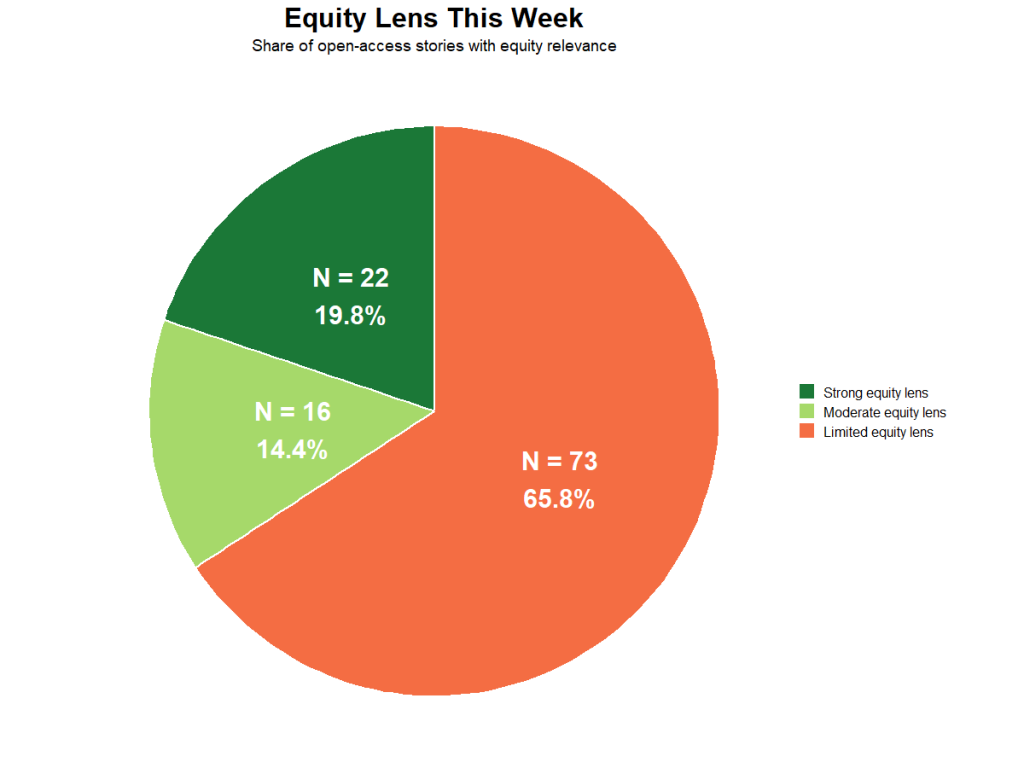
Across these studies, public health systems are revealed as complex, layered systems. Digital tools may correlate with lower spending in Medicare primary care, but the evidence suggests the association reflects structural capacity over time. Blood test trends may enable better triage signals, though modeling limits remain. Social media research shows that sentiment alone won’t explain what people see or why it matters. And equity requires disability inclusion, reliable infection prevention supports, and health system accountability that reaches beyond “access” as a single checkbox