Why Peer Support Matters: Lived Experience, Recovery, and Community Mental Health
There is a deceptively simple question at the heart of peer support:
Why can someone who has “been there” sometimes help in ways that a trained professional cannot?
This does not mean professional expertise is unimportant. Psychologists, physicians, social workers, counselors, and other professionals develop knowledge and skills that can be enormously valuable. But there is another kind of knowledge that is much harder to acquire in a classroom.
It comes from experience.
Someone who has lived through addiction may understand aspects of recovery that are difficult to learn from a textbook. Someone who has lost a spouse may recognize dimensions of grief that are difficult to capture in a diagnostic checklist. A parent caring for a child with a rare disease may learn things about navigating health systems, uncertainty, and everyday life that even an excellent clinician may never encounter.
These are different forms of knowledge. Neither makes the other unnecessary.
That distinction is the starting point for understanding peer support—and it also raises a much bigger public health question:
What would happen if we designed communities not merely to treat people when something goes wrong, but to create the conditions that help people recover, belong, and thrive?
That question will guide this series on peer support and community mental health. The course behind it moves from social connection and loneliness through mutual aid, peer-support systems, community mental health, recovery, citizenship, belonging, and even emerging questions about digital communities and artificial intelligence.
Build Your Public Health Issue
Tell us a little about your work, and we’ll build a personalized issue with five things worth knowing.
What Is Peer Support?
We use peer support constantly, even when we do not call it that.
People seek out others who have experienced grief. Parents ask other parents for advice. People recovering from addiction talk with others further along in recovery. Patients with serious or rare illnesses find communities of people navigating the same diagnosis. People dealing with trauma, disability, caregiving, or major life transitions often search for someone who can say, in one form or another:
I know something about what this is like.
A peer, therefore, is not simply another person. A peer is someone with whom we recognize some meaningful shared experience or identity. Which similarity matters depends on the situation. In peer-support settings, one of the most important forms of similarity is often shared lived experience.
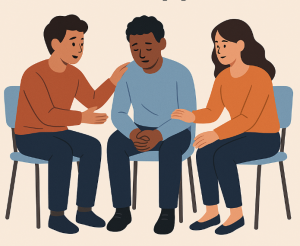
At its core, peer support occurs when people draw upon that lived experience to help others facing similar challenges.
That help might involve encouragement, empathy, practical information, companionship, modeling, connection to resources, or simply being present with someone during an extraordinarily difficult moment.
But there is something else happening too. Peer support can change the relationship between the person providing help and the person receiving it.
From “Expert and Patient” to “Person and Person”
Many traditional healthcare relationships are deliberately hierarchical. One person has specialized expertise. The other needs that expertise. That arrangement makes sense in many situations. If I need surgery, I would very much like the surgeon to know considerably more about surgery than I do.
But mental health, recovery, and well-being involve more than technical knowledge. Peer support introduces a different kind of helping relationship, one organized around ideas such as mutuality, shared power, respect, connection, and self-determination.
That changes the questions we ask.
A traditional clinical system might begin with: What is wrong with you? What are your symptoms? What diagnosis fits? What treatment is indicated?
A recovery-oriented approach can ask a different set of questions:
- What happened to you?
- What matters to you?
- How have you survived?
- What has kept you going?
- Where do you want to go from here?
Those questions do not require us to abandon diagnosis, medicine, psychotherapy, or evidence-based treatment. They simply widen the frame.
A person is more than a collection of symptoms. They are also the accumulation of relationships, experiences, aspirations, losses, strengths, identities, communities, and hopes.
And recovery involves that whole person.
Lived Experience Is a Form of Knowledge
Imagine someone experiencing a severe panic attack.
A clinician can learn the diagnostic criteria for panic disorder. They can understand the physiology of the stress response. They can learn evidence-based treatments and administer validated assessments.
That knowledge matters.
But there is another question: What does a panic attack actually feel like?
What does it feel like when you cannot breathe even though you are breathing? What does it feel like when your body seems to be telling you that something catastrophic is happening?
Someone who has experienced that may possess a kind of knowledge that cannot be completely translated into a clinical chart.
The same is true of grief.
During class, one student described how losing someone close to her changed her understanding of supposedly comforting phrases people commonly use after a death. Before experiencing the loss herself, those statements might have sounded supportive. Afterward, she understood why they could feel completely unhelpful.
The lesson was not that there is a better script everyone should memorize.
In fact, it was almost the opposite.
There is no secret phrase that makes grief disappear. People grieve differently. What lived experience can sometimes provide is a deeper understanding of what it feels like not to know exactly what to say—and a willingness to simply be present.
That helps explain one of peer support’s most powerful messages: You’re not alone.
Peer Support Can Turn Empathy Into Hope
A professional can communicate empathy: I can imagine how difficult this must be.
A peer can sometimes communicate something subtly different: I have been somewhere like this.
And then perhaps: I am still here.
Peer support can transform shared experience into credible hope. Consider someone newly diagnosed with cancer speaking with a cancer survivor. The survivor is not simply saying, “I understand that you’re frightened.” They may be able to say, “I was frightened too. Here are some things that helped me. Would you like to hear about them?”
The experience becomes more than empathy. It can become evidence that another future is possible.
This is particularly important in recovery. An illness-centered identity can gradually become something different.
Instead of: I am a patient.
Or: I am my diagnosis.
The story can become: This happened to me, but it is not the entirety of who I am.
That transition—from an illness story toward a recovery story—is one of the most important ideas we will return to throughout this series.
When the Person Receiving Help Becomes the Expert
One of the most striking developments in modern peer support is the possibility of a complete reversal of traditional roles. Someone can enter a mental health or substance-use system as a service recipient and eventually return as a service provider. Experiences that institutions once treated exclusively as deficits can become qualifications.
That is a remarkable idea.
A history of addiction, hospitalization, homelessness, incarceration, mental illness, or other major challenges does not automatically make someone an effective peer supporter. But under the right conditions, knowledge gained through those experiences can become an asset.
As I told my students, what once made someone a patient can become part of what makes them an expert.
I saw this firsthand early in my career working in substance-use treatment in Philadelphia.
One former client eventually became a care coordinator. Because he had once entered that same system frightened, confused, and uncertain about what would happen next, he understood something about the people walking through the door that others could easily miss.
One example was almost absurdly mundane: paperwork. Certain forms could help people establish eligibility for housing-related assistance. The organizational routine was to process the forms on a particular day. He did not want to wait. He understood that behind a bureaucratic form was a person who needed somewhere to live. So when possible, he dealt with it immediately.
That is hardly a sophisticated therapeutic intervention. But that is precisely the point. Sometimes lived experience changes what you notice. It changes what feels urgent. It changes how you interpret another person’s frustration. And it can change what you decide to do about it.
Peer Support Is Not Therapy Without a Therapist
There is an important distinction here.
A peer is not simply an inexpensive therapist.
Peer support is not psychotherapy performed by someone without a psychology degree. A peer-support worker does not become valuable by learning to imitate a clinician. The distinctive contribution of peer support comes partly from something professional training cannot simply manufacture: credible lived experience.
That does not mean peers should operate without boundaries, training, or accountability. Quite the opposite.
But it creates an interesting problem.
The Professionalization Paradox
Peer support has existed in different forms for centuries, often developing outside formal healthcare and mental health systems. Mutual-aid organizations, recovery communities, voluntary associations, and informal networks did not wait for healthcare institutions to invent the idea of people helping people.
Over time, however, healthcare systems began bringing peer support inside. Peer support became more formalized.
- More trained.
- More certified.
- More supervised.
- More evaluated.
- And, importantly, more likely to be reimbursed as a healthcare service.
There are obvious advantages to this.
Training can improve skills. Supervision can protect both workers and clients. Standards can establish appropriate boundaries. Reimbursement can turn peer-support work into sustainable employment rather than expecting people to provide valuable labor for free.
But professionalization creates a paradox: What happens if we professionalize peer support so thoroughly that we remove the qualities that made it valuable in the first place?
Imagine a peer worker who recognizes that someone needs several hours of help navigating housing, treatment, or benefits—but the reimbursement system permits only 30 minutes.
Which wins?
The relationship or the billing code?
Similarly, how much documentation, credentialing, supervision, standardization, and manualization can we add before a reciprocal human relationship starts looking like another professional service?
There may not be a simple answer.
But it is an increasingly important question as peer specialists and community health workers become more integrated into formal systems.
Peer Support Happens Far Beyond Mental Health Clinics
Another mistake is assuming that peer support belongs primarily to behavioral healthcare. It does not.
Peer-support relationships appear across many areas of public health and community life: addiction recovery, chronic illness, cancer, disability, grief, parenting, caregiving, rare diseases, mutual aid, community health work, mentoring, and many others.
During COVID-19, for example, public health programs increasingly relied on trusted community members to communicate health information in communities that conventional institutions might struggle to reach. This logic is closely related to peer support: who delivers information can matter as much as what information is delivered.
The same principle increasingly extends online.
Someone with an extremely rare disease may never encounter another affected family in their neighborhood. Online, that family can potentially find dozens or hundreds of people navigating similar experiences.
Digital communities can certainly be harmful. But they can also provide extraordinary opportunities for connection, information exchange, and support, particularly when geography makes traditional community impossible.
Community, in other words, does not necessarily require physical proximity.
Recovery Is Bigger Than Treatment
My own interest in these questions grew from working in substance-use treatment. People would often arrive because of one clearly identifiable problem: heroin use, alcohol use, a drug-related arrest, or something similar. But it quickly became obvious that the presenting problem was rarely the whole problem.
- There could also be housing problems.
- Employment problems.
- Legal problems.
- Family problems.
- Financial problems.
- Mental health problems.
- Social isolation.
- Loss of meaning.
- A person could make enormous progress in treatment and then return to an environment where almost nothing supported that progress.
That creates a fundamental public health problem. We can provide excellent individual treatment. But how does someone sustain change when they return to a community that makes that change extraordinarily difficult?
That question pushed me toward community psychology, and it is also why peer support cannot be separated completely from community mental health.
The syllabus for this course deliberately makes that progression. We begin with individual social connections and different forms of support, but eventually move outward to organizations, neighborhoods, community conditions, policies, social determinants, citizenship, inclusion, and belonging.
Because ultimately, recovery does not happen exclusively inside people. It happens between people and the environments in which they live.
A Bigger Question for Public Health
Public health frequently asks how we can reduce disease, prevent injury, decrease substance use, reduce suicide, improve treatment access, or address other measurable problems.
Those are essential questions.
But community mental health pushes us toward another one: What are we trying to create?
Not merely the absence of depression.
Not merely abstinence from drugs.
Not merely the absence of a psychiatric hospitalization.
What would it mean to create communities in which people have meaningful relationships, opportunities to participate, resources they can access, people they can depend upon, and realistic opportunities to pursue the lives they want?
The course frames this distinction explicitly: rather than asking only how individuals recover, we can ask what communities must become for recovery to be possible.
That changes the unit of analysis.
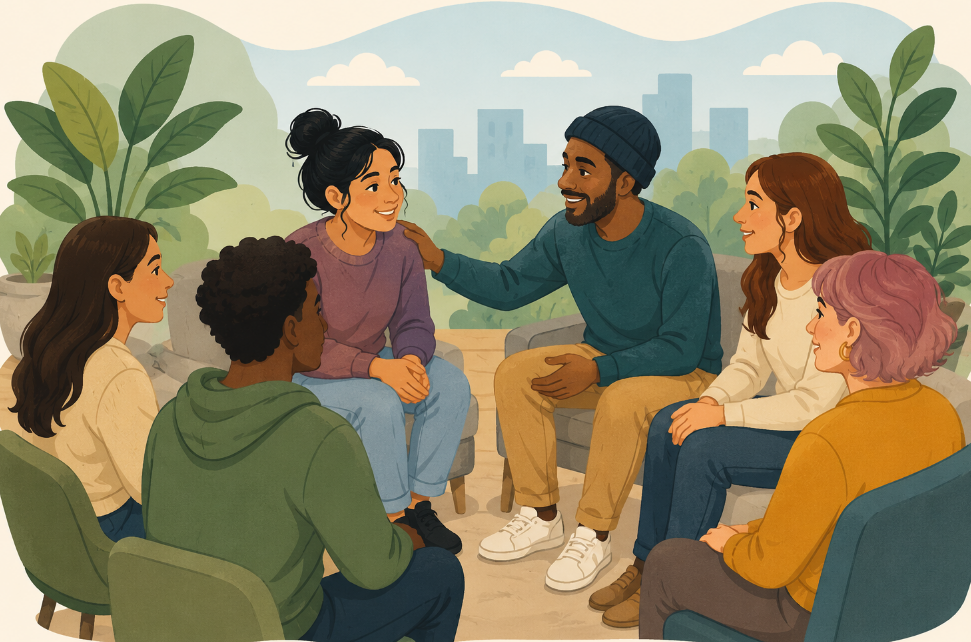
It also changes what counts as an intervention. A friend can matter. A support group can matter. A neighborhood can matter. A community organization can matter. A policy can matter. A Reddit community can matter.
And sometimes the person who has no advanced degree—but knows exactly what it feels like to walk through a particular door—can matter enormously.
Where This Series Is Going
This is the first in a series exploring peer support and community mental health through a public health lens.
We’ll begin with something even more fundamental than formal peer-support programs: why people need other people in the first place.
From there, we’ll examine social support, loneliness and isolation, sense of community, the history of mutual aid, recovery movements, peer specialists, addiction and mental health recovery, chronic illness and grief, digital communities, social determinants of mental health, recovery capital, citizenship, stigma, artificial intelligence, and the future of community mental health. That progression mirrors the course’s movement from social connection, through peer support, toward the broader systems and communities that shape well-being.
But the question underneath all of those topics will remain remarkably consistent:
How do people help other people—and how can we build communities that make that help more likely?