Raw Milk Benefits: What Does the Science Actually Say?
For most of the last century, pasteurization has been one of public health’s quieter success stories. Milk is heated for a short period, disease-causing microorganisms are dramatically reduced, and the milk that reaches consumers retains essentially the same major nutrients.
That arrangement did not generate much controversy for decades.
Recently, however, raw milk has moved from the margins of food culture into a much larger debate about nutrition, health, farming, and how much processing our food really needs. Search for the benefits of raw milk, and you will encounter an impressive collection of claims. Raw milk is said to contain beneficial bacteria that improve gut health. Its natural enzymes supposedly make milk easier to digest. Because it has not been heated, advocates argue that it retains vitamins, proteins, and immune-supporting compounds damaged by pasteurization. Some people with lactose intolerance report being able to drink it without symptoms.
Perhaps the most intriguing claim is that drinking raw or farm milk may protect children against asthma, allergies, and respiratory infections.
These ideas fit neatly into a much larger cultural movement toward foods perceived as natural, minimally processed, local, and traditional. My brother-in-law, for example, keeps trying to feed it to my children. And unlike many health trends, the case for raw milk cannot be dismissed simply by saying there is no science behind any of it.
There is science.
The harder question is what that science actually demonstrates.
Researchers have found differences between raw and pasteurized milk. Observational studies have also found better respiratory and allergic outcomes among some children who consume farm milk. But neither finding automatically means that drinking raw milk makes people healthier. At the same time, the microorganisms that pasteurization is designed to kill are not hypothetical. Raw milk has repeatedly been implicated in outbreaks of foodborne disease.
Understanding the raw milk debate therefore requires separating several questions that are frequently bundled together. Does pasteurization change milk? Do those changes matter for human health? Are people who drink raw milk healthier in some respects? And if they are, is raw milk itself responsible?
Most importantly, any potential benefit has to be considered alongside the reason pasteurization exists in the first place.
That is where the evidence becomes much more interesting.
Why the Claimed Benefits of Raw Milk Are So Persuasive
The strongest version of the argument for raw milk is not that microorganisms do not matter or that foodborne illness does not exist. It is that modern dairy production can manage those risks while avoiding a heat treatment that may alter potentially beneficial components of milk.
There is some legitimate biology behind this argument.
Milk is much more complicated than a mixture of fat, protein, sugar, calcium, and water. It contains enzymes, microorganisms, immunoglobulins, whey proteins, fatty acids, vitamins, and numerous other biologically active compounds. Heating milk changes some of them.
Pasteurization can reduce certain heat-sensitive vitamins and alter or denature some proteins and enzymes. Raw milk also contains a more diverse microbial population than pasteurized milk. None of this is particularly controversial.
The controversy begins with what happens next.
Showing that pasteurization changes a molecule is relatively easy. Showing that the change produces a meaningful difference in human health is much harder.
The same problem applies to microorganisms. Raw milk contains bacteria, but the presence of bacteria does not make a food “probiotic.” A probiotic is generally a specific microorganism demonstrated to provide a health benefit when consumed in an adequate amount. An uncontrolled microbial community containing organisms of uncertain identity and concentration is something very different.
Still, some of the evidence associated with raw milk is harder to explain away.
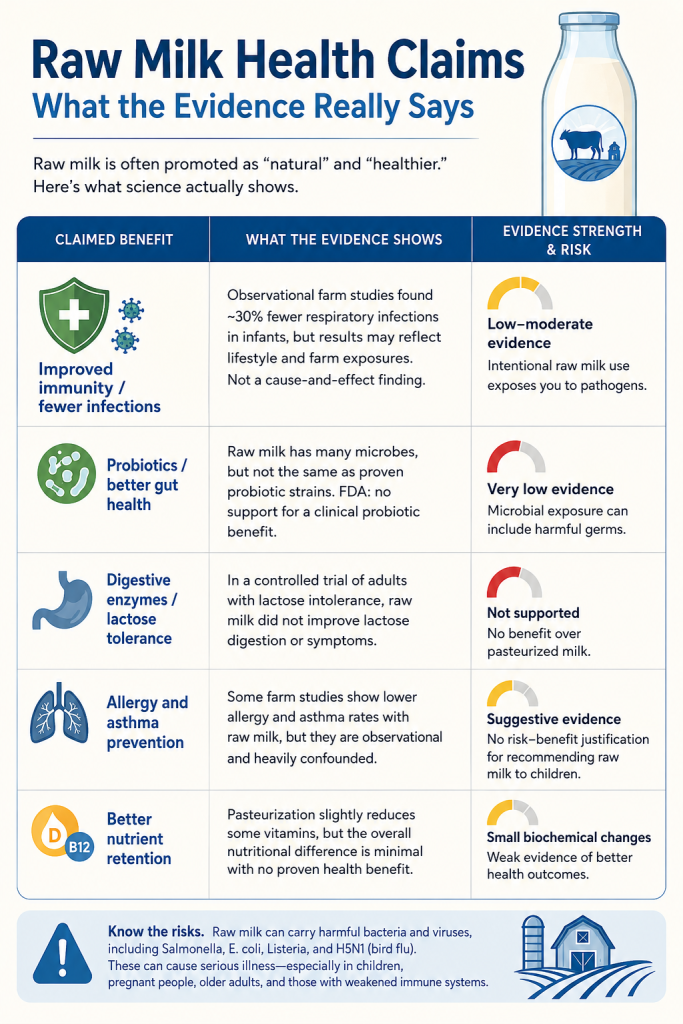
Researchers studying European farming communities have repeatedly observed that children raised in farm environments have lower rates of asthma and some allergic conditions. In several studies, consumption of farm or unprocessed cow’s milk has emerged as one factor associated with that protection. Other research has reported fewer respiratory infections and episodes of fever among infants consuming raw cow’s milk.
Those findings are important. They are also where a scientific observation can very quickly become a health recommendation that the evidence itself does not necessarily support.
Before deciding whether raw milk is healthier, we need to look at the individual claims separately.
What Does the Research Actually Say About Raw Milk’s Benefits?
The evidence for the supposed health benefits of raw milk is not uniform. Some claims have almost no convincing clinical support. Others have produced genuinely interesting findings that researchers are still trying to understand.
Asthma and allergies: the most interesting evidence
The strongest case for a possible benefit comes from research on childhood asthma and allergies. Large European studies of farming communities have found associations between consuming farm milk and lower rates of asthma, allergies, and atopic sensitization. In the GABRIELA study, for example, researchers found an inverse association between consumption of unboiled farm milk and childhood asthma and atopy. Their analyses suggested that some of the association might be related to whey proteins altered by heating.
Other prospective research has produced similarly intriguing results. The PASTURE birth cohort found that infants consuming unprocessed cow’s milk had lower rates of respiratory infections and fever during the first year of life. Researchers estimated reductions of roughly 30% for some outcomes.
That deserves scientific attention.
It does not, however, establish that parents should give children raw milk.
These studies were observational rather than randomized trials. Researchers did not assign infants to drink raw or pasteurized milk and then measure who developed asthma or infections. The families chose what their children consumed, and those choices occurred within environments that differed in many other ways.
The studies therefore demonstrate an association. They cannot completely establish what caused it.
That distinction becomes especially important because of something researchers have been studying for decades: the farm effect.
Lactose intolerance: a claim that has actually been tested
One of the most common personal testimonials about raw milk is that people who cannot tolerate ordinary milk can drink raw milk without digestive problems.
There is an intuitive explanation frequently offered for this: raw milk supposedly contains lactase or other enzymes that help the body digest lactose, while pasteurization destroys them.
The problem is that cow’s milk does not naturally contain enough lactase to explain such an effect.
More importantly, researchers have directly tested the claim. In a randomized crossover trial, Mummah and colleagues studied 16 adults with objectively confirmed lactose malabsorption. Participants consumed raw milk, pasteurized milk, and soy milk during different phases of the experiment while researchers measured hydrogen breath-test results and symptoms.
Raw milk did not improve lactose digestion compared with pasteurized milk. If anything, participants initially experienced more symptoms with raw milk before differences diminished as the study progressed.
It was a small trial, so it cannot answer every possible question about individual experiences. But unlike testimonials, it directly tested whether raw milk improves lactose malabsorption under controlled conditions.
It did not.
Probiotics and digestive enzymes: plausible language, weak clinical evidence
Claims about “good bacteria” and natural enzymes occupy a similar space.
Raw milk unquestionably contains microorganisms. Some may be harmless, and some organisms found in dairy environments may have properties of scientific interest. But that is different from demonstrating that drinking an uncontrolled mixture of microorganisms provides a reproducible clinical benefit.
Commercial probiotics are typically defined by particular strains, doses, and outcomes. Raw milk varies from cow to cow, farm to farm, batch to batch, and even across storage conditions. Its microbial community can include organisms people may want to consume—but it can also include Campylobacter, Salmonella, pathogenic E. coli, Listeria, Brucella, and other organisms capable of causing disease.
The enzyme argument has a related problem. Pasteurization does affect enzymes present in milk, but evidence that those enzymes meaningfully assist human digestion after consumption is lacking. Human digestion already depends overwhelmingly on enzymes produced by our own digestive system.
The existence of enzymes in a food does not establish that preserving them produces a measurable health advantage.
Nutrition: raw milk is different, but is it meaningfully better?
Pasteurization does change the nutritional composition of milk slightly.
A systematic review by Macdonald and colleagues found reductions in several heat-sensitive vitamins following pasteurization, including vitamins B1, B2, C, and folate. If the question is simply whether heating milk changes anything nutritionally, the answer is yes.
But nutritional significance depends on more than whether a laboratory can detect a difference.
Milk is not a major dietary source of several of the vitamins most affected by pasteurization. Meanwhile, its major nutritional contributions—including protein and minerals such as calcium—are largely preserved.
The systematic review therefore concluded that the overall nutritional impact of pasteurization was minimal.
This distinction runs through much of the raw milk debate: biochemical difference does not necessarily equal meaningful health benefit.
And the one area where researchers have observed potentially meaningful health differences—asthma, allergies, and some childhood infections—comes with another major complication.
The Farm Effect Problem: Is It the Milk or the Environment?
Imagine two groups of children.
One group grows up around livestock, barns, soil, animal feed, plants, and the extraordinarily diverse microbial environment of a working farm. Their families may have different diets, different patterns of outdoor activity, different household sizes, different exposures to animals, and different lifestyles.
The other group does not.
Now imagine that children in the first group also drink more raw or minimally processed farm milk.
If those children subsequently develop less asthma, what caused the difference?
That is the central challenge in interpreting much of the research surrounding raw milk.
The phenomenon known as the farm effect predates the current raw milk trend. Children raised on traditional farms have repeatedly been observed to experience lower rates of asthma and allergic disease. Researchers have proposed numerous explanations, including early exposure to a wider diversity of microorganisms, contact with livestock and animal feed, environmental endotoxins, dietary differences, and changes in how the developing immune system learns to respond to its surroundings.
Farm milk consumption is part of that cluster of exposures.
Researchers attempt to statistically adjust for these differences, and some studies have found that the association with farm milk persists after controlling for several other farm-related factors. That makes the milk hypothesis scientifically interesting.
But statistical adjustment cannot perfectly transform an observational study into a randomized experiment.
There is another complication: “farm milk” and “raw milk” are not always interchangeable concepts across studies. Milk may differ in freshness, fat composition, animal diet, bacterial composition, storage, homogenization, processing, or whether it has been heated at home. The biological factor associated with an outcome could therefore be something other than the simple absence of pasteurization.
Perhaps researchers will eventually identify a heat-sensitive protein or another component that contributes to the protective association. If so, that could have important implications for how dairy products are processed.
But that would not necessarily mean the solution is to abandon pasteurization.
It could instead lead to a much more interesting possibility: developing processing methods that preserve whatever beneficial factor researchers identify while still killing pathogens.
That matters because the evidence changes dramatically when we move from potential benefits to demonstrated harms.
Raw Milk Risks: What Outbreak Data Actually Show
The health benefits attributed specifically to raw milk range from unsupported to scientifically intriguing but uncertain.
The infectious-disease risk is different.
Here, the evidence does not depend primarily on testimonials, biomarkers, or observational associations. It comes from microbiology, outbreak investigations, epidemiological surveillance, and documented illnesses.
Milk can become contaminated at multiple points between the animal and the consumer. Cattle, goats, and sheep can carry microorganisms without appearing sick. Pathogens can originate from manure, udders, farm environments, water, equipment, storage containers, or handling.
That means even milk from a healthy animal on a clean, carefully managed farm can become contaminated.
Among the pathogens associated with raw milk are Campylobacter, Salmonella, Shiga toxin-producing E. coli, Listeria, Brucella, and Cryptosporidium. These infections are not equally dangerous to everyone, but some can cause severe disease.
And outbreaks continue to occur.
Koski and colleagues identified 202 recognized U.S. outbreaks associated with unpasteurized milk between 1998 and 2018, resulting in 2,645 illnesses, 228 hospitalizations, and three deaths.
Those numbers require some context.
They do not mean that drinking a glass of raw milk carries an 8.6% chance of hospitalization. The hospitalization percentage describes recognized cases within documented outbreaks, not the risk associated with an individual serving. Nor do outbreak statistics capture every illness caused by raw milk. Many foodborne infections are never diagnosed, reported, or traced back to a particular food.
The more informative question is how the risk compares with pasteurized dairy when differences in consumption are considered.
Using U.S. outbreak and consumption data from 2009 through 2014, researchers estimated that consumers of unpasteurized milk and cheese experienced roughly 840 times the rate of outbreak-associated illness and 45 times the rate of hospitalization per serving compared with consumers of pasteurized dairy.
Those estimates are model-based and depend on older consumption data, so they should not be interpreted as universal constants describing every farm or every glass of milk.
They do, however, illustrate an important point about relative risk.
A much higher relative risk does not mean that every glass of raw milk is likely to make someone sick. Most people who consume raw milk on a particular day will not develop a recognized foodborne infection. That helps explain why someone can drink raw milk for years and sincerely report, “I’ve never gotten sick.”
But individual experience cannot tell us how frequently rare contamination events occur across a population.
Seat belts provide a useful analogy. A person can drive thousands of miles without a seat belt and never be injured. That experience does not demonstrate that seat belts provide no protection. The relevant question is what happens across many people and many exposures when the uncommon event finally occurs.
Food safety operates similarly.
The public-health concern is not that every serving of raw milk contains a dangerous pathogen. It is that contamination cannot reliably be detected by sight, smell, or taste; that some pathogens can cause severe disease; and that the available evidence indicates the risk is substantially greater when the pathogen-killing step is removed.
Recent outbreaks demonstrate that this is not merely a historical concern.
During a large 2023–2024 multistate Salmonella Typhimurium outbreak associated with a California raw-milk dairy, investigators identified 171 cases. Of those cases, 120 occurred in people younger than 18. Twenty-two of the 162 patients for whom hospitalization information was available were hospitalized, including 18 children and adolescents.
No deaths were reported.
For most national outbreak surveillance, however, researchers cannot calculate a precise raw-milk “attack rate” because they do not know exactly how many people consumed milk from contaminated batches. That missing denominator is why claims such as “one in X raw-milk drinkers will get sick” should be treated skeptically.
What the evidence can tell us with considerably greater confidence is that raw milk has repeatedly transmitted human pathogens, that some resulting illnesses have been severe, and that removing pasteurization increases that risk.
The next question is therefore the one at the center of the modern raw-milk movement:
What if the milk comes from an exceptionally clean, carefully monitored farm?
But What If the Farm Is Really Clean?
At this point, supporters of raw milk often make an important distinction.
They are not necessarily defending milk produced under poor sanitary conditions. Many advocates argue that comparisons with historical raw milk—or even with raw milk involved in outbreaks—fail to account for how carefully some modern raw-milk dairies operate.
Healthy animals can be monitored. Udders and equipment can be cleaned. Milk can be rapidly chilled. Farms can test for bacterial contamination. Producers can maintain strict cold chains and discard milk when something appears wrong.
All of those practices matter.
Better animal health, sanitation, refrigeration, testing, and traceability can reduce the likelihood that harmful microorganisms enter milk or multiply before it reaches a consumer. They should be encouraged regardless of whether milk will eventually be pasteurized.
The problem is that reducing risk is not the same as eliminating it.
A dairy animal does not need to appear sick to shed a pathogen. Contamination can occur intermittently, meaning a sample collected on Tuesday may test negative even though milk produced later becomes contaminated. A pathogen may also be unevenly distributed within a batch, so testing one sample does not guarantee that every portion of the milk is free of it.
Testing itself therefore has a fundamental limitation: you can only test the sample you collected.
Routine bacterial counts present another complication. They can provide useful information about sanitation and milk quality, but low overall bacterial counts do not prove the absence of a specific pathogen such as Salmonella, Campylobacter, or Shiga toxin-producing E. coli.
This is why food-safety systems generally rely on multiple layers of protection rather than a single test.
Good farming practices reduce the probability that pathogens enter milk. Refrigeration slows the growth of many microorganisms. Testing can identify some contaminated products before they are sold. Traceability helps authorities respond when something goes wrong.
Pasteurization performs a different function.
Instead of attempting to predict whether a pathogen happens to be present, it assumes contamination is possible and introduces a validated step specifically designed to kill disease-causing microorganisms.
That distinction is central to the raw-milk debate.
A carefully managed raw-milk dairy may produce milk with a lower contamination risk than a poorly managed one. But sanitation and testing do not make pasteurization microbiologically redundant.
And despite how the debate is sometimes framed, pasteurization is not an especially extreme form of food processing.
What Pasteurization Actually Does
The word pasteurization can make the process sound more industrial than it actually is.
In its conventional form, pasteurization means heating milk to a specific temperature for a specific amount of time and then cooling it. A common high-temperature, short-time process heats milk to approximately 161°F (72°C) for 15 seconds. Traditional batch pasteurization uses approximately 145°F (63°C) for 30 minutes.
The goal is not to sterilize milk.
Pasteurized milk can still spoil, and it still requires proper handling and refrigeration. Instead, pasteurization is designed to achieve a large reduction in microorganisms capable of causing human disease while preserving the characteristics and nutritional value that make milk useful as food.
There is a trade-off.
Heat changes biological material. Some enzymes become inactive. Certain proteins can be altered or denatured. Some heat-sensitive vitamins decline. Components that researchers are investigating for possible immune effects may also be affected.
That part of the raw-milk argument is scientifically reasonable.
The question is whether those changes are large enough to produce meaningful nutritional or health consequences.
For the major nutritional components of milk, the evidence suggests they generally are not.
Pasteurization does not eliminate milk’s protein or calcium. A systematic review found measurable reductions in several heat-sensitive vitamins, but concluded that the overall nutritional consequences were small, in part because milk is not an important dietary source of several of the vitamins most affected.
This creates a striking asymmetry in the evidence.
On one side are biochemical changes whose clinical importance is generally small, uncertain, or still being investigated.
On the other is a microbiological effect that is precisely the reason pasteurization was developed: substantial reduction of viable pathogens.
That does not mean every biological change caused by heating should be dismissed as irrelevant. The farm-milk studies suggest that identifying heat-sensitive components potentially associated with immune development could be a worthwhile area of research.
But there is an enormous difference between saying “pasteurization changes milk” and saying “those changes make pasteurized milk less healthy.”
The first statement is clearly true.
The second requires evidence of meaningful health outcomes—and that evidence is much harder to find.
Meanwhile, a newly emerging pathogen has provided an unusually timely demonstration of what the microbiological side of that trade-off looks like.
H5N1 Adds a New Dimension to the Raw Milk Debate
For most of the modern history of pasteurization, public-health concerns about raw milk centered primarily on bacterial pathogens.
Then H5N1 entered dairy cattle.
Beginning in 2024, highly pathogenic avian influenza A(H5N1) was detected in U.S. dairy herds, creating a new question: could infectious influenza virus survive in milk?
The answer turned out to matter considerably for the distinction between raw and pasteurized dairy.
Studies found high concentrations of H5N1 virus in milk from some infected cows. At the same time, experiments evaluating commercial pasteurization conditions found that the heat treatments used for pasteurized dairy effectively inactivated the virus. FDA testing of hundreds of pasteurized dairy products also found no viable H5N1 virus.
In other words, the same pathogen-control step developed long before anyone imagined H5N1 spreading among dairy cattle proved useful against an entirely new microbiological threat.
Raw dairy presents a different situation.
FDA-supported research has found that viable H5N1 can persist in experimentally contaminated raw-milk products under some conditions. Researchers have also found that aging raw-milk cheese for 60 days did not reliably eliminate viable H5N1 in experimental conditions.
That finding requires careful interpretation.
It does not demonstrate that people have contracted H5N1 from eating aged raw-milk cheese. FDA has not reported such human cases. Nor does detecting infectious virus experimentally establish the probability that any particular consumer will become infected.
What it demonstrates is something more fundamental.
Aging, refrigeration, sanitation, and time cannot simply be assumed to provide the same protection as a validated pathogen-killing process.
H5N1 also illustrates why food-safety systems cannot be designed solely around pathogens we already know about.
A farm might maintain excellent sanitation. Animals may appear healthy. Milk might meet routine quality standards. Yet an emerging infectious disease can change the risk landscape.
Pasteurization provides a layer of protection that does not depend on predicting the next pathogen.
For that reason, public-health agencies have been particularly explicit about raw milk during the H5N1 outbreak. CDC and FDA have continued to recommend pasteurized dairy products rather than raw milk, and CDC has specifically rejected the idea that consuming raw milk is a safe way to develop immunity to H5N1.
What Do Public Health Agencies Recommend?
Laws governing raw milk vary considerably around the world.
In the United States, federal law prohibits raw milk intended for direct human consumption from being sold across state lines, while individual states determine whether and under what circumstances raw milk can be sold within their borders. As of FDA’s March 2024 regulatory snapshot, 30 states allowed some form of intrastate raw-milk sale while 20 prohibited it in some form. State laws continue to change, so those numbers should be understood as a snapshot rather than a permanent legal map.
Other countries take different approaches. Canada requires milk sold to consumers to be pasteurized. The European Union regulates raw drinking milk but allows Member States to impose additional restrictions. Rules also differ within the United Kingdom, while New Zealand permits raw drinking milk through a specific regulatory system.
The legal details differ.
The underlying public-health guidance is considerably more consistent.
CDC and FDA recommend choosing pasteurized milk and dairy products. Health Canada similarly recommends pasteurized milk, and WHO advises consumers to drink pasteurized or boiled milk rather than raw milk.
The recommendation is particularly important for young children, pregnant people, older adults, and people with weakened immune systems, because infections that might cause self-limited illness in one person can have much more serious consequences in another.
That consensus does not mean every country has concluded that selling raw milk should be illegal.
It means that the scientific question “Should people be permitted to buy this product?” is different from the public-health question “Which product presents the lower infectious-disease risk?”
On the second question, the evidence is much clearer.
The Bottom Line: Is Raw Milk Actually Healthier?
The most interesting conclusion from the raw-milk debate may not be that every claim made about raw milk is wrong.
Some aren’t that easy to dismiss.
The research on farm milk, childhood asthma, allergies, and respiratory infections is genuinely intriguing. Multiple observational studies have detected associations worth investigating, and researchers have proposed plausible biological mechanisms involving whey proteins and other heat-sensitive components of milk.
There may be something important happening.
But “something about farm milk may be biologically beneficial” is very different from “people should drink milk without pasteurization.”
We do not yet know whether the protective associations observed in farm studies are caused by the milk itself, another aspect of farm life, a particular component of milk, differences in animal feeding or milk composition, or some combination of these factors.
Even if researchers eventually identify a protective component, it does not follow that consuming potentially pathogen-containing milk is the only—or best—way to obtain it.
That may actually be the most promising direction for this research.
Instead of asking whether we should choose between the possible biological advantages of farm milk and the infectious-disease protection provided by pasteurization, researchers can ask whether it is possible to have both.
Could a particular whey protein explain some of the association with asthma? Could processing methods preserve it? Could beneficial microorganisms be isolated, characterized, and delivered as actual probiotics? Could alternative treatments retain useful bioactive compounds while still reliably eliminating pathogens?
Those are testable scientific questions.
For now, however, the evidence for many of the most popular raw milk benefits is weak. Raw milk does not appear to solve lactose intolerance. Its uncontrolled microbial community has not been demonstrated to provide the benefits of a clinically validated probiotic. Its nutritional advantages over pasteurized milk are small. The allergy and asthma findings are more interesting, but remain observational and entangled with the broader farm effect.
The evidence concerning raw milk risks is considerably more direct. Raw milk can carry human pathogens, outbreaks continue to occur, and some infections can result in hospitalization, long-term complications, pregnancy complications, or death.
Pasteurization cannot make milk perfectly safe.
What it can do is remove a substantial and preventable source of risk without meaningfully eliminating the major nutritional benefits that make people drink milk in the first place.
That leaves us with a conclusion more nuanced than either side of the raw-milk debate sometimes suggests.
Raw milk is not a magical superfood. Nor does the scientific evidence require us to pretend that every observation associated with farm milk is meaningless.
There may be something biologically interesting there.
We just don’t currently have good evidence that milk needs to remain raw for consumers to benefit from it—and we have very good evidence for why pasteurization became standard practice in the first place.
References
Costard, S., Espejo, L., Groenendaal, H., & Zagmutt, F. J. (2017). Outbreak-related disease burden associated with consumption of unpasteurized cow’s milk and cheese, United States, 2009–2014. Emerging Infectious Diseases, 23(6).
European Food Safety Authority BIOHAZ Panel. (2015). Scientific Opinion on the public health risks related to the consumption of raw drinking milk. EFSA Journal, 13(1), 3940.
Koski, L., Kisselburgh, H., Landsman, L., Hulkower, R., Howard-Williams, M., & Salah, Z. (2022). Foodborne illness outbreaks linked to unpasteurised milk and relationship to changes in state laws—United States, 1998–2018. Epidemiology & Infection.
Loss, G., et al. (2011). The protective effect of farm milk consumption on childhood asthma and atopy: The GABRIELA study. Journal of Allergy and Clinical Immunology, 128, 766–773.
Loss, G., et al. (2015). Consumption of unprocessed cow’s milk protects infants from common respiratory infections. Journal of Allergy and Clinical Immunology, 135, 56–62.
Lucey, J. A. (2015). Raw Milk Consumption: Risks and Benefits. Nutrition Today.
Macdonald, L. E., et al. (2011). A systematic review and meta-analysis of the effects of pasteurization on milk vitamins, and evidence for raw milk consumption and other health-related outcomes. Journal of Food Protection, 74, 1814–1832.
Mummah, S., Oelrich, B., Hope, J., Vu, Q., & Gardner, C. D. (2014). Effect of raw milk on lactose intolerance: A randomized controlled pilot study. Annals of Family Medicine, 12, 134–141.
U.S. Centers for Disease Control and Prevention. (2024–2025). Raw Milk and related food-safety guidance.
U.S. Food and Drug Administration. (2024). Raw Milk Misconceptions and the Danger of Raw Milk Consumption; Food Safety and Raw Milk.
Weinstein, E., et al. (2025). Outbreak of Salmonella Typhimurium infections linked to raw milk. Morbidity and Mortality Weekly Report.
World Health Organization. (2026). Food Safety; WHO pathogen-specific guidance on Campylobacter and STEC.