
Hidden Risks in Sleep and A Pathway to Precision Medicine
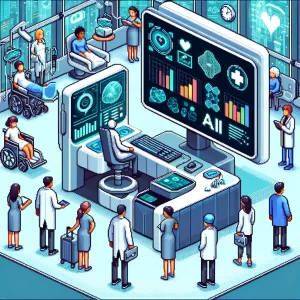
In a bustling sleep clinic, Dr. Emily Sanders faces the daunting challenge of interpreting polysomnography (PSG) results—a task fraught with complexity yet essential for understanding sleep-related health risks. As patients fill the waiting room—each grappling with unique sleep concerns—she wonders if today’s evaluations will truly capture the breadth of their conditions.
Despite advances in technology, sleep studies often rely on the apnea-hypopnea index (AHI) to diagnose disorders like sleep apnea, potentially overlooking crucial data. This limitation could obscure critical health risks linked to sleep disorders. But what if we could tap into the full physiological narrative hidden within sleep data?
The Quest for a Richer Understanding
In sleep medicine, the AHI has long been a cornerstone, simplifying complex physiologic signals into a single score. Yet, this reductionist approach fails to capture the multifaceted nature of sleep and its impact on health. Current diagnostic criteria may miss key insights, but a recent study published in Nature Communications offers a promising leap forward.
Researchers introduced a foundation model that analyzes rich representations of sleep physiology from more than 10,000 PSG recordings. This groundbreaking model identifies latent risk structures invisible to conventional metrics, providing new avenues for precision medicine.
Breaking Down the Study: Method and Findings
The study leveraged data from the Cleveland Clinic and built a transformer-based AI model trained on sleep physiology signals. Unlike traditional models relying on hand-crafted features, this AI architecture captures a broader range of sleep-related physiological signals.
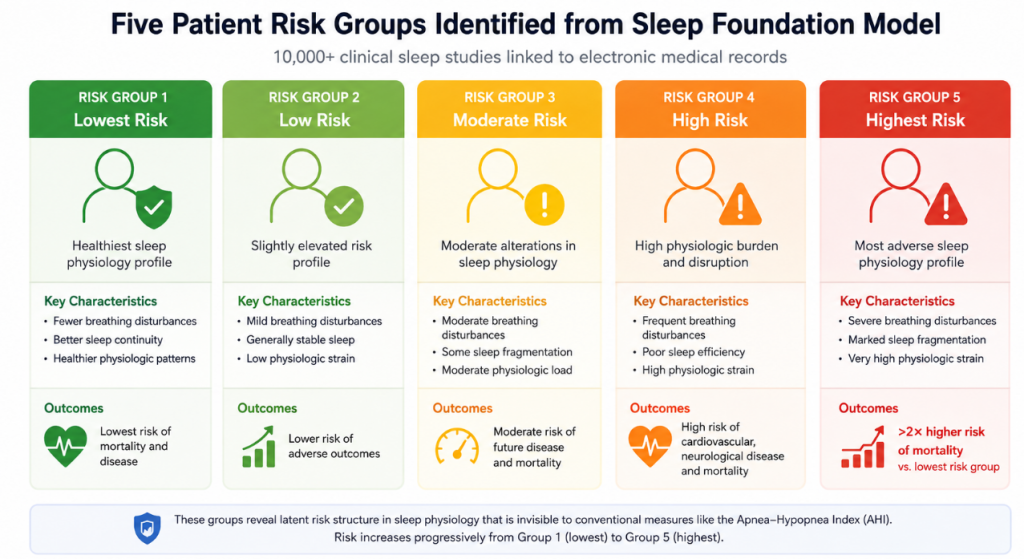
The researchers identified five distinct patient risk groups with varying trajectories in terms of mortality, cardiovascular, and neurological outcomes. Intriguingly, the highest-risk group exhibited over twice the mortality risk compared to the lowest-risk group, challenging the predictive value of traditional AHI severity categories.
Why This Matters: Beyond Sleep Apnea
This model’s implications extend far beyond sleep apnea. It highlights an often-overlooked aspect of sleep health—the integration of multiple physiological pathways affecting long-term health. Sleep disorders are not merely individual struggles; they intersect with broader health outcomes, influenced by systemic factors and healthcare approaches.
What This Means in Practice
- For Health Departments: Consider utilizing advanced models to improve the precision of sleep health assessments.
- For Clinicians: Incorporate models that explore physiologic data beyond conventional measures.
- For Policymakers: Advocate for the development and implementation of AI-driven tools for better risk assessment and prevention strategies.
- For Researchers: Focus future studies on embedding-based stratification to inform intervention designs.
Overcoming Barriers: The Hard Part
While promising, translating these findings into practice is not without hurdles. Challenges include integrating this model into existing clinical workflows and overcoming limitations in current PSG equipment. Additionally, funding and access to technology vary, potentially limiting equitable application across diverse settings.
The model’s generalizability was validated using an external cohort, the Sleep Heart Health Study, reinforcing its robustness across different populations. Nevertheless, ongoing trials and real-world applications are crucial to fully decode the embedding-derived risk signals.
As Dr. Sanders contemplates the future of sleep medicine, she recognizes that this model holds potential to revolutionize how we view and treat sleep disorders—granting her and her colleagues the tools to see beyond traditional boundaries.
The Future of Sleep Medicine
In conclusion, by moving beyond conventional AHI limitations, this innovative model offers a scalable path to more precise sleep medicine. It emphasizes the importance of understanding the interplay of neural, cardiac, and ventilatory systems in determining health risks. As we unlock these complexities, the groundwork is laid for a future where sleep evaluations contribute to a broader understanding of individual and public health challenges.
Conversation Starters
- How could your healthcare institution integrate AI models for better sleep health assessments?
- What barriers might arise when implementing this new approach in underserved communities?
- What strategies could ensure equitable access to advanced diagnostic technologies in sleep medicine?