Firecracker Pollution Worsens Air Quality in Indo-Gangetic Basin During Diwali
Is there any dust still hanging around your community?
In the heart of the Indo-Gangetic Basin, a healthcare worker braces against the biting air as she makes her rounds through a thick smog that resembles more of a burden than breathable air. With every breath, her lungs fill with pollutants that have surged beyond safe limits, leaving a tangible layer of soot and concern across 14 cities during the Diwali festivities, coming up this November.
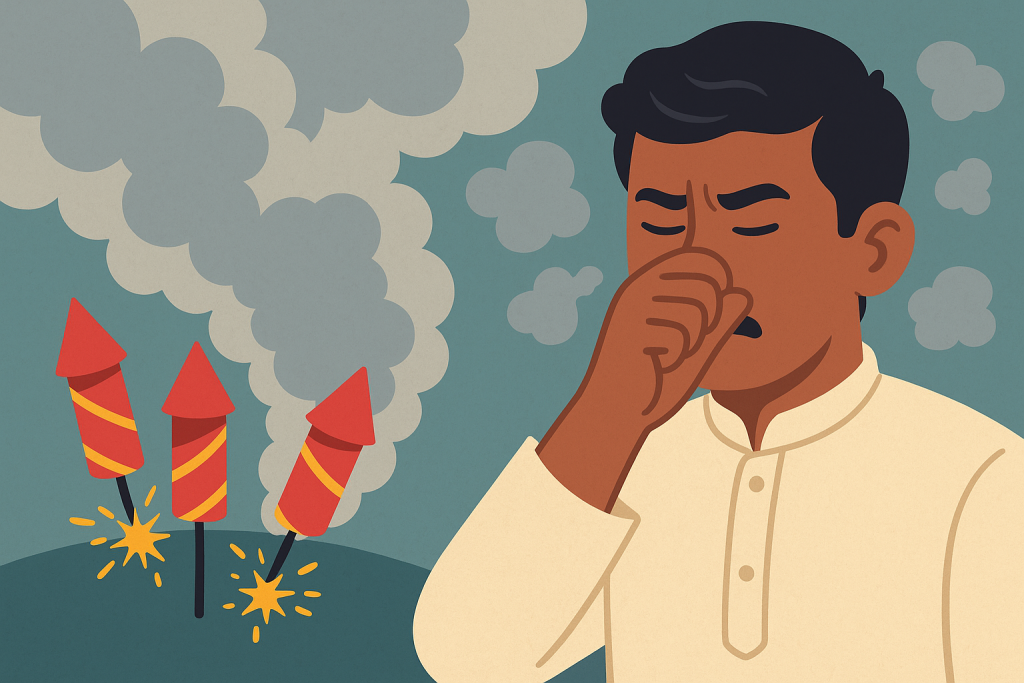
This scenario is more than just an environmental hazard—it is a public health crisis highlighted by a new study examining the impact of Diwali, a time of celebration marked often by a tradition of fireworks that leads to soaring pollution levels.
The Core Public Health Issue
Diwali, the festival of lights, often leads to a surge in air pollution due to the extensive use of fireworks, creating an air quality crisis, particularly in densely populated regions such as the Indo-Gangetic Basin (IGB). This area is home to nearly one-seventh of the world’s population and several major industrial and urban hubs, making it exceedingly vulnerable to pollution flare-ups.
During Diwali, air quality in this region deteriorates sharply, exceeding national safety benchmarks by up to 10 times. As the World Health Organization reports, exposure to such high levels of air pollution can result in severe respiratory and cardiovascular diseases, disproportionately impacting urban poor communities already facing underinvestment in public health resources.
The Study’s Key Inquiry
Researchers aimed to quantify how Diwali festivities affect air pollution and the resulting health burden across 14 major cities in the IGB. The crux was to understand the contribution of firecrackers to the decline in air quality and the associated acute health effects during the festival period.
Methodology Overview
This comprehensive study employed both ground-based and satellite data to assess pollution levels, focusing on pollutants such as PM₂.₅, PM₁₀, SO₂, and NO₂. It correlated these data with health impacts, particularly respiratory hospitalizations, during the Diwali period compared to baseline conditions.
The analysis spanned the pre-Diwali period through several days post-festival, enabling a thorough examination of pollution peaks and their persistence. Advanced statistical tools provided insights into temporal changes in pollution post-Diwali, while meteorological assessments helped identify how stagnant weather conditions amplified exposure risks.
The festival-induced spikes in pollutants were found to amplify existing health risks, driving an alarming 15–20% increase in respiratory-related hospitalizations in affected cities. Cities like Delhi, already bearing a heavy pollution load, saw particulate matter (PM₂.₅) figures skyrocket, reinforcing the narrative of Diwali as a significant public health stressor.
Notably, Chandigarh saw a decline in pollution spikes due to partial bans on fireworks, illustrating that regulatory measures, when effectively enforced, can have a noticeable impact.
Implications for Practice
What This Means in Practice
- Local Health Departments must prioritize real-time air quality monitoring and swift public health messaging.
- Policymakers should look to implement and enforce stricter controls on firecracker usage, potentially endorsing ‘green cracker’ alternatives.
- Community-Based Organizations: Play a critical role in educating the public about environmental health and leverage local trust to shift cultural practices toward safer alternatives.
- Researchers can further explore the socio-economic impacts of pollution on vulnerable communities, delving into long-term health outcomes from acute exposures.
Challenges and Limitations
The Hard Part: Turning Evidence Into Action
Despite the study’s insights, implementing change is fraught with challenges. Political resistance and cultural sensitivities around traditional celebrations limit enforcement of firework bans. Furthermore, uneven infrastructure across cities complicates the deployment of consistent air-quality interventions, while public mistrust of data reliability undermines health advisories.
Adding layers of complexity are scientific limitations; attribution of air quality improvements directly to specific interventions requires long-term data and high-resolution analyses that weren’t fully encapsulated within this study’s scope.
Conclusion: Bridging Tradition and Public Health
As the air finally begins to clear, the demands on public health infrastructure recede momentarily, but the memory of hospital wards overcrowded with patients persists. The study serves as a clarion call for strategic action, underscoring the need to balance cultural traditions with environmental resilience.
Strengthening regional air quality policies, advancing public health infrastructure, and engaging communities are not just urgent but essential to safeguarding health without sacrificing cultural heritage.
Conversation-Starting Questions
- How can public health practitioners build trust in data and advisories during peak pollution events?
- What are innovative strategies to shift cultural practices that emphasize health without negating tradition?
- In what ways can regional cooperation be fostered across the Indo-Gangetic Basin to tackle air quality uniformly?