
Why “Barriers and Facilitators” Is Not Enough in Public Health
In public health, we love to ask a very, very familiar question: What are the barriers and facilitators?
It is a useful question. It helps us listen. It helps us organize what people are experiencing. It gives researchers, evaluators, and program leaders a way to summarize messy real-world conditions. When a new program struggles, we can identify barriers like limited staffing, poor communication, lack of trust, weak leadership support, confusing workflows, or inadequate funding. We can also identify facilitators like strong partnerships, committed champions, training, shared goals, and community engagement.
None of that is wrong. But it is often not enough.
The problem is that a list of barriers does not automatically help someone make a decision. In fact, a long list can make decisions harder. If everything is a barrier, what should leaders fix first? If every facilitator matters, which one deserves scarce time and money? If a report says “leadership,” “communication,” and “resources” are important, what is a public agency supposed to do on Monday morning?
Public health decisions are not made in a vacuum. They are made inside budgets, contracts, laws, staffing limits, political pressure, reporting requirements, and accountability systems. A local health department cannot simply “improve collaboration” if the problem is that a contract does not pay community partners for outreach time. A Medicaid agency cannot simply “increase engagement” if the real issue is that providers have no financial incentive to participate. A community organization cannot “build trust” forever if the program is underfunded, understaffed, and designed around rules it did not create.
This is why public health needs to move from barriers to decisions.
A Medicaid Example
Imagine a state Medicaid agency is deciding whether to renew a care coordination contract.
The program was supposed to help people with complex health and social needs connect to services, stay out of the hospital, and receive more consistent support. After several years, the results are mixed. Some clients report better experiences. Some providers like the program. But referral completion is low, hospital use has not changed much, and community partners say the process is confusing.
A typical barriers-and-facilitators study might find several themes.
Staff need more training. Providers need better communication. Community partners want stronger relationships. Clients face transportation barriers. Data systems do not talk to each other. The contractor needs clearer expectations. Trust is uneven. Resources are limited.
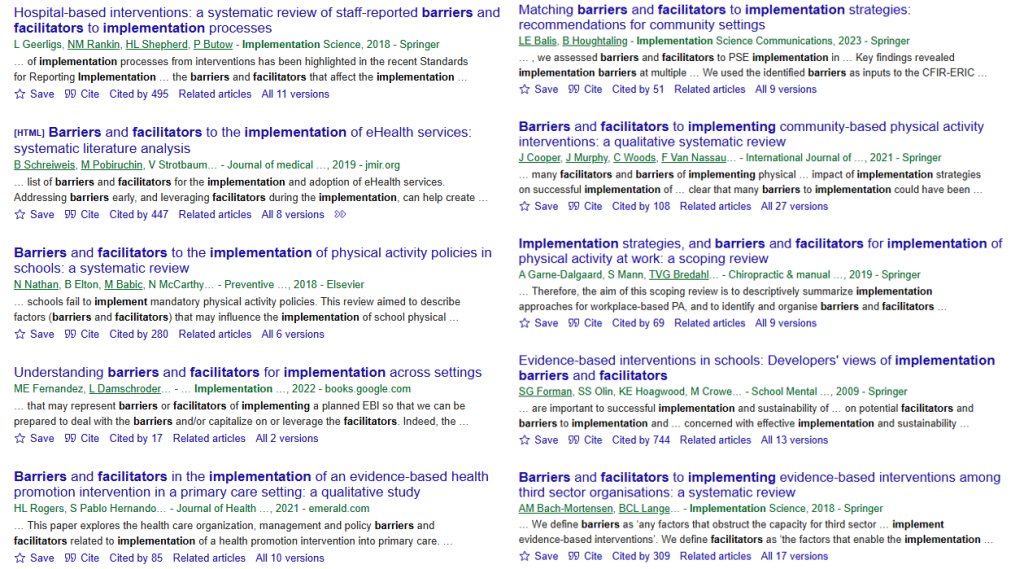
Again, none of this is wrong. It may all be true. But the Medicaid agency still has to make a decision.
Should it renew the contract as written? Should it end the contract? Should it change the payment model? Should it require new performance measures? Should it add funding for community outreach? Should it simplify referral rules? Should it shift responsibility to managed care organizations? Should it ask the legislature for new authority? Should it accept that the program cannot succeed under current conditions?
A list of barriers does not answer those questions. To make a real decision, the agency needs more specific information. Which problem is most responsible for weak performance? Is the main issue provider behavior, client access, contractor performance, payment design, data infrastructure, or state policy? Which actor has the authority to change the problem? Is the solution inside the agency’s control, inside the contractor’s control, or dependent on a law, waiver, budget, or federal rule? Which actions are feasible within the next budget cycle? Which changes would cost more money, require political approval, or create trade-offs somewhere else?
That is the level of evidence decision-makers need.
The Difference Between a Barrier and a Lever
One reason the barriers-and-facilitators language can fall short is that it often stops at description. A barrier is something that gets in the way. A lever is something someone can actually move.
“Lack of trust” is a barrier. But what is the lever?
Is trust low because residents had bad experiences with public agencies? Is it low because outreach workers are underpaid and have high turnover? Is it low because eligibility rules are confusing? Is it low because services were promised but never delivered? Is it low because community partners were asked to recruit participants, but were not included in program design?
Each of those explanations points to a different action. If the problem is history and harm, the lever may be accountability and repair. If the problem is turnover, the lever may be workforce funding. If the problem is eligibility complexity, the lever may be administrative simplification. If the problem is broken promises, the lever may be changing what agencies commit to and how they report back. If the problem is exclusion from design, the lever may be shared governance and paid community leadership.
The word “trust” alone does not tell us which path to take.
The same is true for “leadership,” “communication,” “resources,” and “buy-in.” These words are so broad that they can hide the real implementation problem. They can make structural issues sound like relationship problems. They can make funding problems sound like motivation problems. They can make governance problems sound like communication problems.
That matters for equity. Communities that have been underserved by public systems are often asked to overcome barriers they did not create. They are asked to participate more, trust more, navigate more, adapt more, and engage more. But many barriers sit upstream, in how programs are funded, contracted, governed, and held accountable.
If public health research only names barriers without identifying the authority and leverage, it risks placing responsibility on the people closest to the problem while leaving the systems that shape it untouched.
Four Better Questions
The solution is not to stop studying barriers and facilitators. The solution is to ask better follow-up questions.
What matters most?
Not every barrier has the same weight. Some are minor irritants. Some are symptoms of deeper problems. Some are decisive constraints that can make or break a program. Public health research should help leaders separate what is present from what is most important.
Second: How does the barrier work?
It is not enough to say that staffing is a barrier. Does staffing affect quality, reach, timeliness, trust, data entry, follow-up, or sustainability? Does it interact with burnout, funding cycles, or contracting rules? If we do not understand how a barrier works, we cannot choose the right response.
Who has the authority to act?
This may be the most important question. Some problems can be solved by a program manager. Others require an agency director, a contractor, a funder, a state legislature, CMS, a school board, or a county commission. If the person reading the report does not have the authority to change the barrier, the report should say that.
What action is feasible now?
Good implementation evidence should help people decide what to do next. That does not mean every study must offer a perfect solution. But it should clarify realistic options, likely trade-offs, and the conditions needed for action.
These four questions move us from description to decision support.
Why This Matters Now
Public health is operating under intense pressure. Agencies are being asked to respond to complex problems with limited staff, uncertain funding, political scrutiny, and growing community needs. Health systems are trying to improve outcomes while managing workforce shortages, rising costs, and administrative burden. Community organizations are expected to serve as trusted partners, often while surviving on short-term grants and thin margins.
In that environment, “more research is needed” is not enough. Neither is “stakeholders identified several barriers.” Decision-makers need evidence that helps them choose. They need to know what to fund, what to stop, what to redesign, what to require, and what to escalate. They need to know whether a problem can be solved through training, contract changes, payment incentives, staffing investments, data infrastructure, regulation, or policy change.
Public health research should make those choices clearer.
From Barriers to Better Decisions
The barriers-and-facilitators frame has helped public health describe the real world. That is valuable. But description is only the first step.
If we want research to support action, we need to go further. We need to identify which barriers matter most, explain how they operate, show where authority sits, and connect findings to feasible levers for change.
A better implementation study does not just say, “These are the barriers.” It says, “This is the constraint that matters most. This is how it limits implementation. This is who has the power to change it. These are the realistic options. These are the trade-offs.” That is the kind of evidence public health needs now.
Because the goal is not simply to understand why programs struggle. The goal is to help people make better decisions about what to do next.