The Future of American Healthcare: Collapse, AI, or Reinvention?
What thousands of patients, clinicians, and insiders believe comes next
If you want to glimpse the future of American healthcare, don’t just read policy papers or hospital reports. Listen to patients.
In a viral online discussion, hundreds of participants, including nurses, physicians, freelancers, and retirees, shared their predictions for the next 5, 10, and 25 years. Their answers were strikingly consistent. And deeply unsettling.
Across thousands of words, five major themes emerged: rising inequality, the expanding role of artificial intelligence, structural collapse or stagnation, growing distrust of institutions, and the possibility, however faint, of systemic reinvention.
Taken together, these perspectives reveal something more profound than pessimism. They expose a system that many believe is no longer designed primarily to heal.
Theme 1: Healthcare Inequality Will Intensify
The most common prediction was simple: healthcare in America will become increasingly stratified by wealth.
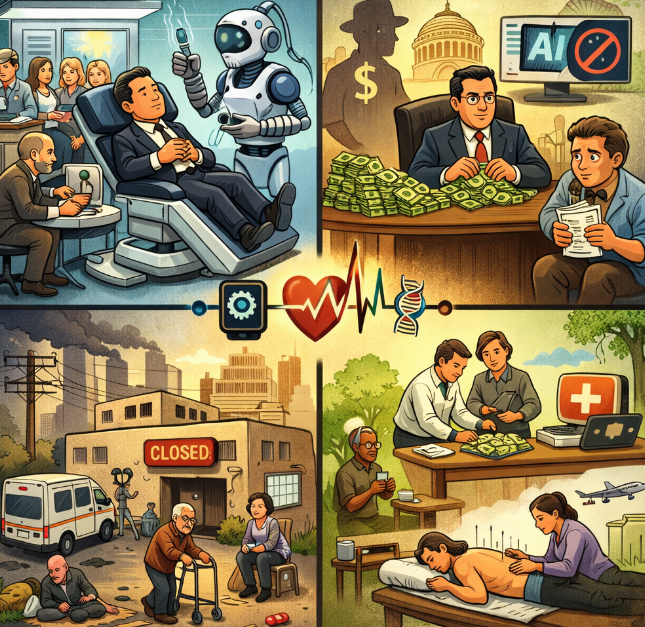
Many commenters predicted a future in which cutting-edge treatments, such as gene editing, personalized therapies, and longevity medicine, exist but remain accessible only to the affluent (basically the plot of Elysium and many, many other sci-fi parables). Meanwhile, ordinary Americans face worsening access, longer waits, and higher costs.
As one commenter summarized bluntly: healthcare will likely become “more and more health…only for the rich.”
This prediction aligns with current trends. Concierge medicine, boutique clinics, and private-pay telehealth services are already expanding rapidly. Meanwhile, rural hospital closures continue to accelerate, and medical debt remains the leading cause of personal bankruptcy in the United States.
Several healthcare workers in the discussion also warned that staffing shortages, particularly among physicians, will exacerbate inequality. Patients may increasingly receive care from mid-level providers, such as nurse practitioners and physician assistants, due to physician shortages and cost pressures.
The implication is stark: the quality of your care may depend less on your medical needs and more on your income.
Theme 2: Artificial Intelligence Will Transform Healthcare—But Not Necessarily for Patients
Artificial intelligence emerged as both a symbol of hope and a source of fear.
Some commenters envisioned AI streamlining diagnosis, coordinating care, and reducing administrative overhead. One predicted a future where AI enables “rapid diagnostics, personalized treatment plans, and follow-ups powered by machine learning.”
In theory, AI could address some of healthcare’s most significant inefficiencies. Automated triage systems, predictive analytics, and integrated medical records could dramatically improve coordination.
But most commenters were skeptical.
Many feared that AI would primarily serve insurers and corporations rather than patients. Several noted that AI is already being used to deny insurance claims more efficiently, raising concerns that automation may reinforce profit-driven decision-making.
Others warned that AI might optimize billing rather than care, increasing revenue extraction rather than improving health outcomes.
This reflects a broader truth: technology rarely fixes systems on its own. It amplifies existing incentives.
If those incentives prioritize profit over care, AI will simply accelerate that trajectory.
Theme 3: Structural Incentives Make Meaningful Reform Unlikely
Perhaps the most striking theme was the widespread belief that healthcare dysfunction is not accidental—it’s structural.
Many commenters pointed to the industry’s enormous scale. Health insurance alone generates more than $1 trillion annually. This creates powerful incentives to maintain the status quo.
As one commenter explained, healthcare persists in its current form because “the system works for the people who own and run it, enriching them massively.”
This perception is rooted in the economic architecture of the American healthcare system.
Unlike most developed nations, the United States relies heavily on private insurance, employer-based coverage, and fee-for-service payment models. These structures reward volume: tests, procedures, visits rather than outcomes.
One commenter captured this dynamic clearly, explaining that fee-for-service medicine incentivizes more rather than healthier outcomes, thereby contributing significantly to rising costs. Reddit thread
This incentive structure impedes reform because many powerful stakeholders, like insurers, hospital systems, pharmaceutical companies, and investors, financially benefit from the current system.
Theme 4: Collapse or Crisis May Be the Only Catalyst for Change
A recurring prediction was that meaningful reform may not occur gradually, but only after systemic failure.
Some commenters compared healthcare reform to past crises such as the Great Depression, which led to the creation of Social Security and Medicare.
Others predicted worsening hospital closures, insurance denials, and access barriers that eventually force political or economic intervention.
One commenter suggested that only a major disruption, such as an economic collapse or public health crisis, could trigger reform.
This reflects a well-known pattern in public policy. Major systems rarely transform voluntarily. They change in response to crises that make existing structures unsustainable.
Healthcare may follow the same trajectory.
Theme 5: Distrust in Institutions Is Driving Alternative Healthcare Models
Perhaps the most revealing theme was not technological or economic but psychological.
Many commenters expressed profound distrust in traditional healthcare institutions.
Some predicted increased reliance on alternative practitioners, cash-based clinics, medical tourism, or direct-pay healthcare models.
Others envisioned decentralized care, including independent physician cooperatives or technology-enabled direct access to treatment.
These predictions reflect a deeper shift: patients increasingly see themselves as consumers navigating a marketplace rather than participants in a trusted care system.
Trust, once the foundation of medicine, is eroding.
What Happens in 5, 10, and 25 Years?
Synthesizing these perspectives reveals a surprisingly coherent timeline.
5 Years: More Friction, More Automation
In the near term, patients will likely experience incremental changes rather than dramatic transformation.
AI will become more visible, but primarily in administrative workflows, such as documentation, triage, and claims processing.
Healthcare access challenges such as insurance complexity, provider shortages, and rising costs will persist.
Patients may see more telehealth, but fundamental structural issues will remain unresolved.
10 Years: Divergence Between Two Healthcare Systems
Within a decade, healthcare may split into two parallel systems.
Affluent patients will increasingly access concierge care, personalized medicine, and rapid diagnostics.
Meanwhile, traditional insurance-based care may become slower, more bureaucratic, and more resource-constrained.
AI will play a larger role, but its impact will depend heavily on the structure of incentives.
25 Years: Systemic Transformation—Through Innovation or Collapse
Over longer time horizons, transformation becomes inevitable.
Technological advances, including AI diagnostics, wearable health monitoring, and genomic medicine, will fundamentally reshape healthcare delivery.
But the key question is not technological feasibility.
It’s governance.
Healthcare could evolve into a more equitable, efficient system. Or, a more stratified, unequal one.
Technology alone won’t determine the outcome.
Policy, incentives, and collective decisions will.
Who Will Fix American Healthcare?
Many commenters concluded with a sobering answer: no single actor will fix the system.
Not technology companies.
Not hospital systems.
Not insurers.
Not politicians.
Healthcare systems reflect societal priorities. They change only when those priorities shift.
Some commenters argued that meaningful reform would require collective political action rather than technological innovation alone.
Others predicted a gradual transformation driven by market forces, technological disruption, or generational change.
History suggests both forces will play a role.
The Most Likely Future: Slow Transformation, Not Sudden Revolution
Despite the pessimism, the most realistic future is neither collapse nor utopia.
Healthcare will likely evolve unevenly.
Some aspects will improve dramatically. AI-driven diagnostics, remote monitoring, and personalized medicine will save lives and reduce suffering.
Other aspects, such as cost, access, and inequality, may worsen before improving.
Healthcare systems rarely change all at once. They evolve through cycles of innovation, resistance, and adaptation.
The Bottom Line
The future of American healthcare is not predetermined.
It will be shaped by technology, economics, policy, and public trust.
But the most important insight from this discussion may be this:
Healthcare systems reflect collective choices.
Technology can accelerate change.
But only people can decide its direction.