
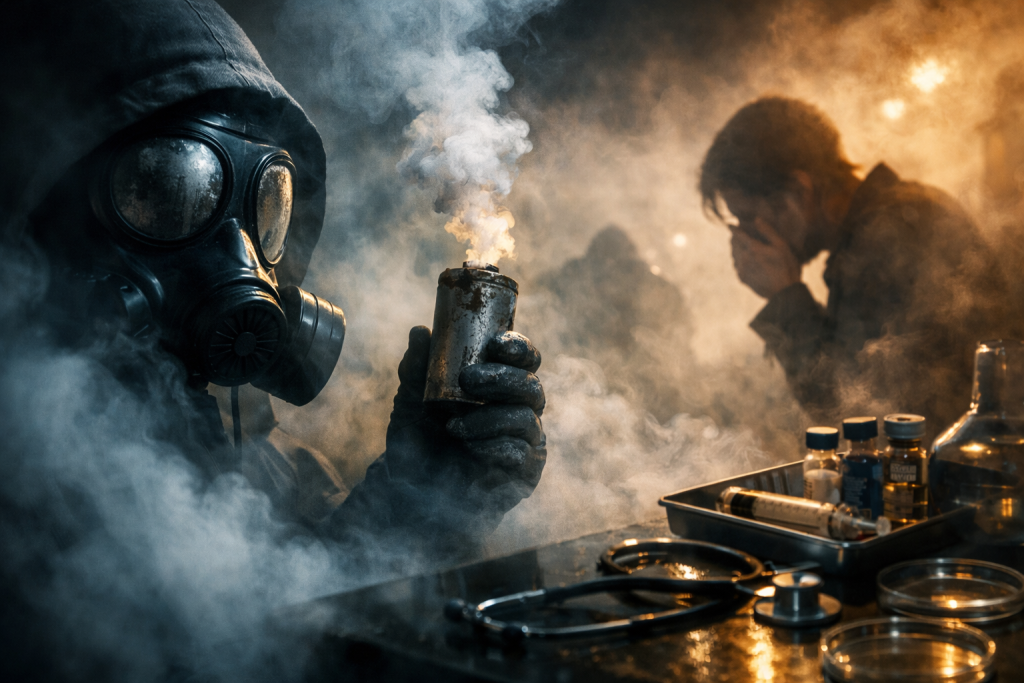
Tear Gas and Public Health: Why It’s More Than a Temporary Irritant
Your eyes slam shut. Your skin burns. Breathing suddenly feels harder than it should. Tear gas is often talked about as if it simply causes a few miserable minutes and then passes. Public health evidence tells a more serious story.
Tear gas is not a harmless mist. It is a group of chemical irritants used for crowd control, including agents such as CS, CN, and pepper-based compounds like OC. These chemicals are designed to overwhelm the eyes, nose, throat, skin, and lungs. For many people, the effects are short-lived. But under the wrong conditions, tear gas can cause significant injury, send people to emergency care, and create risks that matter far beyond the moment of exposure.
[newsletter_signgup]
Tear gas works by attacking the body’s most sensitive surfaces
The term “tear gas” can sound oddly mild, but the chemistry is meant to trigger intense irritation fast. According to guidance from the CDC and WHO, riot control agents commonly cause immediate eye pain, tearing, blurred vision, runny nose, coughing, chest tightness, sore throat, and skin burning.
That reaction is the point. These chemicals hit moist tissues first, especially the eyes and airways. In open air, many people recover once they move away from the exposure and decontaminate. But “temporary” does not mean trivial. A chemical that can suddenly make large groups of people cough, panic, and struggle to see or breathe is a public health concern by design.
For people with asthma or heavy exposure, the danger can escalate quickly
The biggest health risks appear when exposure is intense, repeated, prolonged, or happens in enclosed spaces. Under those conditions, tear gas can do more than irritate. CDC materials and clinical guidance describe more serious outcomes including bronchospasm, pulmonary edema, severe eye injuries, and, in rare cases, death.
This matters because crowd-control exposures are rarely neat or controlled. A person may be exposed multiple times, trapped in a poorly ventilated area, or hit at close range. Someone with asthma or another lung condition may face a much harder time recovering than a healthy person exposed briefly outdoors.
From a public health perspective, that means risk is not evenly distributed. The same cloud that causes temporary misery for one person may trigger a medical emergency for another.
Eye injuries can outlast the moment of exposure
One reason tear gas deserves serious medical attention is that the eyes are especially vulnerable. The American Academy of Ophthalmology notes that these agents can cause intense pain, tearing, light sensitivity, and blurred vision. Most people improve after prompt irrigation and removal from exposure, but severe or delayed treatment can increase the chance of lasting damage.
Projectiles and canisters add another layer of harm. Even when the chemical effects fade, blunt trauma from crowd-control devices can cause major injury. In real-world events, the health burden often combines chemical exposure, panic, falls, and impact injuries rather than a single cause.
Recent protest studies show a broad pattern of short-term health problems
Observational studies from recent protest settings help show what exposure looks like outside controlled guidance documents. Research on adults exposed during the 2020 Portland protests reported substantial respiratory, eye, and skin symptoms, along with healthcare use after exposure. Other protest-related studies have reported similar clusters of short-term problems.
These findings matter because they reflect community exposure in the settings where tear gas is used: chaotic, stressful, and often repeated over time. They reinforce a central public health point: the immediate harms are real, common, and not limited to a little watery-eyed discomfort.
The long-term picture is still developing
The strongest evidence today supports acute harm. Reviews of the medical literature conclude that tear gas and related chemical irritants can cause a range of short-term injuries, and that serious outcomes become more likely as exposure becomes more intense or prolonged.
Long-term health effects are harder to map because high-quality follow-up studies are limited. That does not erase concern. It means the science has been much better at documenting what happens in the hours and days after exposure than what happens months later, especially after repeated exposures.
For public health professionals, this is a familiar challenge: chemicals used in unpredictable real-world settings can produce harms that are easier to recognize clinically than to study longitudinally.
Why reproductive health concerns are getting attention
One of the most discussed newer questions is whether tear gas exposure may affect menstrual or reproductive health. Some recent studies have reported associations between exposure to law-enforcement chemical agents and menstrual changes or other reproductive health concerns.
These reports deserve attention, especially because they come from people exposed in real protest environments rather than laboratory volunteers. But they should be interpreted carefully. Stress, trauma, violence, and mixed exposures during protests can all affect menstrual cycles and related health outcomes. At this stage, the signal is important, but causality is not established.
The public health takeaway is not that this question is settled. It is that reproductive health should be included in surveillance and future research, not treated as an afterthought.
Tear gas is also a population health issue, not just an emergency medicine issue
Much of the public conversation focuses on what tear gas does to an individual in the moment. Public health asks a broader question: what happens when a chemical irritant is dispersed across a crowd that may include children, older adults, people with asthma, pregnant people, people with disabilities, and bystanders with no protective equipment?
That shift in perspective matters. Crowd exposures can strain emergency services, disrupt access to care, and amplify risk in people who are already medically vulnerable. They can also create fear and chaos that increase secondary harms, from falls to delayed treatment for breathing problems.
In other words, tear gas is not just a tactical tool with side effects. It is a mass exposure event.
The bottom line: acute harms are clear, and the public health stakes are bigger than many people assume
The evidence is strong on the central point. Tear gas is a real chemical irritant with well-documented immediate effects on the eyes, skin, and lungs. In heavier or repeated exposures, or in enclosed settings, it can cause serious injury. Emerging questions about long-term and reproductive health effects remain under study, but they fit a larger pattern: these exposures deserve to be taken seriously.
For public health, the key lesson is simple. Tear gas should not be framed as a harmless inconvenience that merely disperses crowds. It is a population-level exposure with predictable acute harms, unequal risks, and unanswered questions that matter for surveillance, clinical care, and policy.
Build Your Public Health Issue
Tell us a little about your work, and we’ll build a personalized issue with five things worth knowing.
References
CDC — Riot Control Agents | Chemical Emergencies
WHO — Signs and Symptoms of Chemical Exposures
CDC — Riot Control Agents | Chemical Threats and Laboratory
Systematic Review — Health impacts of chemical irritants used for crowd control