
Mental Health Recovery Takes More Than Treatment. It Takes a Place to Live.
Why housing, meaningful employment, and economic security may be just as important to recovery as what happens in a therapist’s office.
Imagine someone receiving treatment for depression and anxiety. Over several months, their symptoms improve. Their depression scores decline, their anxiety becomes more manageable, and their treatment team considers them a success.
But outside the clinic, their life is falling apart.
They’re sleeping on a relative’s couch, unsure whether they’ll have somewhere to stay next month. Their work schedule changes every week. They struggle to afford transportation, and they worry constantly about how they’ll pay their bills.
Their symptoms are improving. Their life is not.
So, have they recovered?
This question gets at one of the most important challenges in community mental health. We have developed increasingly sophisticated ways to diagnose and treat mental health conditions, but treatment alone cannot guarantee someone a stable home, a reliable income, or the opportunity to build a meaningful life.
If we want to improve mental health at a population level, we need to look beyond clinical care and consider the conditions in which people actually live.
That means talking about housing, employment, poverty, and the sometimes contradictory systems we have created to address them.
The Difference Between Feeling Better and Living Better
Mental health professionals often distinguish between two forms of recovery.
Clinical recovery focuses on improvements in psychiatric symptoms and functioning. Someone experiences fewer panic attacks, less depression, or greater ability to manage daily activities. We can assess these changes using standardized measures and clinical observations.
Personal recovery asks a broader question: Can this person live the life they want to live?
That might mean maintaining relationships, pursuing education, finding satisfying work, living independently, or simply having control over everyday decisions.
These forms of recovery are related, but they are not interchangeable.
Years ago, I worked with a young man who had been ordered into substance use treatment. The court wanted him to develop relapse prevention plans and identify triggers associated with his drug use.
But that wasn’t what concerned him most.
Someone had stolen his identity, and numerous people were using his information to obtain credit and employment. His financial future was being damaged by circumstances he could barely control.
So we spent several sessions working through the paperwork, documenting the fraud, and writing letters to credit agencies.
Was that traditional substance use counseling? Not particularly.
But it addressed the problem that mattered most to him.
That experience has stayed with me because it illustrates something that is easy to overlook in systems designed around diagnoses and treatment plans: People’s priorities do not always align with the priorities of the organizations serving them.
A recovery-oriented approach must consider three interconnected conditions:
- Stability: Having dependable housing, income, transportation, and access to basic necessities.
- Opportunity: Being able to pursue employment, education, relationships, and meaningful roles in the community.
- Self-determination: Having genuine choices about where to live, how to work, and what kinds of support to receive.
These are not luxuries that become important after someone gets better. They are often part of what makes sustained recovery possible.
Housing Is More Than Four Walls
When we talk about housing as a social determinant of mental health, we tend to focus on whether someone has somewhere to live.
But simply having a roof overhead tells us surprisingly little about whether that housing supports health.
Consider two people.
One lives in a small apartment with affordable rent, reliable heating, and easy access to public transportation. They know they can stay there for the foreseeable future.
The other lives in an overcrowded apartment where the landlord rarely makes repairs. Rent consumes most of their income, mold grows in the bathroom, and they’re never quite sure whether they’ll be able to afford another month.
Both people are housed.
Their experiences of stability, safety, and control differ entirely.
Housing affects mental health through several overlapping pathways. Affordability determines whether people have money left for food, medication, and transportation. Quality influences exposure to physical hazards and unsafe conditions. Stability affects whether people can maintain routines, relationships, employment, and access to care.
Location matters, too. An affordable apartment can become considerably less affordable when reaching a job, grocery store, or doctor requires an hour-long drive.
These are reasons housing policy cannot be separated from transportation, employment, healthcare, and community development.
What the housing maps reveal
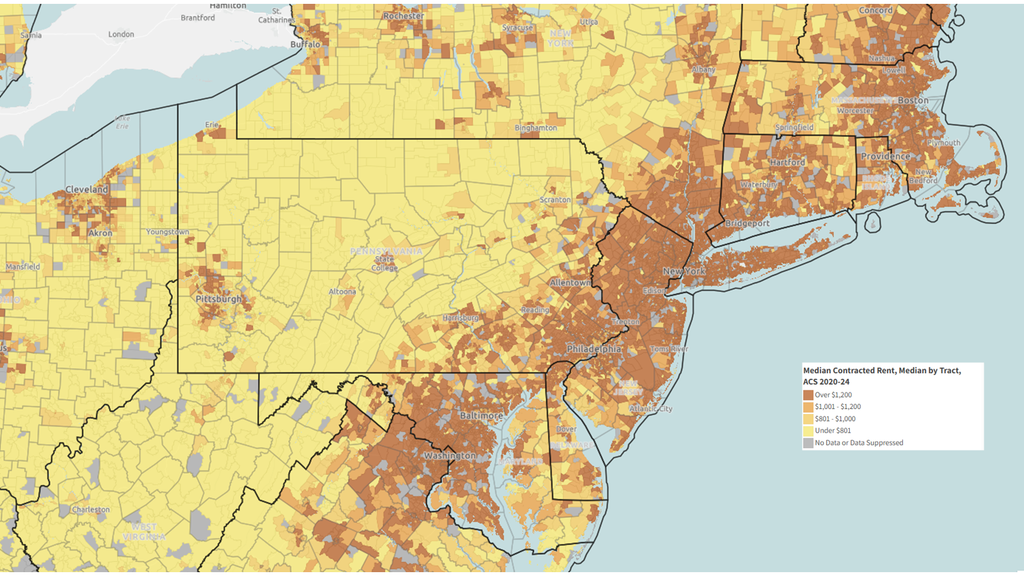
Insert Map 1: Median Monthly Rent by Census Tract (Map generated by WIN Measures)
Suggested caption: Housing costs vary substantially across the Northeast, with high-rent areas concentrated around major metropolitan regions and other employment centers. Geographic differences in rent influence where households can afford to live and the opportunities available to them.
During a recent lecture, I pulled up maps of monthly rents across the northeastern United States.
The geographic differences were striking. Expensive rental markets stretched across much of the New York metropolitan region, while some rural communities offered substantially lower rents.
At first glance, moving somewhere cheaper seems like an obvious solution.
But consider what happens when a person moves away from their job, family, treatment providers, or public transportation.
Lower rent might come with higher transportation costs, fewer employment opportunities, and greater social isolation.
A housing intervention can therefore improve one dimension of someone’s life while creating problems in another.
The lesson is simple: Affordable housing is not necessarily accessible housing, and accessible housing is not necessarily stable housing.
Homelessness Doesn’t Always Look Like We Expect
When many people think about homelessness, they imagine someone sleeping on a sidewalk or living in a tent.
Those experiences are real and important, but they represent only part of a much broader housing crisis.
Housing instability can also involve people moving repeatedly between relatives, sleeping temporarily on friends’ couches, living in overcrowded conditions, or facing imminent eviction.
Some people have somewhere to sleep tonight but no reliable place to stay next month.
This distinction matters because housing instability can disrupt ordinary activities most of us take for granted.
How do you maintain employment when you don’t know where you’ll be living next week? How do you receive important mail without a stable address? How do you store medication, keep appointments, or maintain a predictable routine when your living arrangements change constantly?
These disruptions can create considerable psychological stress even when someone does not meet a particular administrative definition of homelessness.
And they are not necessarily visible to healthcare providers.
Someone can arrive at an appointment, report improving mental health symptoms, and leave without anyone realizing they may soon lose their housing.
That is why housing needs must be assessed directly rather than inferred from psychiatric diagnoses or clinical progress.
Housing First: What Happens When We Stop Making People Earn Stability?
For decades, many homelessness programs followed a model sometimes called Treatment First.
People experiencing homelessness were expected to demonstrate that they were ready for independent housing.
They might begin in an emergency shelter, move to transitional housing, participate in treatment, maintain sobriety, and eventually qualify for a more permanent residence.
The underlying assumption was that people needed to resolve their behavioral or clinical challenges before they could successfully maintain housing.
There was a certain logic to this approach.
But there was also an obvious problem.
How can someone consistently attend treatment, maintain sobriety, or build stable routines while experiencing the chaos of homelessness?
What happens when someone has a setback and loses the very housing they need to recover?
Housing First reverses that logic.
Instead of requiring people to demonstrate readiness before receiving housing, Housing First prioritizes access to permanent housing without making sobriety or treatment participation a prerequisite.
Supportive services remain available, but participation is generally voluntary.
The philosophy is straightforward: Housing provides a foundation from which people can begin addressing other challenges. It is not a reward for successfully addressing them first.
This is more than a different way to organize services. It represents a different understanding of dignity, autonomy, and what people need to make meaningful changes in their lives.
Does Housing First actually work?
The evidence is encouraging, particularly when we focus on the outcome the approach is designed to improve: housing stability.
A systematic review of 26 studies in the United States and Canada found that permanent supportive housing using Housing First reduced homelessness by 88% and improved housing stability by 41% compared with Treatment First approaches. PubMed
But there is an important distinction.
Providing housing does not automatically resolve trauma, eliminate depression, address substance use, or repair strained relationships.
Research examining Housing First and health outcomes has produced more mixed findings. A recent Health Affairs evidence review similarly concludes that the approach consistently improves housing outcomes, while its effects on mental health, other health outcomes, and cost savings are less certain. Health Affairs
That does not make Housing First unsuccessful.
It means that housing and psychiatric recovery are different outcomes, and we should not assume that improvements in one will necessarily produce equivalent improvements in the other.
A stable apartment may make it easier to attend treatment, maintain medication routines, sleep consistently, and plan for the future. But some people will still need intensive mental health services, social support, and assistance navigating everyday challenges.
Housing First provides a foundation. It does not eliminate the need to build on it.
What it takes to make housing work
I have a personal connection to this work.
My parents have spent much of their retirement volunteering with Off the Streets, an organization in Lancaster County, Pennsylvania, that helps people transition into permanent housing.
My mother helps manage a warehouse filled with the ordinary necessities of a home: beds, towels, dishes, cups, furniture, and household appliances.
These are things that people moving from homelessness may not have.
When someone finally receives the keys to an apartment, they may still have no bed to sleep in, no dishes to eat from, and few resources to purchase what they need.
The volunteers help bridge that gap.
What has always struck me about this work is how practical it is. Nothing particularly glamorous comes from organizing towels or moving a couch.
But having a bed, a table, and a few dishes can make the difference between occupying an apartment and beginning to establish a home.
It is also a reminder that community organizations play an essential role in making broader social policies successful.
Housing programs face enormous implementation challenges: limited affordable housing, landlord participation, rental assistance, available supportive services, and the ability to coordinate across organizations.
Even an evidence-based approach will struggle when there are simply not enough homes available.
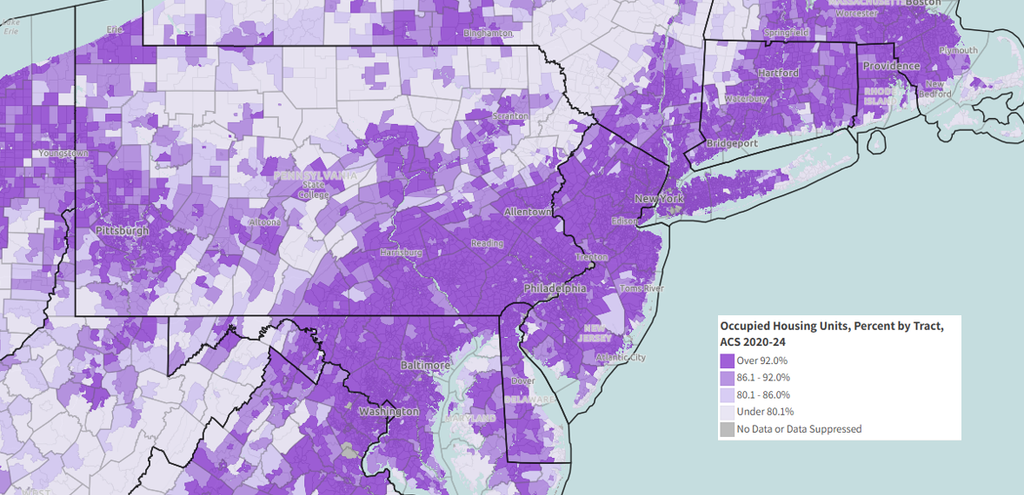
Insert Map 2: Percentage of Occupied Housing Units by Census Tract
Suggested caption: Occupancy patterns reveal differences in local housing supply across the Northeast. In areas with high occupancy, finding available housing may be especially challenging, although occupancy alone does not establish whether affordable units are available.
The second set of maps from my lecture examined housing occupancy across different regions.
In many communities, more than 90% of housing units were occupied. This matters because housing programs must compete within the same local rental markets as everyone else.
Even when funding is available, few suitable units may exist, particularly in neighborhoods near jobs, public transportation, and healthcare.


Map 3: Housing Occupancy in Colorado and North Dakota
Suggested caption: Housing pressures are not limited to major coastal cities. Regional economic growth, population changes, and local housing supply can create challenges in smaller metropolitan and rural communities as well.
The additional maps of Colorado and North Dakota highlight another important point: housing challenges are not exclusive to New York, Boston, or other expensive coastal cities.
Communities experiencing economic development, shifting labor demand, or rapid population changes can also face substantial housing pressures.
And the problem cannot always be solved by moving people somewhere else. A vacant home hundreds of miles from someone’s family, job, or treatment network is not necessarily an appropriate alternative.
Housing policy must account for where people actually need and want to live.
Employment: More Than a Paycheck
Housing provides stability, but a meaningful life requires more than somewhere to sleep.
For many people, employment is an important part of that equation.
Work provides income, certainly. But it can also offer structure, social connection, identity, confidence, and purpose.
Think about how frequently conversations begin with a simple question: What do you do?
For better or worse, employment is deeply connected to how we understand ourselves and our relationships with others.
It can also provide a pathway toward greater independence and economic security.
Of course, having a job does not automatically mean having a good job.
Unsafe working conditions, unpredictable schedules, discrimination, inadequate wages, and exhausting commutes can make employment a source of psychological distress rather than stability.
That distinction becomes especially important when we consider employment programs for people experiencing mental health challenges.
Individual Placement and Support: Work first, train along the way
Traditional vocational rehabilitation programs often follow a familiar sequence.
First, teach someone the skills necessary for employment. Then, once they demonstrate sufficient readiness, help them find a job.
In some cases, this makes sense. Someone cannot become a qualified electrician or nurse without appropriate training.
But for people with serious mental illness, lengthy assessments and preparation requirements can also create unnecessary barriers to employment.
An alternative model, called Individual Placement and Support, or IPS, takes a different approach.
Instead of assuming people must become ready before working, IPS helps individuals find competitive employment relatively quickly and provides ongoing support as they develop their skills and navigate challenges.
The approach emphasizes personal preference, integration with mental health services, and continued support after someone starts working.
It shares an important principle with Housing First: People should not have to demonstrate that they have overcome every challenge before gaining access to ordinary opportunities.
The evidence is substantial.
According to the IPS Employment Center, across 28 randomized controlled trials, an average of 55% of IPS participants obtained competitive employment, compared with 25% of participants receiving comparison services. The IPS Employment Center
These are meaningful differences.
Getting hired is not necessarily the same as finding satisfying, sustainable employment.
People may continue to need assistance with transportation, scheduling, workplace relationships, symptom management, and decisions about whether to disclose a mental health condition or request accommodations.
And sometimes moving from one job to another is a sign of progress rather than failure.
The goal is not simply to place someone in a job. It is to help them pursue work that fits their interests, abilities, and long-term aspirations.
Poverty and Mental Health Can Reinforce Each Other
Housing and employment bring us to a broader issue: economic security.
Poverty and mental health have a complicated, two-way relationship.
Financial hardship can contribute to chronic stress, reduce access to healthcare, limit opportunities, and create uncertainty about basic necessities.
At the same time, mental health difficulties can interfere with employment, education, financial planning, and the ability to navigate complex administrative systems.
These pressures can reinforce one another.
Consider someone struggling with anxiety who begins missing work. Their income declines, making it harder to pay rent. Financial insecurity increases their anxiety, disrupting sleep and making regular employment even more difficult.
The cycle continues.
This is one reason it is so difficult to separate mental health from the broader social and economic conditions in which people live.
We sometimes discuss these issues as though mental health difficulties are exclusively individual problems.
But many of the pressures people experience are not primarily psychological. They are practical, financial, and structural.
Income is not the same as economic security
Imagine two households earning the same annual income.
One has predictable monthly earnings, savings, affordable housing, and manageable expenses.
The other has irregular wages, substantial debt, expensive housing, and little ability to absorb an unexpected bill.
Their annual income may be identical, but their financial security is not.
Economic security depends on more than how much money someone earns. It also depends on how reliably that money arrives, how much is already committed to basic expenses, and whether financial resources are available during emergencies.
Ucertainty itself can be stressful.
People living with limited financial reserves must constantly weigh competing needs. Paying one bill may require postponing another. Taking time off work to attend a medical appointment may mean losing income needed for groceries.
Under these circumstances, what appears to be poor decision-making from the outside may actually represent a reasonable response to immediate constraints.
A public health approach should seek to understand these circumstances rather than simply judge people’s choices.
When Earning More Money Leaves You Worse Off
One of the more frustrating features of American social assistance programs is something called the benefits cliff.
Imagine someone receiving public benefits who begins working and gradually increases their income.
They do well at their job. Their supervisor recognizes their performance and offers a raise.
Under ordinary circumstances, we would consider this a success.
But what happens if the additional earnings push the person beyond an eligibility threshold for an important benefit?
They may lose assistance with healthcare, childcare, housing, or other essential expenses. Depending on the program and their circumstances, what they lose can exceed the additional wages they receive.
Suddenly, a promotion can leave someone worse off financially.
Not every program operates this way, and eligibility rules and available protections differ. But the problem illustrates how policies designed to support financial stability can sometimes undermine it.
For people managing mental health challenges, the resulting uncertainty can create additional stress.
It also complicates employment decisions.
Should someone accept additional hours? Is a pay increase worth the possible loss of health insurance? What happens if their work schedule changes unexpectedly?
Benefits counseling can help individuals understand these tradeoffs, but program design also matters.
A system that encourages employment while imposing abrupt penalties for earning more can create conflicting incentives.
And those consequences reach beyond household finances.
They can influence people’s choices about work, education, treatment, and long-term independence.
The Unpaid Internship Problem
During my lecture, a student raised a concern that brought several of these ideas together.
They were approaching graduation and needed to complete an internship. Many available placements were unpaid.
For someone who also needs to work to pay rent, an unpaid internship can create a difficult situation.
They need the internship to graduate. They need paid employment to survive. But the time required for one makes it harder to maintain the other.
We often talk about education and workforce development as pathways toward economic opportunity.
And they can be.
But if participation requires people to absorb costs they cannot afford, access becomes unequal.
A student with substantial family support may complete an unpaid placement with relatively little financial disruption. Another student, equally capable and motivated, may struggle to meet the same requirement.
This is precisely where economic security, opportunity, and mental health intersect.
The issue is not simply whether an internship provides valuable experience.
It is whether the system makes that experience realistically accessible to the people who need it.
And that question applies to far more than internships.
We should be asking it about job training programs, community services, healthcare appointments, educational opportunities, and the administrative requirements associated with public benefits.
The Bigger Challenge: Our Systems Don’t Work Together
Housing First and Individual Placement and Support are different interventions addressing different problems.
But they share a common insight.
Instead of requiring people to resolve every difficulty before accessing housing or employment, both approaches help people access key resources and provide support along the way.
They also challenge a familiar assumption in social services: that people must demonstrate readiness before they deserve opportunity.
Yet putting these ideas into practice is difficult.
Housing programs cannot create employment opportunities on their own. Mental health providers cannot guarantee affordable apartments. Employment services cannot rewrite Medicaid eligibility rules. Transportation agencies cannot resolve housing shortages on their own.
These systems are interconnected in everyday life but often fragmented in administration, funding, and accountability.
This is one of the lasting challenges of community mental health.
As psychiatric care moved away from large institutions and toward community-based services, responsibility became distributed across many organizations and sectors.
That transition created important opportunities for autonomy and community participation, but it also introduced coordination problems that remain unresolved.
And resources are limited.
Even well-intentioned organizations must make difficult choices about how to allocate funding, which populations to serve, and which outcomes to prioritize.
The challenge is not simply identifying what works.
It is building the capacity, partnerships, and policy conditions necessary to make effective approaches work in the real world.
We Need to Measure What Actually Matters
One final point is worth emphasizing.
Public health programs tend to measure what is easiest to count.
How many appointments did someone attend? How many people enrolled in a service? How many referrals were completed? How many people found employment?
These measures can be useful, but they tell only part of the story.
A housing program might successfully place someone in an apartment without knowing whether that person remains housed six months later.
An employment program might report impressive placement numbers while overlooking whether people earn enough to meet their needs.
A mental health service might demonstrate reduced depression scores without understanding whether its clients feel more capable of living the lives they want.
If we are serious about improving community mental health, we need to ask better questions.
Did people obtain housing they could maintain? Did their living conditions become safer and more affordable? Were they able to pursue employment, education, or relationships that mattered to them?
Did they experience greater autonomy and stability?
And importantly, who benefited and who was left behind?
Those questions should shape how we design, implement, and evaluate interventions.
They also require humility.
Social conditions are complicated. We cannot always isolate one factor and confidently attribute every improvement to it. And many of the most important changes unfold across years, organizations, and policy environments.
But complexity is not an excuse to ignore the problem.
It is a reason to invest in better evidence, better implementation, and more meaningful measures of success.
Recovery Is About Building a Life
Return to the person we met at the beginning.
Their depression has improved, but they remain uncertain about where they will sleep, how they’ll get to work, and whether they’ll have enough money for basic necessities.
We should celebrate their clinical progress.
But we should not confuse that progress with the completion of recovery.
Community mental health is ultimately concerned with something larger than reducing symptoms.
It is about creating conditions in which people can live safely, pursue meaningful opportunities, participate in their communities, and exercise control over their own lives.
Housing matters because it provides a place to begin.
Employment matters because it can create purpose, connection, and economic opportunity.
Economic security matters because people need some predictability and control to plan for the future.
And effective public policy matters because no individual treatment provider can create all these conditions alone.
Perhaps the most important question for community mental health isn’t simply whether someone’s symptoms have improved.
It’s whether their community has made it possible for them to build a life worth living.
Build Your Public Health Issue
Tell us a little about your work, and we’ll build a personalized issue with five things worth knowing.